
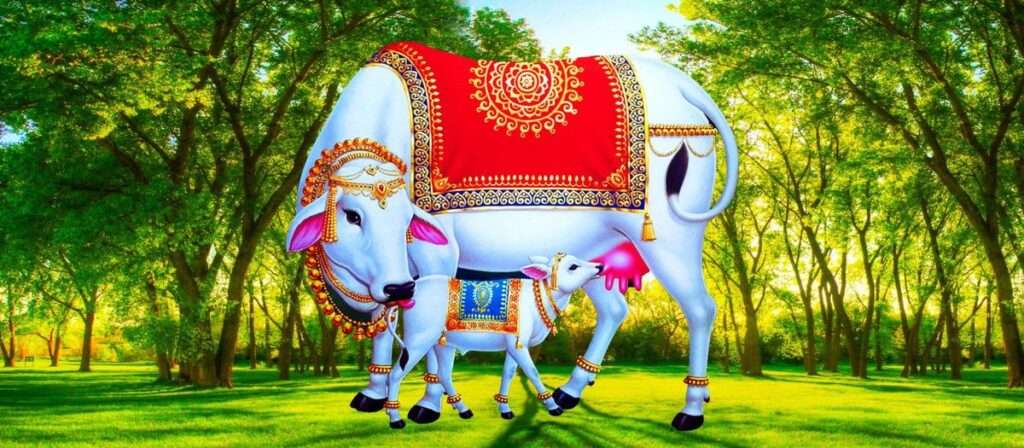
In Hindu mythology, the reverence for cows is deeply embedded, tracing its origins to ancient scriptures and legendary tales. One of the most significant narratives is that of Kamadhenu, the divine cow, whose story intertwines with the festival of Vasubaras, highlighting the sacred bond between humans and cattle.
Kamadhenu: The Divine Cow of Plenty
Kamadhenu, also known as Surabhi, is a celestial cow in Hinduism, revered as the mother of all cows. According to the Mahabharata’s Adi Parva, she emerged during the Samudra Manthan (churning of the ocean of milk), a cosmic event where gods and demons churned the ocean to obtain the nectar of immortality, amrita. From this churning, Kamadhenu, along with other divine entities, was born and presented to the Saptarishi (seven great sages).
Kamadhenu is depicted as a white cow with a woman’s head, wings of a bird, and the tail of a peacock. She is believed to possess the ability to grant any wish, symbolizing abundance, fertility, and spiritual wealth. Her association with prosperity is further emphasized in various scriptures, where she is considered a source of nourishment and a protector of the Brahminical class.
Vasubaras: Celebrating the Sacred Cow
Vasubaras, also known as Govatsa Dwadashi, is a Hindu festival celebrated primarily in Maharashtra, Gujarat, and parts of North India. Observed on the twelfth day of the Hindu lunar month of Kartika, it marks the beginning of the Diwali festival. The day is dedicated to honoring cows, particularly young ones, by feeding and decorating them, symbolizing gratitude for their role in agrarian societies.
The festival’s significance is rooted in the belief that cows, being manifestations of Kamadhenu, bring prosperity and blessings to households. Rituals performed during Vasubaras include offering special food to cows, applying turmeric and vermilion on their bodies, and seeking blessings for a prosperous year ahead. This tradition underscores the deep respect for cows in Hindu culture and their integral role in religious and daily life.
The Legend of King Uttanapada and Dhruva
The connection between cow worship and celestial events is further illustrated in the story of King Uttanapada and his son Dhruva. King Uttanapada, a descendant of the sage Manu, had two wives, Suruchi and Suniti. Desiring a son from Suruchi, he neglected Suniti, who bore Dhruva. Feeling slighted, Dhruva sought solace in the forest, where he meditated upon Lord Vishnu. Pleased with his devotion, Vishnu granted Dhruva a boon, making him the eternal pole star, Dhruva Nakshatra, symbolizing unwavering faith and devotion.
This narrative highlights the themes of devotion and righteousness, which are central to Hindu philosophy. While not directly related to cow worship, the story’s emphasis on moral values resonates with the reverence for cows, which are considered embodiments of purity and selfless service in Hinduism.
Conclusion
The mythological tales of Kamadhenu and the observance of Vasubaras reflect the profound respect for cows in Hindu culture. These traditions not only honor the sacred cow but also reinforce values of gratitude, prosperity, and spiritual devotion. As society progresses, these age-old customs continue to serve as a reminder of the harmonious relationship between humans and nature, emphasizing the importance of reverence for all living beings.

