
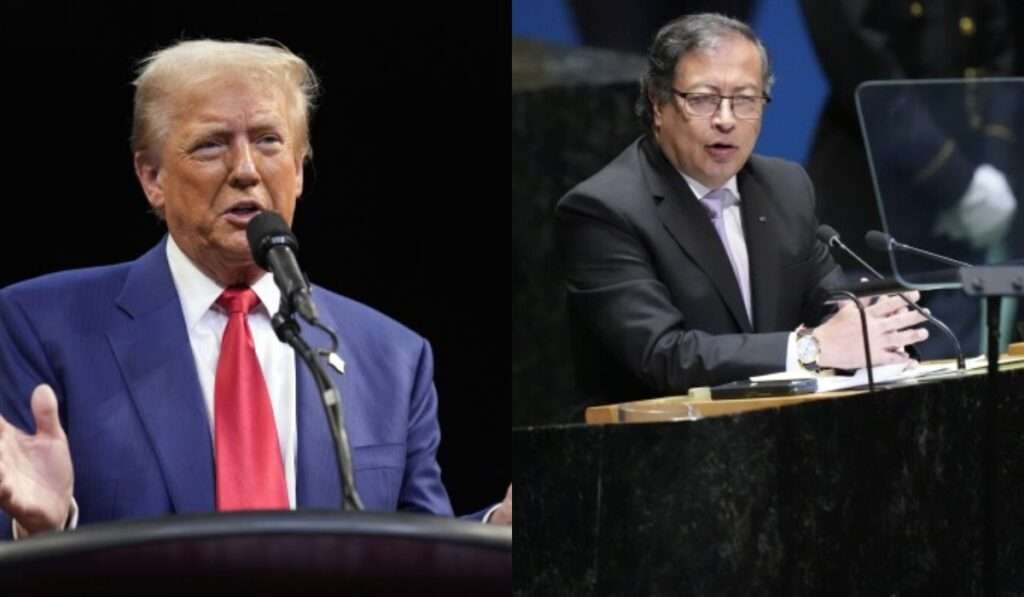
In a dramatic escalation of bilateral tensions, U.S. President Donald Trump announced on October 19, 2025 that the United States will immediately cease all financial aid and subsidies to Colombia, accusing its President Gustavo Petro of functioning as an “illegal drug leader.” The decision follows a series of military strikes, anti-narcotics operations, and trade threats that have sharply strained the long-standing U.S.–Colombia partnership.
Trump’s proclamation included a threat to impose steep tariffs on Colombian exports and a full halt to any other form of payment or subsidies as of that day. He accused Colombia of operating as “a drug manufacturing machine,” claiming its government lacks any credible fight against narcotics operations. The announcement marks one of the most severe policy measures taken by Washington against a Latin American ally in recent years.
Petro’s government, which has historically been a close U.S. partner in counternarcotics and regional security, responded forcefully. Bogota’s Foreign Ministry stated that the U.S. accusations constitute a “grave violation of Colombian sovereignty and dignity.” The flashpoint for this diplomatic rupture appears tied to a U.S. strike on a maritime vessel in the Caribbean, which Washington claimed was linked to Colombia’s National Liberation Army (ELN) drug-trafficking network. Colombia insists the ship was a civilian fishing vessel and says the strike killed innocent people, further inflaming tensions.
From a strategic standpoint, the aid cut jeopardizes deeply embedded U.S.–Colombia cooperation across military, anti-narcotics, and development arenas. Analysts warn that this abrupt policy shift undermines Colombia’s capacity to combat rebel groups, implement peace accords, and address the rising cycle of coca cultivation and cocaine exports. The decision also signals a potential shift in Washington’s regional priorities — one that could alter alliances, create openings for other global powers, and inject new instability into Latin America’s geopolitical landscape.
Economically, the move comes at a fragile moment. Colombia relies heavily on the United States as its largest trading partner, and any punitive tariffs or aid reductions could ripple through its economy, affecting currency stability, exports, and overall fiscal health. Domestically within the U.S., Trump’s move reinforces his broader agenda focused on drugs, borders, and national security, portraying Latin America as a central stage for his foreign policy narrative.
The suspension of U.S. aid to Colombia marks a watershed moment in bilateral relations. With President Trump branding President Petro a “drug leader” and threatening trade sanctions, the once-solid U.S.–Colombia alliance now faces one of its most severe tests. The implications extend beyond financial assistance — touching regional security, drug-trafficking control, and sovereignty concerns. As both nations navigate this growing crisis, the outcome is poised to reshape not only their diplomatic ties but also the broader balance of power across Latin America.

