
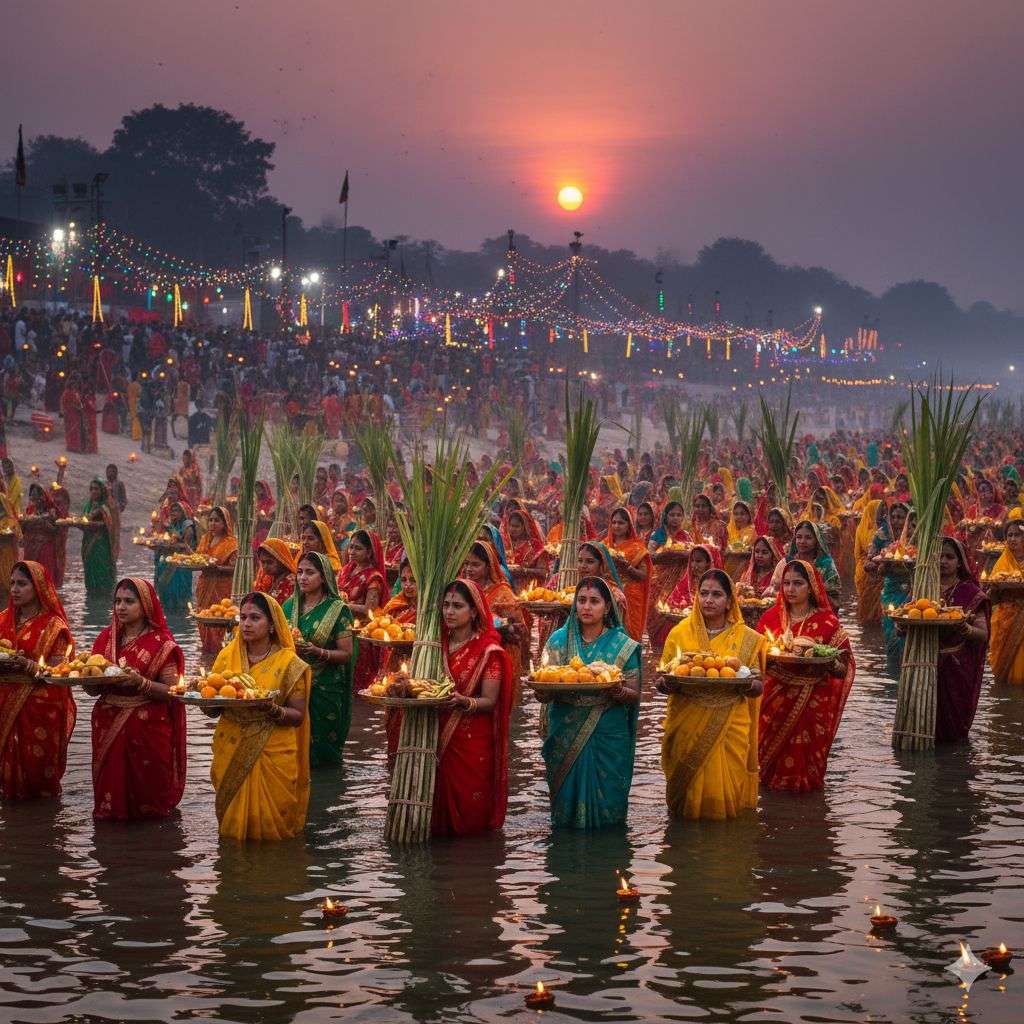
The four-day Hindu festival Chhath Puja, which venerates the Sun God (Surya) and his sister Chhathi Maiya, has transcended its traditional heartlands of Bihar, Jharkhand and eastern Uttar Pradesh to become a significant cultural event for Indian communities around the world. From the United States and Canada to the United Kingdom, Australia, Mauritius and Fiji, Indian diaspora organisations are adapting the festival’s distinctive rituals—fasting, offering arghya at water-bodies and communal gathering—to sustain cultural continuity abroad and reinforce a sense of belonging.
Rooted in Vedic tradition and Hindu mythology, Chhath Puja honours the Sun God Surya and the goddess Chhathi Maiya through rigorous rituals such as the Nahay Khay (ritual bath and first meal), Kharna (evening meal and fast), Sandhya Arghya (sunset-offering) and Usha Arghya (sunrise-offering). Historically centred in states such as Bihar, Jharkhand and eastern Uttar Pradesh in India and in nearby Nepal, the festival emphasises gratitude to nature, self-discipline and community devotion.
In recent years, Chhath Puja has gained traction far beyond its traditional base. The Indian diaspora has brought the festival to urban centres and foreign shores, helping it evolve from a regional observance into a global cultural phenomenon. Communities in the United States have conducted large gatherings allowing devotees to offer arghya at lakes or artificial water-bodies, keeping the core rituals intact while adapting to local settings.
Across countries such as the United Kingdom, the United Arab Emirates, Mauritius and Ireland, Indian communities—particularly those originating from Bihar and eastern Uttar Pradesh—have organised major Chhath celebrations. In London, a UK-based organisation created an artificial water-body to simulate the river-bank experience and invited local neighbours to participate. In Dubai, devotees gather on Mamzar Beach for sunset arghya; in New Jersey, associations recreate ghat-style venues with banana-stems and vibrant lighting to evoke the traditional ambience of the festival.
These diaspora celebrations highlight two key dynamics: the desire to preserve authenticity—such as fasting for 36 hours, standing in water for offerings, and singing traditional songs—and the flexibility to adapt to local laws, spaces and climates, with artificial pools or indoor auditoriums used as makeshift ghats.
For many Indian expatriates, celebrating Chhath Puja abroad serves multiple purposes: preserving cultural identity, reinforcing family and community bonds, and showcasing Indian traditions to host-country audiences. Festivals like Chhath provide a sense of belonging and connection to one’s roots for Indian expatriates. Moreover, the global celebration of Chhath has been linked to India’s soft-power outreach, with the government reportedly moving to secure recognition of Chhath Puja as an intangible cultural heritage with UNESCO—an initiative that could further boost its international visibility.
The internationalisation of Chhath Puja carries both opportunities and challenges. On one hand, it strengthens diaspora solidarity and promotes cross-cultural engagement. On the other, maintaining ritual purity—such as standing in natural water-bodies at sunrise or sunset—becomes difficult in foreign climates and urban settings, requiring innovation. The push for UNESCO recognition signals a growing ambition to institutionalise Chhath Puja’s global presence, which may stimulate more large-scale community events, cultural performances and media coverage abroad.
In a world of increasing migration and globalization, the celebration of Chhath Puja by Indian diaspora communities underscores how anchored traditions can travel far from their geographic origins. By combining devotion to the Sun God Surya and Chhathi Maiya with adaptive practices in new locales, devotees abroad are not only preserving their cultural heritage but also enriching the tapestry of global Indian festivals. As the festival continues to flourish on foreign shores, Chhath Puja stands as a vibrant example of how ritual, identity and community can harmonise across borders.

