
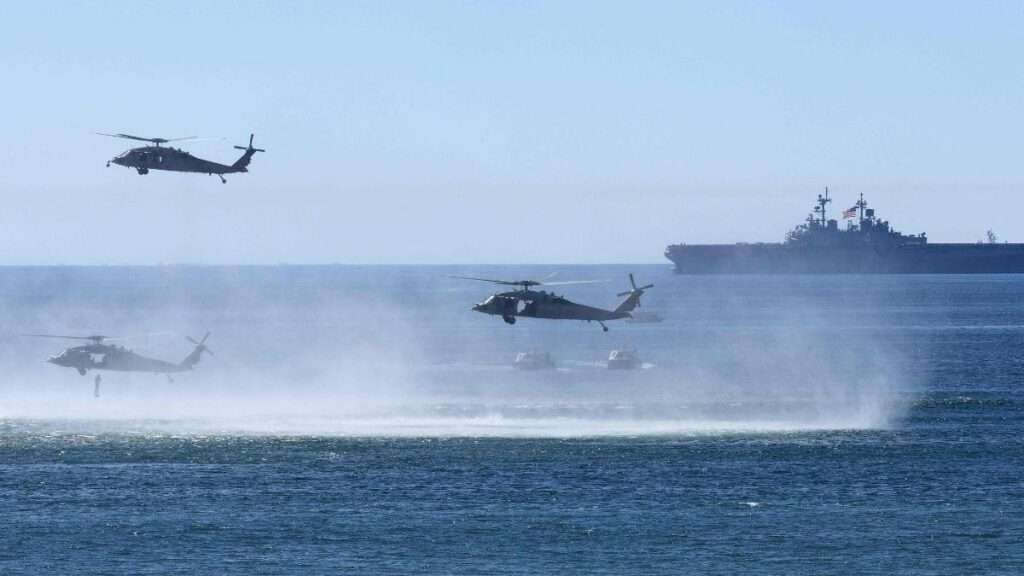
In a highly unusual occurrence, two aircraft from the USS Nimitz (CVN-68) – a MH-60R Sea Hawk helicopter and a F/A-18F Super Hornet fighter jet – crashed in separate incidents over the South China Sea on 26 October 2025, within roughly 30 minutes of each other. All five crew members were successfully rescued and reported to be in stable condition, while formal investigations have been opened to determine the causes.
According to the U.S. Pacific Fleet, the first crash occurred at approximately 2:45 p.m. local time when the Sea Hawk helicopter, assigned to Helicopter Maritime Strike Squadron 73 (“Battle Cats”), went down while conducting routine operations from the Nimitz. Search and rescue assets from the carrier strike group recovered all three crew members safely. Roughly half an hour later, at about 3:15 p.m., the Super Hornet from Strike Fighter Squadron 22 (“Fighting Redcocks”) also crashed while operating from the same carrier. Its two crew members successfully ejected and were rescued shortly after.
The South China Sea is a region of immense strategic importance and contested territorial claims, with the United States routinely conducting operations to affirm freedom of navigation and reassure allied nations. The fact that these crashes occurred during carrier-based routine operations in such a high-tension zone raises questions about safety protocols, mechanical reliability, and overall readiness under operational conditions. Moreover, the twin losses come amid a trend of multiple aircraft mishaps for the U.S. Navy over the past year, particularly associated with carrier-based aviation, pointing to potential systemic issues rather than isolated incidents.
The U.S. Navy has stated that the causes of both incidents are under investigation. President Donald Trump described the crashes as “very unusual” and mentioned a possible fuel issue as a preliminary concern, though he ruled out any indication of foul play. Meanwhile, China’s government offered humanitarian assistance following the incidents and emphasized the need for stability in the region. This gesture highlights how military operations in the South China Sea carry not only operational risks but also significant diplomatic implications.
The near-simultaneous loss of an MH-60R Sea Hawk helicopter and an F/A-18F Super Hornet fighter jet from the USS Nimitz—both operating over the South China Sea—is a rare event with far-reaching implications. While the safe recovery of all five crew members is a positive outcome, the twin mishaps have prompted closer scrutiny of aircraft readiness, carrier operations, and the inherent risks of maintaining presence in contested maritime zones. As investigations proceed, the findings are expected to influence U.S. naval aviation safety protocols and could shape broader strategic considerations for operations in the Indo-Pacific region.

