
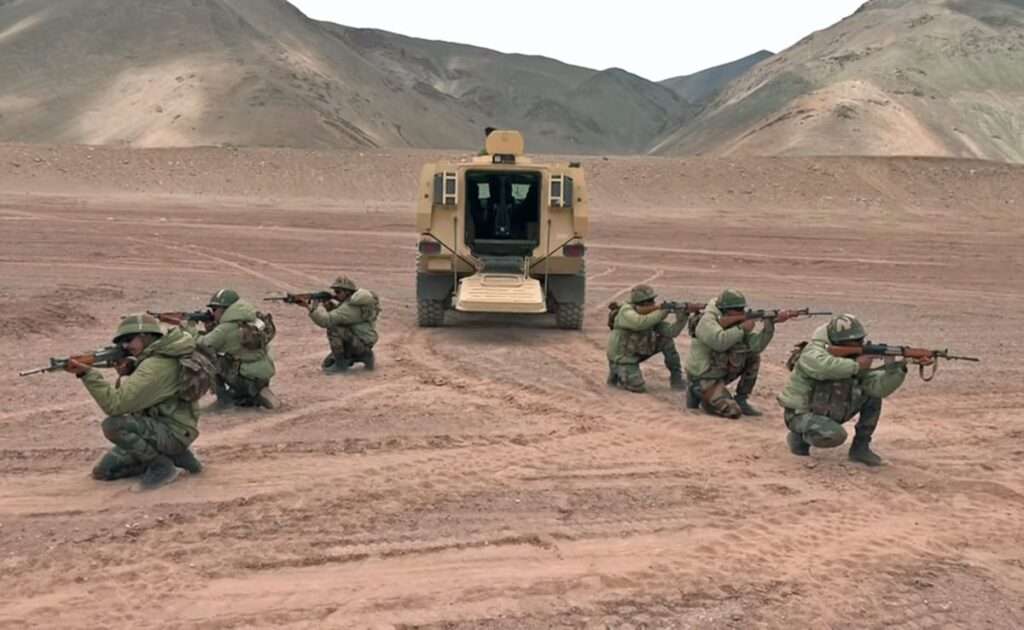
India on Thursday officially commenced Exercise Trishul, a large-scale 12-day tri-service military exercise along the Indo-Pakistan western border. Running until November 10, the drill marks India’s first major war games since Operation Sindoor and underscores New Delhi’s intent to reinforce deterrence and joint operational readiness.
The Trishul exercise is being held predominantly in Gujarat and Rajasthan, with particular emphasis on the Sir Creek and Kutch sectors — regions of acute strategic significance along the India–Pakistan line of control. Defence sources stated that the objective is to test the jointness and interoperability of the Army, Navy, and Air Force in complex terrain and multi-domain operations.
Reports indicate that the Indian Army has mobilised around 25,000 troops to participate in the exercise, supported by assets such as T-90 battle tanks, BrahMos missile systems, long-range drones, Rafale and Sukhoi fighter jets, and amphibious naval platforms. The Indian Navy is also deploying destroyers, frigates, and fast attack craft to project maritime strength as part of this integrated war game.
To accommodate the scale and complexity of the exercise, India has issued a Notice to Airmen (NOTAM) that restricts aerial operations up to 28,000 feet over specific sectors from October 30 to November 10. In parallel, Pakistan imposed its own airspace restrictions, triggering speculation that Islamabad views the exercise as a strategic signal. In response to Trishul’s commencement, Pakistan reportedly scrambled fighter jets early Thursday morning, conducting multiple sorties from bases including Shorkot, Risalpur, and Mianwali — a demonstration of concern amid rising tensions.
The launch of Exercise Trishul comes six months after Operation Sindoor, India’s missile strike campaign in May 2025 that followed a series of cross-border terror incidents. That operation injected renewed volatility into India–Pakistan relations, and Trishul is being viewed by defence analysts as a calibrated show of readiness in this evolving strategic environment. Experts believe that Trishul aims not only to sharpen combat preparedness but also to send a strong deterrent message that India retains the capability for sustained military operations along sensitive border zones.
With Trishul unfolding over a strategically delicate frontier, the exercise is expected to enhance India’s joint operations doctrine, stress-test logistics under duress, and refine command and control across air, land, sea, and unmanned systems. It also factors into a broader regional posture, projecting strength without provoking direct confrontation.
As of now, there have been no reports of any direct clashes or airspace violations, and both nations appear to be proceeding cautiously. Nevertheless, the scale of the exercise and its proximity to the border are likely to influence regional defence strategies, diplomatic signalling, and future security planning.
Exercise Trishul marks a renewed emphasis on tri-service coordination at a time when India seeks to consolidate deterrence and operational depth. Through the deployment of indigenous weapon systems, airspace regulation, and synchronized domain operations, New Delhi is signalling its resolve to maintain strategic stability while remaining ready to respond to potential threats. Over the next 12 days, the degree of Indian military integration, tactical innovation, and geopolitical messaging will shape perceptions in the region and potentially recalibrate the strategic balance along India’s western frontier.

