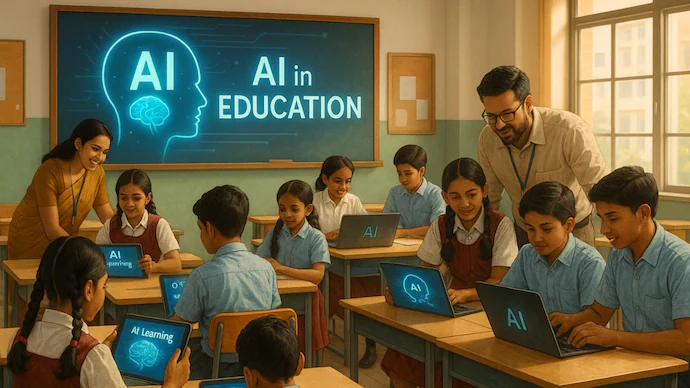
In a landmark move impacting millions of young learners across the country, India’s Ministry of Education (MoE) has announced that Artificial Intelligence (AI) and Computational Thinking (CT) will be formally introduced in the school curriculum from Grade 3 onwards beginning in the academic year 2026–27. The initiative signals the government’s commitment to embedding digital-age skills at a foundational level, treating AI as a “basic universal skill” for students.
Under the framework of the National Curriculum Framework for School Education (NCF–SE) 2023 and aligned with the National Education Policy 2020, the education ministry has embarked on the development of a curriculum that places AI and computational thinking as core elements of schooling from early grades. According to the official announcement, the aim is not merely to acquaint children with machines and algorithms but to instil awareness of how AI interacts with the world around them—ethical considerations, societal impact, and problem-solving.
The rollout will begin in the 2026–27 academic session, with Grade 3 as the starting point, and will gradually expand into higher grades. The ministry has constituted an expert committee chaired by Karthik Raman of IIT Madras to spearhead curriculum design. Key partner bodies include the Central Board of Secondary Education (CBSE), the National Council of Educational Research and Training (NCERT), the Kendriya Vidyalaya Sangathan (KVS), and the Navodaya Vidyalaya Samiti (NVS), along with state governments and Union Territories.
Teacher training and material preparation are central to the implementation timeline. The ministry has stated that teacher-training modules, digital learning content, and printed materials will be ready by December 2025 to ensure a smooth transition into the new system. This will allow teachers to adapt to innovative teaching methods that combine AI concepts with practical, real-world examples suitable for young learners.
The initiative emphasises inclusivity and ethical use of technology. The new curriculum will integrate AI and computational thinking “organically” from foundational stages and emphasise “AI for public good,” directing learning towards societal and real-world challenges. Additionally, the ministry underscores that the curriculum must be broad-based, student-centric, and adaptive to evolving needs. For example, early lessons may focus on recognising how machines think or how algorithms influence daily life, while older students may move into elective or subject-specific modules to explore AI applications in greater depth.
While the policy signals a transformative shift, its success will depend on effective execution. Ensuring teacher preparedness across India’s diverse school ecosystem, especially in rural and remote areas, presents a major challenge. Material development, infrastructure readiness, digital access, and pedagogical training will require sustained focus. At the same time, this reform presents a significant opportunity for India’s future workforce—if young students develop computational thinking and AI awareness early, the country could enhance its global competitiveness in technology and innovation.
The Ministry of Education’s decision to embed Artificial Intelligence and Computational Thinking into the school curriculum from Grade 3 marks a momentous step in India’s education reform journey. By treating AI as a foundational skill and emphasising ethical, inclusive, and future-oriented learning, the initiative aims to prepare millions of children for a rapidly digitising world. Its success will rely on robust teacher training, effective resource development, and seamless rollout—but if executed well, it could profoundly transform how India’s next generation learns and innovates.