
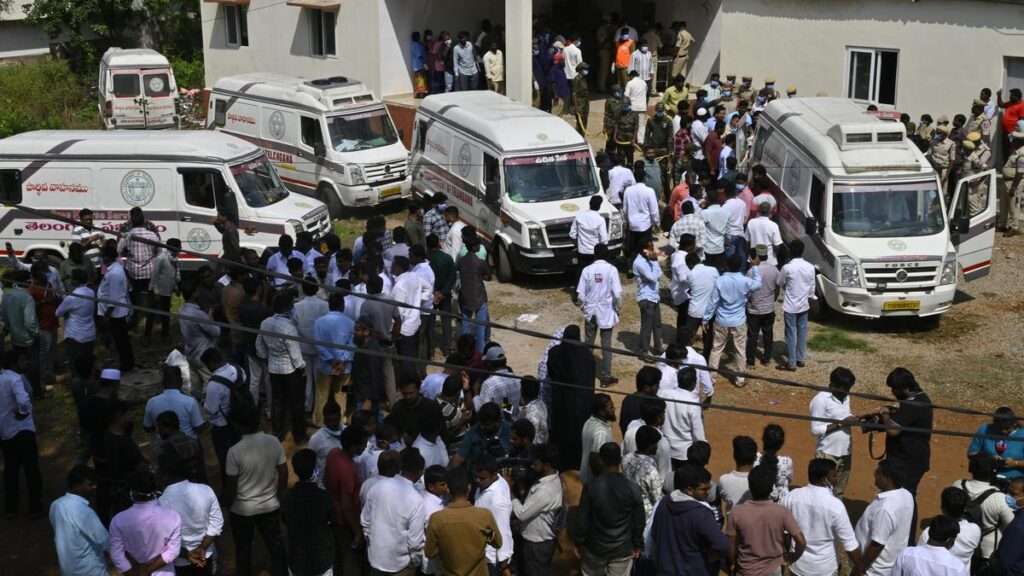
In a tragic accident on the morning of Monday, November 3, 2025, at least 20 people lost their lives and many more were injured when a gravel-laden tipper truck collided head-on with a Telangana State Road Transport Corporation (TSRTC) bus near Chevella in the Ranga Reddy district of Telangana. The bus was travelling towards Hyderabad on the Hyderabad–Bijapur highway when the crash occurred early in the morning near the Mirzaguda–Khanapur Gate area.
According to eyewitness and official reports, the bus — originating from the Tandur depot — was carrying around 70 passengers, many returning after the Sunday holiday. The tipper truck, reportedly travelling at high speed and possibly on the wrong side of the road, struck the bus from the opposite direction. The force of the impact caused the truck’s gravel load to spill into the front section of the bus, crushing passengers seated in the first six rows. Among the deceased are the drivers of both vehicles, a 10-month-old baby with her mother, and several women.
Rescue teams, including local villagers and emergency services, rushed to the scene, with three JCB machines used to clear debris and extricate survivors trapped under the load. The injured were taken to the Chevella Government Hospital, with critically injured patients referred to hospitals in Hyderabad. The accident caused major traffic disruption on the highway, complicating the rescue efforts.
In response, Telangana Chief Minister A. Revanth Reddy expressed deep grief and directed senior officials to rush to the site and oversee relief operations. The Prime Minister’s Office announced ex-gratia compensation of ₹2 lakh for the next of kin of each deceased and ₹50,000 for injured persons. Investigations are underway to determine the precise cause of the collision, with overspeeding and possible lane violation by the tipper driver emerging as preliminary factors.
This tragic incident underscores the persistent road-safety risks on busy highway routes in India, particularly involving heavy-load vehicles and public transport. The fact that a tipper laden with loose gravel could impact the bus and cause the load to crash into the passenger section highlights weaknesses in load-securing, vehicle maintenance, driver training, and highway enforcement. In past years, similar bus-truck collisions have resulted in heavy casualties in the region. The presence of multiple passengers standing aboard the bus further raises concerns about regulation compliance by public transport services.
For local communities and transport authorities, the accident raises urgent questions: Are heavy vehicles being permitted to operate on major inter-city highways without adequate safeguards? Are public-transport buses over capacity, especially during early-morning commutes? What monitoring mechanisms are in place for driver fatigue, speed control, and load safety on state highways? The multiple casualties among front-row passengers also point to structural vulnerabilities in bus design and crash-protection standards.
The fatal collision near Chevella in Ranga Reddy district has left a devastating toll on lives and families, while shining a harsh light on long-standing systemic challenges in road transport safety. As rescue operations continue and investigations proceed, the incident will likely spur renewed calls for stricter oversight of heavy-vehicle operations, enhanced safety protocols for public buses, and improvements in highway infrastructure and enforcement. The true measure will lie in whether the authorities translate grief into actionable reform — to prevent such tragedies from recurring.

