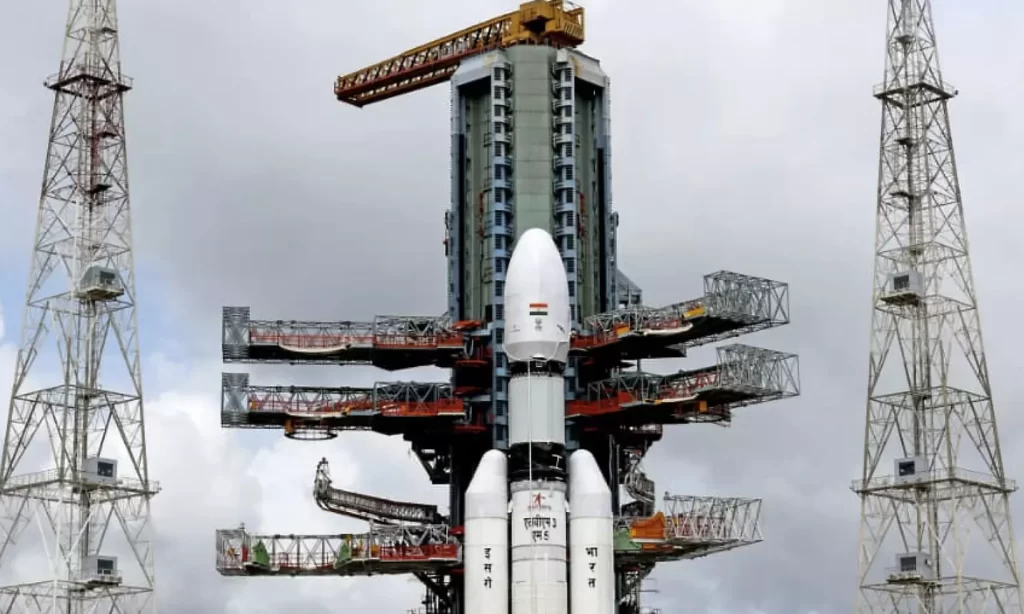
The Indian Space Research Organisation (ISRO) achieved a landmark success on 2 November 2025 with the launch of its heaviest communication satellite to date — GSAT-7R, also known as CMS-03. Weighing approximately 4,410 kg, the satellite was placed into orbit from India’s soil aboard the indigenous LVM3-M5 heavy-lift rocket. The mission marks a major boost to the Indian Navy’s secure communications and underscores India’s growing autonomy in space-based defence infrastructure.
The GSAT-7R satellite is dedicated to the Indian Navy and is intended to replace the earlier GSAT-7 (“Rukmini”) satellite, enhancing naval communications across the Indian Ocean region. With its multi-band payload spanning UHF, S, C, and Ku-bands, GSAT-7R is designed to transmit voice, video, and data between ships, submarines, aircraft, and shore stations. This advanced configuration significantly improves network-centric maritime operations and strengthens the Navy’s real-time situational awareness.
The success of this mission signals a major advancement in India’s launch capabilities. With a launch mass of 4.41 tonnes, GSAT-7R is the heaviest communication satellite ever launched from Indian soil. The LVM3-M5 vehicle once again demonstrated India’s matured heavy-lift launch capacity. The launch took place from the Satish Dhawan Space Centre in Sriharikota and followed rigorous pre-launch procedures, showcasing ISRO’s operational precision and technological reliability.
Strategically, the timing and capabilities of GSAT-7R are significant. India’s maritime interests in the Indian Ocean — including sea-lane monitoring, anti-submarine surveillance, and fleet coordination — increasingly rely on robust satellite communication. The new satellite enhances the Navy’s ability to maintain secure and uninterrupted links across vast distances, even during challenging operational conditions. This development strengthens India’s maritime domain awareness and boosts its resilience amid evolving regional challenges. Moreover, by indigenously developing and launching the satellite, India reduces dependence on foreign systems and reinforces its pursuit of self-reliance in defence technology.
Beyond its military value, the GSAT-7R mission also reflects the broader momentum within India’s space and defence sectors. ISRO’s successful deployment of the satellite demonstrates the country’s growing competence in high-capacity satellite manufacturing and heavy-lift missions. The achievement aligns with India’s long-term goals of strengthening space infrastructure, supporting national security, and expanding its global presence in the field of advanced space technology.
The successful launch of GSAT-7R stands as a cornerstone in India’s maritime and space synergy — combining cutting-edge satellite communications with strategic defence planning. For the Indian Navy, it provides a more robust and secure communication backbone. For ISRO and the nation, it marks another step toward mastering heavy-lift and defence-oriented space missions. As India continues to advance in space technology and strategic autonomy, the GSAT-7R mission will be remembered as a defining milestone in the country’s journey toward technological and geopolitical strength.