
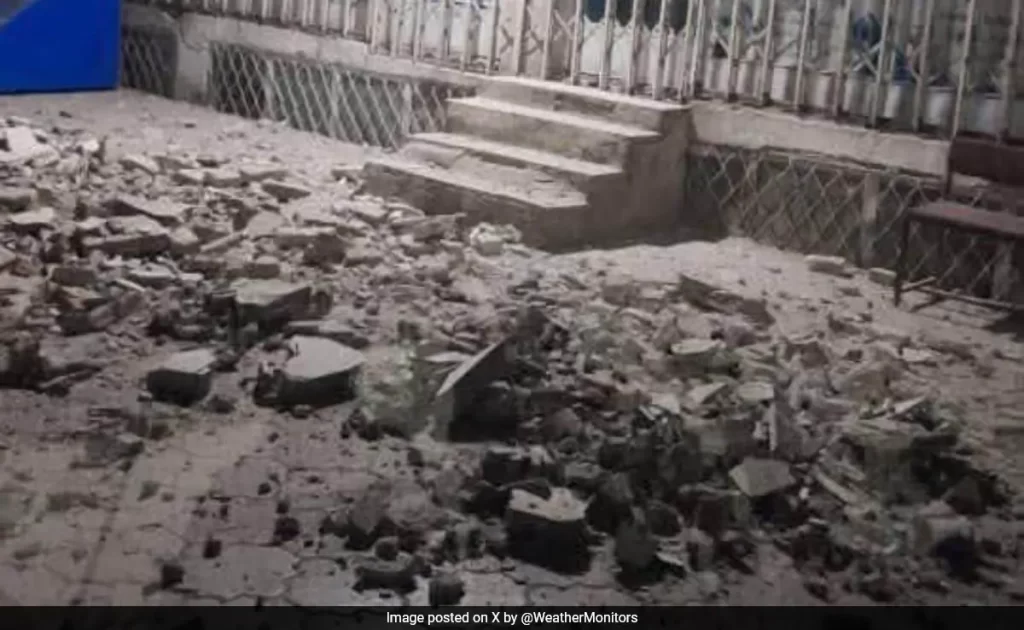
In the early hours of Monday, a powerful earthquake measuring magnitude 6.3 struck northern Afghanistan, centering near Mazar-e-Sharif in the Balkh Province. The quake left at least 20 people dead and hundreds injured, according to initial government reports. The disaster has caused widespread damage across the neighboring Samangan Province, where rescue operations are still underway, and officials have warned that the death toll is likely to rise as emergency teams reach remote areas.
The United States Geological Survey (USGS) reported that the earthquake occurred at a depth of approximately 28 kilometers, with its epicenter located about 22 kilometers west-southwest of Khulm, near Mazar-e-Sharif. The tremors struck in the pre-dawn hours, jolting residents awake and forcing many to flee their homes in panic. Witnesses described scenes of chaos as buildings swayed and debris fell, leaving several homes and public structures severely damaged.
Preliminary data from the Afghan Ministry of Public Health indicates that at least 20 people have been confirmed dead and more than 500 injured, though these figures are expected to rise as communication with outlying areas is restored. In several rural districts of Samangan, roads have been blocked by landslides, hampering relief efforts and delaying medical assistance to the injured. Local hospitals have reported being overwhelmed by casualties, prompting authorities to call for additional supplies and medical staff.
The tremor also caused structural damage to historical landmarks, including the iconic Blue Mosque in Mazar-e-Sharif, a 15th-century heritage site. While the main structure remains intact, parts of its decorative tilework and outer walls were reportedly damaged. A major highway connecting Mazar-e-Sharif to other provincial centers was temporarily closed after a landslide, disrupting transportation and aid delivery routes.
Afghanistan is among the most seismically active regions in Asia, lying along the collision zone of the Eurasian and Indian tectonic plates. The country’s mountainous terrain and fragile infrastructure make it particularly vulnerable to earthquakes. Earlier this year, a magnitude 6.0 quake in eastern Afghanistan claimed more than 2,200 lives, further straining the nation’s limited disaster response capacity.
Relief and rescue operations are ongoing, with military teams and local volunteers digging through the rubble in search of survivors. Hospitals near the affected areas have been placed on high alert, while international organizations, including the United Nations Mission in Afghanistan, have deployed emergency teams to assist with assessment and aid distribution.
The magnitude 6.3 earthquake has once again highlighted Afghanistan’s ongoing struggle with natural disasters amid economic and political instability. As the country grapples with the immediate aftermath, officials emphasize the urgent need for international support, reconstruction assistance, and long-term planning to strengthen disaster preparedness. The true scale of devastation will become clearer in the coming days as rescue teams continue their work in the remote, quake-hit regions of Balkh and Samangan.

