
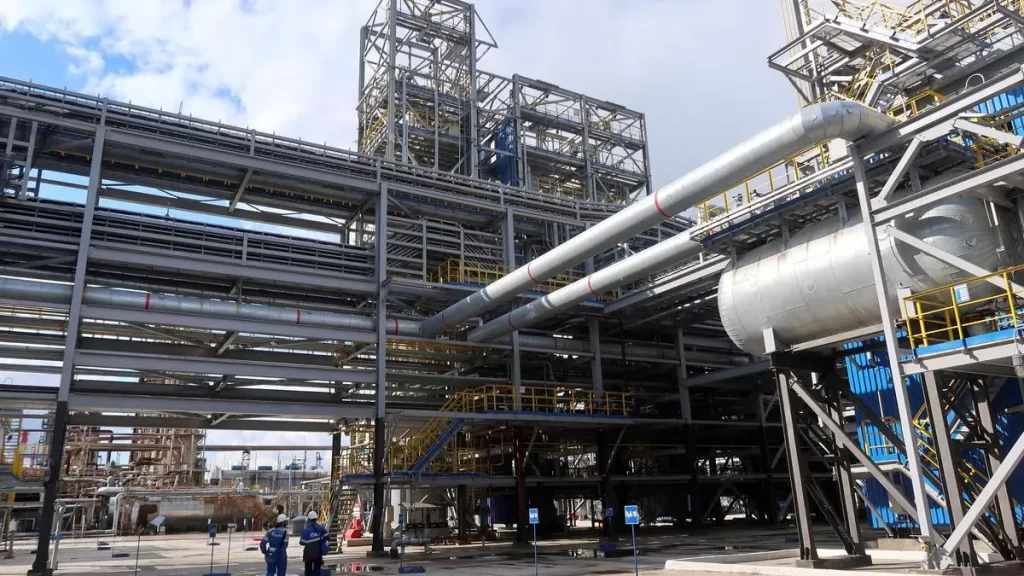
In a striking escalation of its long-range campaign, Sterlitamak’s petrochemical complex in Russia’s Bashkortostan region sustained damage early on 4 November as two drones launched by Ukraine penetrated deep into Russian territory. Russian authorities confirmed that a water-treatment facility at the plant partially collapsed, although there were no reported casualties.
The targeted facility, located some 1,500 km inside Russia, is operated by the petrochemical division in Sterlitamak and features a water-treatment section integral to its industrial operations. Regional Governor Radiy Khabirov reported that both drones were intercepted by Russian air-defence units, but debris triggered an explosion that caused the partial collapse of the water-treatment infrastructure. Despite the incident, officials say the plant remains operational. According to Khabirov, there were five workers present at the time of the strike, and none were injured.
The attack underscores Ukraine’s growing reliance on unmanned aerial vehicles (UAVs) and drone-capabilities to target energy and industrial infrastructure far beyond the front lines. Analysts note that such strikes serve to disrupt supply chains and logistics that support Russia’s war machinery. From Moscow’s perspective, these operations are deemed “terrorist” attacks on civilian-adjacent infrastructure. Kyiv, however, frames the drone strikes as legitimate acts of self-defence in the face of an invasion that began in February 2022.
The incident takes place amid reports of intensified drone and missile exchanges. Russia’s defence ministry claimed that 83 drones were intercepted overnight across seven regions, in addition to this incident in Bashkortostan. While the Sterlitamak facility is not the first to be targeted — previous strikes in the region have struck large petrochemical and oil-refining facilities — the distance travelled by the drones highlights the shifting nature of the conflict: one moving from the front-line battlefields into the industrial heartlands.
The strategic logic behind Ukraine’s long-range strikes is two-fold: first, to impose costs on Russia by targeting its energy and industrial infrastructure, and second, to force Moscow to reallocate resources to homeland defence rather than frontline operations. The Sterlitamak operation signals an intensification of that approach. For Russia, these attacks risk undermining confidence in the invulnerability of industrial hubs far from the conflict zone, potentially raising insurance and maintenance costs, and disrupting operations at petrochemical complexes. For Ukraine, the strike serves as a message of capability: that it can reach targets deep inside Russia, thereby widening the theatre of operations. At the same time, it raises risks of escalation. Moscow may feel compelled to retaliate with increased strikes or broader operations against Ukrainian infrastructure. The potential for collateral damage or civilian impact also remains a concern, especially as industrial complexes often sit close to civilian populations.
The drone strike on the Sterlitamak petrochemical plant marks a new stage in the Ukraine-Russia conflict: one in which Ukraine is not only defending its territory but projecting force deep into Russian industrial territory. While no casualties were reported on this occasion, the damage to the water-treatment facility nonetheless reveals vulnerabilities in Russia’s industrial defence architecture. As the war enters its fourth year, the significance of such strikes may extend beyond immediate material damage to influence the broader strategic calculus of both Kyiv and Moscow.

