
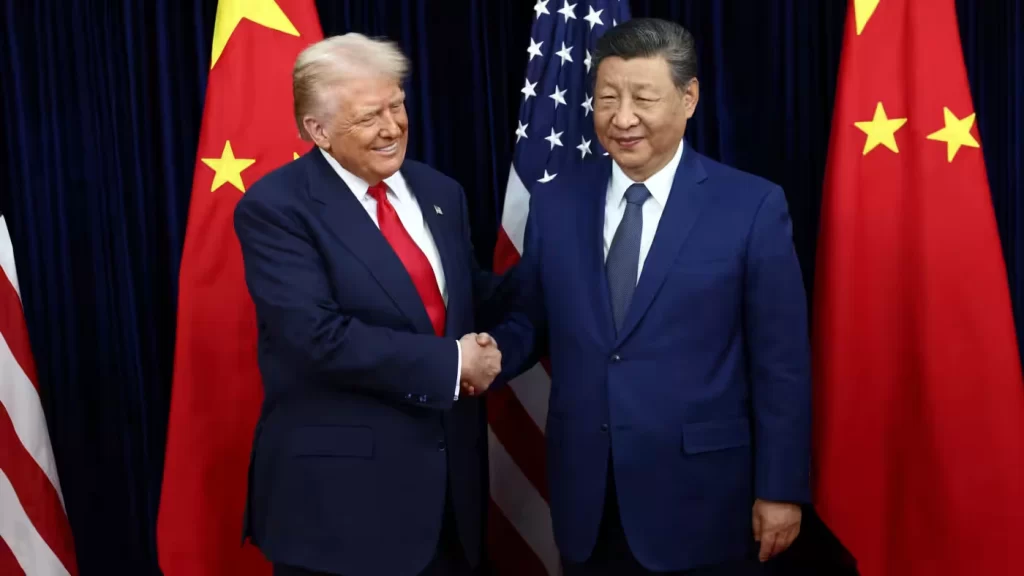
In a significant move to ease trade tensions, China has announced the suspension of its export ban on three critical minerals — gallium, germanium and antimony — to the United States. The suspension will take effect from November 9, 2025, and remain in place until November 27, 2026. This decision follows a meeting between Chinese President Xi Jinping and U.S. President Donald Trump in South Korea on October 30, 2025, where both leaders agreed to a one-year trade truce aimed at stabilizing bilateral economic relations.
The Chinese Ministry of Commerce confirmed that export restrictions on these “dual-use” materials, which have applications in both civilian and military industries, will be temporarily lifted. The suspension covers licensing requirements for exports of gallium, germanium, antimony and related compounds to U.S. entities. These materials are essential components in advanced technologies such as semiconductors, fibre optics, infrared sensors and high-capacity batteries.
China’s decision marks a notable reversal of its earlier policy. The country had imposed the export ban in December 2024, citing national security concerns and strategic resource management. The move at that time intensified the global supply chain crisis, as China is the world’s dominant producer of gallium, accounting for nearly 99 percent of refined output, and germanium, with around 83 percent of global refining capacity. Antimony, another vital mineral, is also primarily sourced from China and is used extensively in flame retardants, electronics and defence equipment.
The latest announcement comes in the backdrop of renewed diplomatic engagement between Washington and Beijing. During the meeting in Busan, both leaders agreed to pause tariff escalations and suspend additional export control measures for a year. The White House described the truce as an opportunity for both nations to reassess their economic strategies and reduce disruptions in global trade flows. Analysts, however, caution that the agreement represents a temporary pause rather than a permanent resolution to the broader strategic rivalry between the two powers.
Industry experts have welcomed the suspension, noting that it will ease supply chain pressures on U.S. technology and defence sectors that rely heavily on Chinese mineral exports. Semiconductor and clean energy industries, in particular, are expected to benefit from the renewed flow of these materials. The decision also reflects China’s strategic recalibration, suggesting a willingness to stabilize its trade relationships without relinquishing long-term control over critical mineral supplies.
While the suspension provides short-term relief for industries dependent on rare minerals, it does not eliminate the underlying tension in U.S.–China relations. The competition for technological supremacy and resource security continues to define their engagement. As the one-year truce unfolds, global markets and policymakers will closely monitor whether this temporary détente evolves into a sustained phase of cooperation or merely precedes another round of economic confrontation.

