
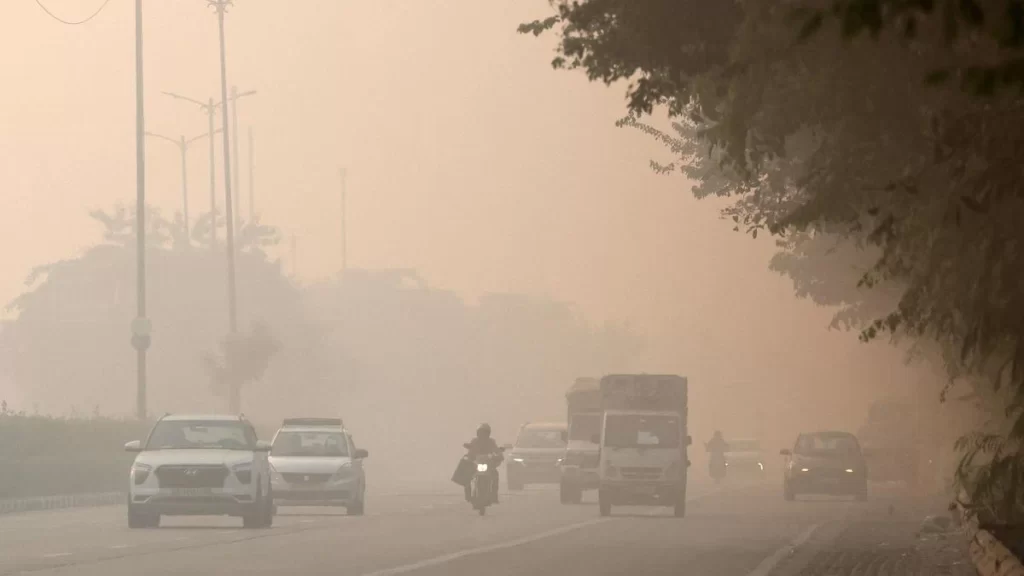
The national capital region has entered a critical phase of air pollution, as Delhi’s Air Quality Index (AQI) surged into the “severe” category (401-500) for the first time this year, reaching a level of 428. In response, the Commission for Air Quality Management (CAQM) activated Stage III of the Graded Response Action Plan (GRAP) across Delhi and the adjoining National Capital Region (NCR), triggering sweeping restrictions aimed at curbing pollution and protecting public health.
The sharp rise in air pollution caught authorities’ attention after the AQI jumped dramatically from a previous reading of 362 to above 425 within a short span. According to CAQM orders dated November 11, 2025, the invocation of Stage III was deemed necessary under the extant GRAP schedule for “Severe Air Quality” (AQI 401-450).
Under Stage III measures, construction and demolition (C&D) activities – including excavation, brick-masonry, tile-cutting, and loading or unloading of dust-generating materials – are banned outright except for essential infrastructure. Older, high-pollution vehicles are also targeted: petrol-powered BS-III and diesel BS-IV four-wheelers have been restrained from operating in Delhi and neighbouring districts. The restrictions extend to brick-kilns, stone-crushing units, mining operations, and diesel generator sets not running on clean fuel, as part of efforts to control multiple sources of pollution simultaneously.
The immediate health implications prompted additional measures. Schools for children up to Class V were shifted to hybrid or online modes to minimise exposure of young children to toxic air. Some corporate entities reinstated work-from-home advisories and curtailed non-essential employee travel in line with CAQM’s recommendations.
Meteorological conditions have exacerbated the crisis: calm winds and a stable atmospheric layer prevented pollutant dispersion, allowing particulate matter concentrations (PM2.5 and PM10) to accumulate. Experts warn that while the stubble-burning season in neighbouring states remains a contributing factor, urban sources like vehicular emissions, construction dust, and industrial output continue to dominate this early-season spike.
This year’s first “severe” level air day in Delhi is a wake-up call for policymakers and citizens alike. Although the average AQI for January to November 9, 2025, was recorded at about 175 (compared to 189 during the same period last year), the sudden overnight deterioration underscores the volatility of air quality in the region. The GRAP mechanism, introduced to provide tiered responses to changing air conditions, demonstrates its relevance: moving from Stage I (Poor: AQI 201-300) and Stage II (Very Poor: AQI 301-400) to Stage III at this juncture signals the urgency of mitigation.
The economic implications are significant: the construction and real-estate sectors face abrupt halts, and transportation restrictions may ripple into logistics and commuting. On the public health front, with AQI above 400, even healthy individuals may experience respiratory irritation and reduced lung function, while high-risk groups face serious danger.
As Delhi enters a phase of severe air pollution, the activation of Stage III of the GRAP by CAQM marks a decisive step in pollution control. The layered measures—banning construction dust, curbing older vehicle emissions, shifting school modes, and restricting industrial output—are aimed at restoring breathable air in the capital region. However, sustained improvement will depend on mitigating both immediate sources and structural causes, from vehicular emissions to regional biomass burning. For residents, vigilance and adherence to advisories, including indoor air protection and limiting outdoor exposure, are critical in the coming days. The path ahead will test the efficacy of the GRAP framework and collective action in tackling one of India’s most persistent environmental challenges.

