
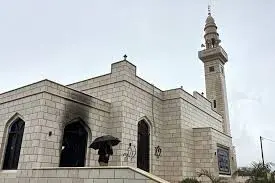
A sharp escalation in violence and symbolic exchanges has added new momentum to the already volatile situation in the occupied Palestinian territories. In one dramatic episode, Israeli settlers reportedly set fire to a mosque in the West Bank village of Deir Istiya, while simultaneously the Palestinian militant group Hamas transferred the remains of an Israeli hostage back to Israel. These incidents — one of destructive religious violence and the other of deeply symbolic human loss — underscore the increasing intensity of the conflict, the fragility of mediation efforts, and the challenge of restoring any measure of stability.
On 13 November 2025, Israeli settlers set fire to the Hajja Hamida Mosque in Deir Istiya, in the north of the West Bank near Salfit, damaging the building and burning several copies of the Quran. The attack followed a wave of settler violence across the occupied West Bank, marked this year by what the United Nations described as a record number of assaults on Palestinian communities and religious sites. Activists say the mosque torching carries deep symbolism: an attack on worship, identity, and the body politic of the Palestinian community. Moreover, the incident drew rare public condemnation from Israeli military leadership, who described such extremist attacks as crossing a “red line.”
International actors also voiced concern. The United Nations Secretary-General’s spokesman said the incident was “completely unacceptable” and urged Israel, as occupying power, to fulfill its responsibility for civilian protection. Experts say the escalation of settler violence is linked to the broader war in Gaza, with settlers feeling empowered and Palestinians increasingly vulnerable, especially during the olive-harvest season when many such attacks occur.
On the same day, Israel announced that the remains of an Israeli hostage held by Hamas were returned and identified as that of Meny Godard, 73, of Kibbutz Be’eri. Godard was abducted during the deadly 7 October 2023 Hamas attack; his wife Ayelet was killed in that attack, and his body had remained held in Gaza until now. The return of his remains forms part of the delicate cease-fire and exchange mechanism mediated by third-party brokers and highlights the human cost of prolonged conflict: for the families and for the political dynamics. Israel stated that three other dead hostages still remain in Gaza, and pressure continues for Hamas to hand them over.
These two incidents, occurring simultaneously, underscore the volatility of the situation in the Middle East. They demonstrate the complexities of ongoing violence, the deeply personal human toll of conflict, and the challenges facing regional and international actors seeking to mediate peace.

