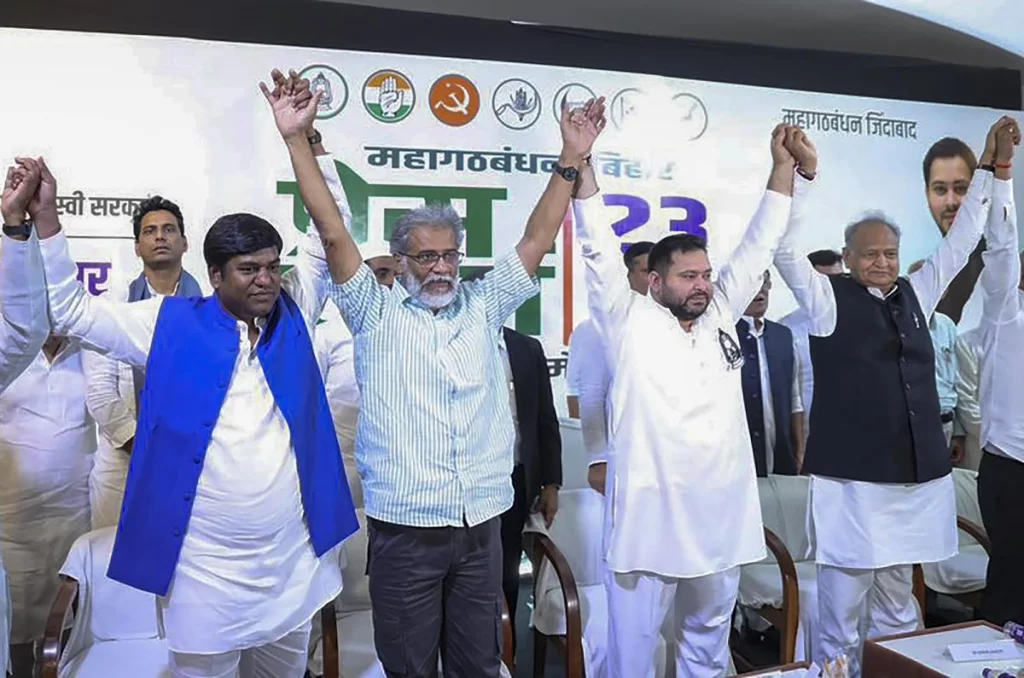
The 2025 Bihar Assembly election has delivered one of the most decisive political setbacks for the Mahagathbandhan, the opposition bloc comprising the Rashtriya Janata Dal, the Congress, and the Left parties. As counting progressed, the alliance found itself trailing severely, managing to lead in only about 30 to 40 constituencies out of the 243-member Assembly. The National Democratic Alliance, led by the Janata Dal (United) and the Bharatiya Janata Party, surged far ahead, comfortably crossing the majority mark and securing what appears to be a historic mandate.
The election outcome marks a dramatic reversal of expectations for the Mahagathbandhan, which had entered the contest projecting itself as the primary challenger to the ruling coalition. Despite an energetic campaign and efforts to consolidate anti-incumbency sentiment, the opposition alliance failed to achieve a breakthrough across key regions. Early trends showing the NDA taking commanding leads in a majority of seats quickly solidified, leaving little room for the Mahagathbandhan to recover ground.
Several factors contributed to the opposition’s poor performance. Analysts point to strategic miscalculations within the alliance, particularly around messaging, candidate selection, and the inability to unite voter sentiment across caste and regional lines. Internal disagreements over seat-sharing had earlier signaled cracks within the coalition, weakening coordination on the ground. While the RJD remained the largest component of the Mahagathbandhan, it was unable to replicate its previous electoral performances in traditional strongholds, with several constituencies reflecting unexpected swings toward the NDA.
Additionally, the ruling alliance appears to have benefited from a consolidated voter base and a strong campaign that emphasized governance, welfare delivery, and stability. The NDA leadership effectively framed the election as a choice between continuity and uncertainty, influencing voter behavior in both urban and rural constituencies. Reports from polling districts indicated that even sections previously considered sympathetic to the opposition appeared to favor the ruling alliance’s narrative this time.
For the Mahagathbandhan, the outcome represents more than an electoral defeat—it raises serious questions about the coalition’s strategy, unity, and future relevance in Bihar’s politics. Leaders within the alliance are expected to undertake a phase of introspection, reassessing why their messaging failed to resonate and how they can rebuild trust among voters who have shifted their support elsewhere.
The NDA, while bolstered by a sweeping mandate, now faces the responsibility of delivering on its promises. With a significantly strengthened position in the Assembly, the ruling coalition is expected to accelerate its development agenda, address employment challenges, and improve public services. However, political observers note that an emphatic victory also sets high expectations, and the government’s performance will be closely watched in the coming years.
The Bihar 2025 election results underscore a decisive reshaping of the state’s political landscape. The Mahagathbandhan’s dramatic rout, coupled with the NDA’s commanding lead, reflects shifting voter dynamics and the growing importance of coherent messaging, organizational discipline, and leadership credibility. As the dust settles, Bihar enters a new chapter marked by both renewed political strength for the ruling alliance and significant challenges for the opposition as it seeks a path to recovery.