The 2025 Bihar Assembly elections delivered a decisive victory for the National Democratic Alliance (NDA), driven by a strategic mix of governance-focused messaging, women-centric welfare policies, and a strong rebuttal to the opposition’s “jungle raj” allegations. Political analysts agree that the NDA’s success stemmed from its ability to merge development promises with targeted social outreach, reshaping voter demographics in its favor.
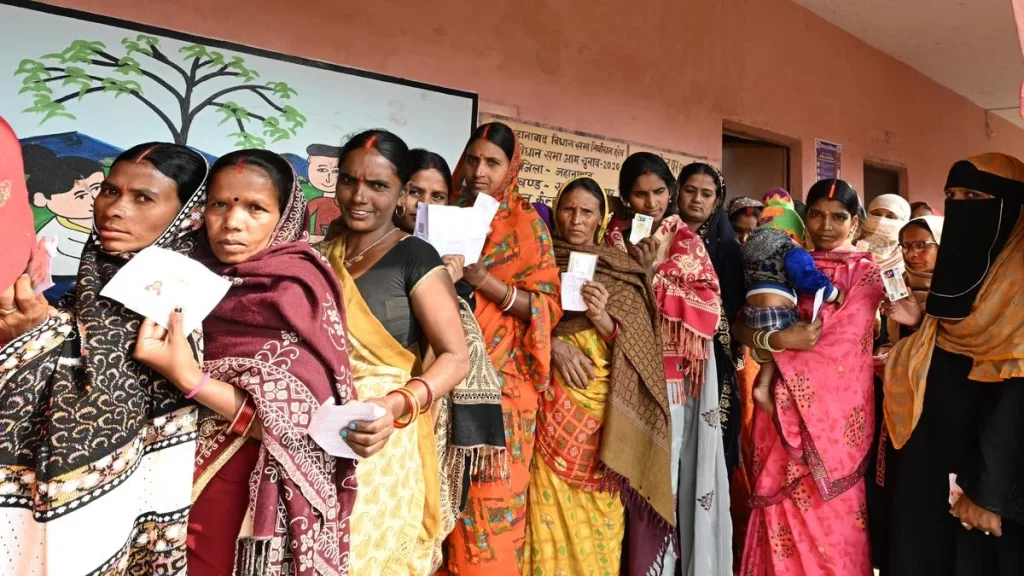
One of the most notable shifts in this election was the unprecedented participation of women voters. In several constituencies, women reportedly outnumbered male voters by significant margins. This surge was directly tied to the NDA’s focused welfare strategy. Cash-transfer schemes such as the Mahila Rojgar Yojana, enhanced social security support, and expanded reservations for women in local bodies created a strong sense of trust and gratitude. Women, especially in rural and semi-urban regions, appeared to reward policies that offered both financial support and improved livelihood opportunities.
Complementing this was the NDA’s emphasis on the “double-engine government” narrative. The alliance projected itself as a unified force capable of ensuring seamless cooperation between the Bihar state government and the central leadership. This message of synchronized governance resonated with voters seeking stability, continuity, and accelerated development. Over the past few years, improvements in infrastructure, electricity access, and local governance were highlighted as tangible outcomes of this model, strengthening the perception that the NDA was best positioned to deliver sustained progress.
Another significant factor was the revival of the “jungle raj” narrative. By invoking memories of past lawlessness associated with earlier regimes, the NDA contrasted its governance model with what it described as the risks posed by the opposition. For many voters, particularly older generations familiar with past instability, this messaging reinforced the idea that the NDA represented order, safety, and responsible administration. The opposition’s attempts to counter this narrative failed to gain traction, as the NDA successfully framed itself as the guarantor of law and order.
Caste dynamics also played a crucial role in shaping the election outcome. The NDA broadened its social coalition by strengthening its outreach to Economically Backward Classes and other marginalized groups. Analysts attributed the alliance’s success to a new political calculus often described as the “ME factor” — the combined influence of Mahila (women) voters and EBC communities. By integrating women-centric welfare with targeted support for backward-class households, the NDA effectively disrupted traditional caste alignments that favored its rivals.
Nitish Kumar’s enduring influence added further stability to the NDA’s image. Despite concerns regarding his political longevity, his reputation as a calm, corruption-averse administrator continued to resonate with voters. His government’s track record of welfare expansion, particularly for women and economically weaker communities, reinforced the overall narrative of reliable governance.
In summary, the NDA’s landslide victory in Bihar was not the result of a single factor but a carefully synchronized electoral strategy. Women voters emerged as a transformative force, the double-engine promise strengthened public confidence, and the rejection of the jungle raj narrative provided clarity to undecided voters. Together, these elements delivered the NDA a robust mandate, signaling a shift in Bihar’s political landscape toward governance-driven voting patterns rather than solely identity-based politics.