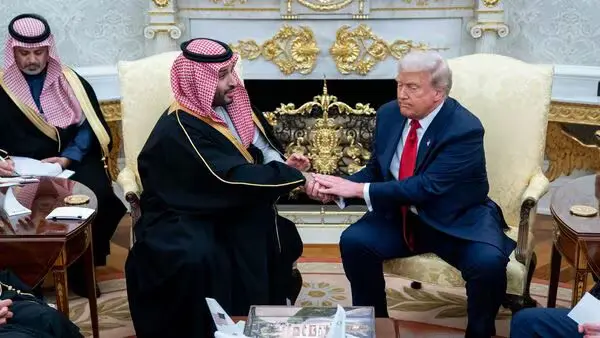
In a sweeping realignment of U.S. Middle East policy, President Donald Trump on Tuesday officially designated Saudi Arabia a “major non-NATO ally”, granting the kingdom access to expanded military cooperation and advanced defence technology. The announcement came during Crown Prince Mohammed bin Salman’s high-profile visit to the White House on November 18, 2025, where both leaders unveiled a major defence and strategic partnership package that includes U.S. approval for the future sale of F-35 Lightning II stealth fighter jets.
The move positions Saudi Arabia among a select group of nations with enhanced security ties to Washington, signalling a renewed U.S. push to strengthen its influence in the Gulf amidst shifting regional alliances and increasing global competition. The designation provides Riyadh with priority access to U.S. defence equipment, joint training programmes, and collaborative research initiatives, effectively deepening bilateral military integration.
According to U.S. officials, the defence package extends far beyond the F-35 approval. It includes provisions for streamlined weapons transfers, co-location of U.S. military logistics on Saudi soil, and the expansion of joint defence technology development—particularly in areas such as unmanned systems, cybersecurity, and advanced intelligence-sharing frameworks.
The White House emphasized that the updated partnership reflects evolving security needs in the Middle East, where rising tensions, drone warfare, and shifting power balances require new levels of coordination. For Saudi Arabia, the agreement marks a significant breakthrough in its long-term military modernization agenda under Vision 2030, which aims to reduce dependence on foreign contractors and strengthen domestic defence manufacturing.
The economic components of the visit further underscored the growing strategic interdependence between the two nations. Saudi Arabia reiterated its plan to increase investments in the United States to nearly USD 1 trillion, with proposed cooperation in artificial intelligence, civil-nuclear development, and critical minerals—a sector vital to global technology supply chains. Analysts say these commitments align with Washington’s effort to secure alternative supply routes and reduce global reliance on competing powers.
Despite the strategic gains, the decision has drawn international scrutiny. Critics argue that elevating Saudi Arabia’s status and approving the sale of cutting-edge military aircraft raises questions about regional stability, particularly in maintaining the long-established qualitative military edge of Israel. Others point to ongoing concerns over human rights issues, including the 2018 killing of journalist Jamal Khashoggi, which continues to shadow the kingdom’s global reputation.
Key Highlights of the U.S.–Saudi Agreement
- Formal designation of Saudi Arabia as a major non-NATO ally
- U.S. approval for the future sale of F-35 stealth fighter jets
- Accelerated defence cooperation, including advanced weapons transfer mechanisms
- Joint development in AI, civil-nuclear energy, and defence technology
- Saudi pledge to increase U.S. investments to nearly USD 1 trillion
The strengthened partnership is expected to reshape security dynamics in the Middle East, influencing everything from defence-industry supply chains to ongoing diplomatic efforts in the region. While Saudi Arabia maintains that full normalization with Israel remains contingent upon progress toward Palestinian statehood, the new defence alignment may influence future negotiations and the broader trajectory of the Abraham Accords.
As the United States recalibrates its foreign-policy priorities, the upgraded alliance with Saudi Arabia signals a long-term strategic commitment likely to have far-reaching implications for regional geopolitics, defence markets, and global power balances.