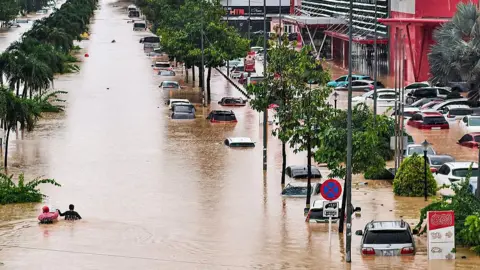
Relentless rains and severe flooding have devastated central Vietnam, leaving at least 41 people dead and nine still missing, according to official assessments. The unprecedented deluge, which began over the weekend, has engulfed more than 52,000 homes, crippled key transport links, and left nearly half a million households and businesses without electricity, marking one of the region’s worst natural disasters in recent years.
Widespread Rainfall Sparks Deadly Flash Floods
Provinces including Dak Lak, Khanh Hoa, Lam Dong, Gia Lai, Hue, and Da Nang were among the worst affected, recording continuous heavy rainfall that triggered widespread flash floods and landslides.
Authorities reported that Dak Lak registered 16 fatalities, followed by 14 in Khanh Hoa, four in Lam Dong, three in Gia Lai, and two each in Hue and Da Nang. Rescue teams continue searches for the missing as rivers overflow and water levels remain dangerously high.
Aside from human casualties, the natural disaster has caused extensive agricultural destruction. More than 13,000 hectares of crops and 2,100 hectares of perennial trees have been submerged or washed away. Floodwaters also claimed over 30,000 livestock and poultry, severely impacting local livelihoods.
Infrastructure Collapses Under Flood Pressure
Transport infrastructure across central Vietnam has borne the brunt of the catastrophe. Several major national highways, including Highways 1, 14, 14E, 40B, and 20, have been blocked due to landslides or high water levels. Railway services have been disrupted, forcing authorities to suspend multiple passenger trains. Tuy Hoa Airport was temporarily shut down as runways flooded and visibility deteriorated.
Power outages remain a significant challenge. At the peak of the crisis, more than one million customers were cut off from electricity. While restoration efforts have already reconnected over half a million households, many remote regions remain in the dark as crews work against time and treacherous terrain.
Massive Rescue Efforts Underway
In response to the widespread devastation, the Ministry of National Defense has mobilized more than 18,000 personnel, hundreds of specialized vehicles, and four helicopters. Troops are delivering emergency supplies, including drinking water, food packets, inflatable boats, life jackets, and medical kits, to isolated communities stranded by rising waters.
Authorities have evacuated over 60,000 residents from high-risk zones. With several mountain slopes saturated, the threat of landslides remains extremely high, prompting continuous monitoring and precautionary evacuations.
Meteorological Factors and Climate Concerns
Weather experts attribute the disaster to the rare convergence of multiple atmospheric systems. A strong cold surge combined with moisture-laden winds from the sea resulted in prolonged rainfall concentrated against mountainous terrain. Unusually warm sea surface temperatures in the East Sea—measuring 1 to 1.5°C above average—intensified the moisture content in the air, contributing to the scale of the downpour.
The incident has renewed concerns about Vietnam’s vulnerability to climate change–driven extreme weather, raising questions about the region’s preparedness and infrastructure resilience.
Economic Losses and Long-Term Outlook
Preliminary damage assessments estimate economic losses exceeding VND 3 trillion. With thousands of homes uninhabitable and key agricultural areas destroyed, recovery and reconstruction are expected to take months.
As relief operations continue, officials emphasize the need for long-term investment in flood-resilient infrastructure, modern early warning systems, and climate-adaptive planning to safeguard vulnerable communities.