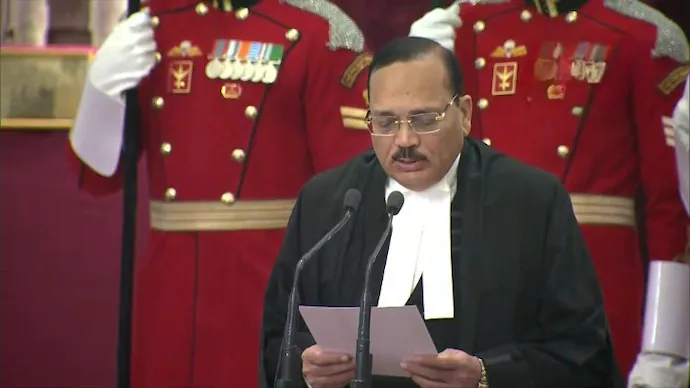
Justice Surya Kant was sworn in on Monday as the 53rd Chief Justice of India (CJI), marking a significant transition in the leadership of the country’s judiciary. President Droupadi Murmu administered the oath of office at a ceremonial event held at Rashtrapati Bhavan. He succeeds Justice B.R. Gavai, who demitted office on November 23 after completing his tenure as the 52nd CJI.
A Distinguished Judicial Journey
Born on February 10, 1962, in Hisar, Haryana, Justice Surya Kant began his legal practice in 1984 at the Hisar district court before moving to the Punjab and Haryana High Court the following year. Over the decades, he built an extensive career marked by notable contributions to constitutional, administrative, and criminal law.
He served as Advocate General of Haryana in 2000 and was elevated as a judge of the Punjab and Haryana High Court in 2004. In 2018, he became the Chief Justice of the Himachal Pradesh High Court. His elevation to the Supreme Court came in 2019, where he went on to serve on several key benches handling matters of national importance.
His appointment as CJI follows the long-standing seniority convention of the Supreme Court. With a tenure extending until February 2027, Justice Kant is expected to lead the judiciary for nearly 15 months.
Focus Areas and Expected Judicial Priorities
Justice Kant assumes office at a time when the Supreme Court faces an extensive pendency of cases, crossing approximately 90,000 matters. Addressing backlog reduction is expected to be one of his foremost priorities. This includes strengthening mediation mechanisms, streamlining case management systems, and increasing the frequency of Constitution Bench hearings to resolve long-pending constitutional questions.
Throughout his Supreme Court tenure, Justice Kant has been part of benches that examined major issues such as the legal challenges to the abrogation of Article 370, the temporary suspension of the colonial-era sedition law, and matters related to electoral transparency and gender representation in governance. His judgments reflect a balanced judicial philosophy rooted in constitutional accountability and administrative fairness.
Institutional Significance
Justice Kant’s elevation signifies continuity in the Supreme Court’s leadership and reinforces confidence in the established seniority-based selection convention. His experience across various levels of the judiciary positions him to steer administrative reforms, particularly in enhancing judicial efficiency and ensuring timely disposal of cases.
Legal experts note that the coming year will be crucial for shaping the court’s approach to several sensitive issues, including electoral reforms, data protection, and centre-state relations. His leadership is also expected to advance efforts in digital infrastructure, including virtual hearings and technological integration, aimed at improving access to justice.