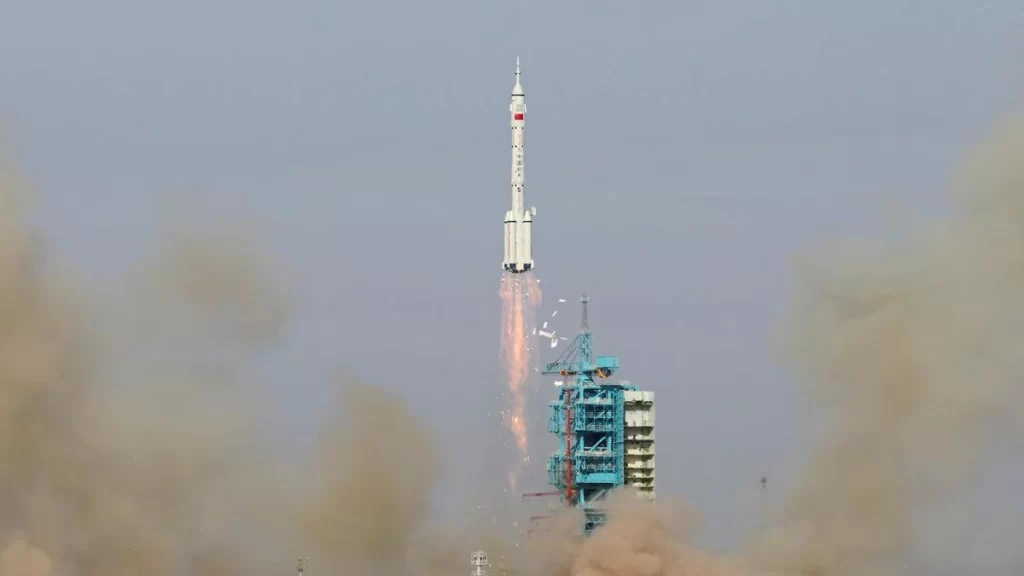
China Manned Space Agency (CMSA) on 25 November 2025 successfully launched the uncrewed Shenzhou-22 spacecraft in a rare emergency operation designed to safeguard three astronauts currently aboard the Tiangong space station. The unprecedented “lifeboat mission” was triggered after the station’s original return vehicle became unavailable, leaving the Shenzhou-21 crew without a designated means to return to Earth. The new spacecraft is expected to dock automatically with Tiangong, restoring evacuation capability and ensuring crew safety.
A Mission Born of Crisis
The emergency launch was initiated when the Shenzhou-20 return craft was deemed unsafe for re-entry after suffering damage to a window—likely due to orbital debris—during its mission. As a result, the Shenzhou-21 spacecraft, originally reserved for the astronauts currently on board Tiangong, was repurposed for the Shenzhou-20 crew’s urgent return to Earth. This left the three Shenzhou-21 astronauts stranded without a return vessel for nearly ten days, prompting China to accelerate plans for an uncrewed rescue craft.
Shenzhou-22 lifted off aboard a Long March-2F/G rocket from the Jiuquan Satellite Launch Centre at 04:11 GMT. CMSA later confirmed that the spacecraft entered its intended orbit and began its autonomous journey toward Tiangong. The mission marks China’s first “launch-on-need” emergency operation—an approach commonly associated with mature spacefaring programs.
Why This Mission Matters
The Shenzhou-22 launch underscores several critical aspects of China’s human spaceflight development:
- Crew Safety Protocols: The absence of an immediate return vehicle exposed a major vulnerability in long-duration station operations. The rapid deployment of Shenzhou-22 illustrates China’s growing emphasis on redundancy and crisis readiness.
- Orbital Debris Threat: The damage sustained by Shenzhou-20 renews concerns about the growing hazards of orbital debris, which continues to pose significant risks to spacecraft, astronauts, and station infrastructure.
- Operational Maturity: By executing an uncrewed emergency launch on short notice, CMSA has signaled its capability to manage advanced space station contingencies—an area dominated historically by the International Space Station and its partner agencies.
Mission Snapshot
| Key Detail | Information |
|---|---|
| Mission | Shenzhou-22 (Uncrewed Emergency Launch) |
| Objective | Provide return craft for stranded Shenzhou-21 crew |
| Launch Time | 04:11 GMT, 25 November 2025 |
| Launch Site | Jiuquan Satellite Launch Centre |
| Rocket | Long March-2F/G |
| Trigger Event | Shenzhou-20 return craft damaged by suspected debris |
| Strategic Significance | China’s first dedicated “lifeboat” mission |
Broader Implications
The emergency deployment of Shenzhou-22 is expected to influence China’s future station operations. Experts anticipate that CMSA may introduce routine standby return vehicles or rapid-launch protocols to prevent similar vulnerabilities. The event also adds urgency to global discourse on managing space debris—a growing threat that has implications for all space-faring nations.
International observers note that China’s fast-response mission positions it among the limited group of countries capable of complex, crew-safety-centred space operations. As Tiangong continues to expand scientific output and mission tempo, the Shenzhou-22 episode may serve as a turning point in China’s approach to space station risk management.