
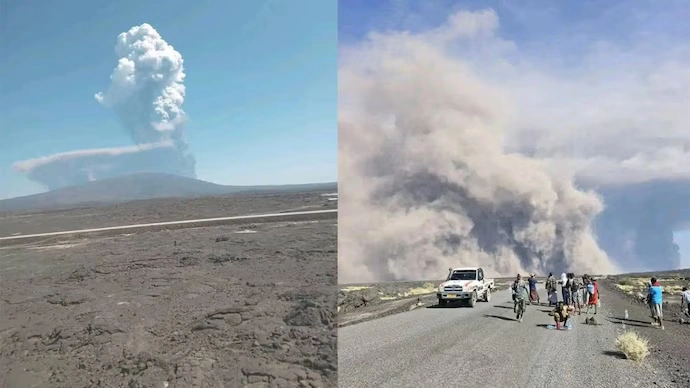
A massive eruption of Ethiopia’s Hayli Gubbi volcano — believed to have been dormant for nearly 10,000 years — sent a towering ash plume sweeping across India on November 24 and 25, causing widespread flight disruptions before the cloud finally drifted out of the country’s airspace late Tuesday evening. Aviation authorities have since confirmed that normal operations are gradually resuming.
Dormant Volcano Awakens After Millennia
The sudden explosive eruption began on November 23 in Ethiopia’s Afar region, propelling ash and sulphur dioxide up to nearly 14 kilometres into the atmosphere. Strong upper-level winds carried the plume eastward across the Red Sea and Arabian Peninsula, eventually pushing it into western and northern India.
By early Tuesday, the ash cloud had passed over Gujarat, Rajasthan, Delhi-NCR, Punjab, Haryana and parts of Maharashtra. While the plume remained at high altitudes, posing minimal risk to ground-level air quality, it created significant hazards for aircraft cruising through these air corridors.
Flight Cancellations and Rerouting Across India
The Directorate General of Civil Aviation (DGCA) issued immediate advisories to airlines, instructing them to avoid ash-affected routes and conduct precautionary aircraft checks. Volcanic ash can severely damage jet engines, reduce visibility and impact onboard instruments, making it one of the most serious threats to aviation safety.
Major carriers, including Air India, IndiGo and Akasa Air, cancelled or rerouted multiple flights. Several international services to and from Delhi, Mumbai and Hyderabad were affected, with long-haul operations facing the greatest disruption. Airlines grounded select aircraft for inspection after flying near the ash-laden zones.
Overall, dozens of flights experienced delays, cancellations or diversions as carriers sought safer routes around the ash cloud’s trajectory.
Ash Cloud Exits India — Skies Clear Again
Late Tuesday evening, meteorological authorities confirmed that the ash plume had fully exited Indian airspace, drifting further east toward China. By around 7:30–10:30 pm IST, most affected regions were declared safe for normal aviation operations.
Experts stressed that because the ash remained confined to higher altitudes, large-scale impact on India’s air quality was unlikely. However, the aviation sector experienced considerable strain due to mandatory safety protocols and altered flight paths.
Key Facts at a Glance
| Aspect | Details |
|---|---|
| Volcano | Hayli Gubbi, Afar region, Ethiopia |
| Eruption | Began November 23; first major activity in ~10,000 years |
| Ash plume height | Approx. 14 km (upper troposphere) |
| Indian regions affected | Gujarat, Rajasthan, Delhi-NCR, Punjab, Haryana, parts of Maharashtra |
| Aviation impact | Flight cancellations, delays, rerouting; DGCA advisories issued |
| Current status | Ash plume has exited Indian airspace; normal operations resuming |
Broader Implications
The unexpected reawakening of Hayli Gubbi serves as a global reminder that even long-silent volcanoes can unleash powerful events with far-reaching consequences. For India’s aviation ecosystem, the incident highlighted the importance of real-time volcanic monitoring, rapid inter-agency coordination and flexible operational planning.
Environmental scientists continue to study the dispersion pattern of the ash and its potential long-term atmospheric effects, though immediate ground-level impact in India remained limited.
As operations return to normal, the episode stands as a testament to the delicate balance between natural forces and modern infrastructure — and the need for constant vigilance when Earth’s ancient giants stir once again.

