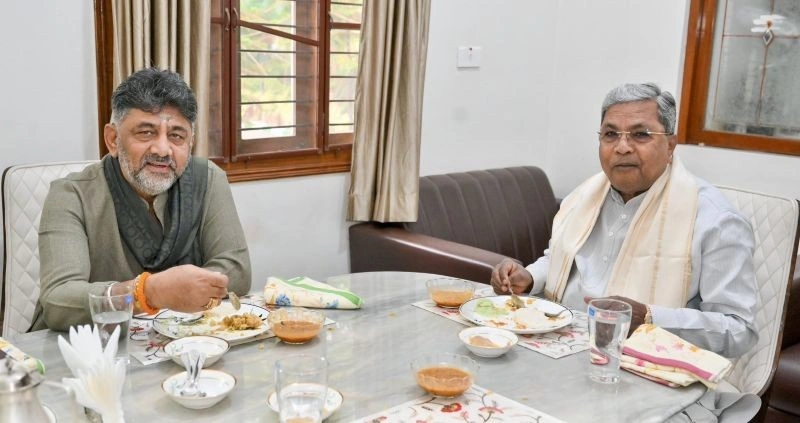
In a carefully orchestrated show of unity, Karnataka Chief Minister Siddaramaiah hosted his deputy D.K. Shivakumar for a breakfast meeting at his official residence on the morning of November 29, 2025. The meeting is widely seen as an effort to address the growing leadership tension within the Congress party over speculations surrounding a purported “rotational CM deal.”
A Breakfast to Break the Ice
The breakfast invitation followed guidance from the Congress high command, which reportedly asked both senior leaders to hold direct talks to resolve the impasse. During the meeting, both Siddaramaiah and Shivakumar maintained a composed and cordial demeanor.
In a joint press briefing after the meeting, the leaders dismissed rumours of discord, stating unequivocally that “there are no differences between us — and there will be none in the future.” Shivakumar described the meeting as “productive,” emphasizing a shared focus on Karnataka’s priorities and long-term political strategy.
What’s at Stake: Power-Sharing and Political Stability
| Key Issue | Importance |
|---|---|
| Alleged rotational CM arrangement | Speculation suggests a deal was made in 2023 for a mid-term change, with Shivakumar to succeed Siddaramaiah. This has triggered internal demands for clarity on leadership transition. |
| Internal Unity vs. Factional Tension | The perceived power struggle risked dividing the party, demoralizing cadres, and projecting instability ahead of upcoming local elections. The breakfast meet was aimed at neutralizing these threats. |
| 2028 Assembly Election Strategy | Both leaders publicly reaffirmed their commitment to a long-term agenda, projecting unity as vital for retaining power in the 2028 Assembly elections. |
While the breakfast meeting did not result in a concrete decision on leadership change, it signaled a willingness from both sides to defer to the central Congress leadership. Siddaramaiah reiterated that he would abide by any decision from the high command, and Shivakumar echoed this position.
Mixed Signals: Public Unity, Private Doubts
Despite the show of goodwill, analysts suggest the meeting served more as a symbolic gesture than a resolution. Neither leader formally conceded any position — Shivakumar did not drop his claim, while Siddaramaiah avoided promising continuity until the end of his term. With both leaders still relying on the central leadership to call the final shot, the potential for the underlying power struggle to resurface remains.
Implications for Karnataka Governance
- The breakfast truce offers temporary breathing space for governance, enabling focus on developmental and administrative priorities.
- It allows the Congress to project stability ahead of parliamentary sessions and stave off opposition attacks on internal disarray.
- Without a clear directive from the central leadership, the fragile unity underscores a latent risk of renewed factionalism.
Looking Ahead
The key factors moving forward include the stance of the Congress high command and the reactions of party MLAs and supporters of both camps. Observers will be closely watching cabinet reshuffles, public statements, and other political signals, as any sign of tension could reignite the dispute.
For now, the breakfast meeting serves as a symbol of temporary unity, but whether it translates into long-term stability for the Karnataka government remains uncertain.