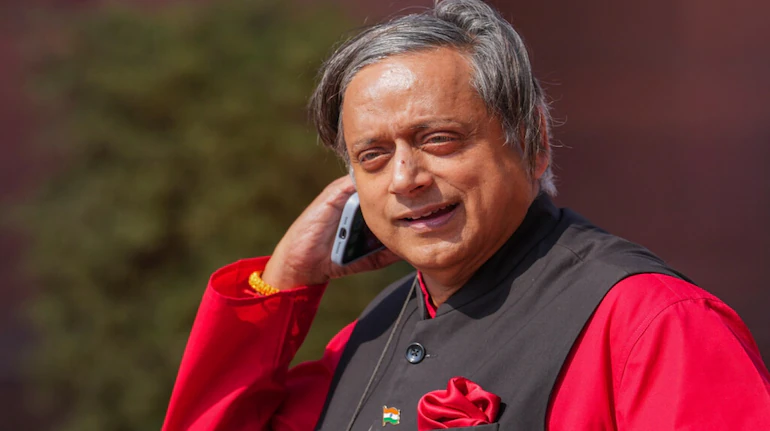
Amid rising political tension over the government’s directive to pre-install the Sanchar Saathi app on all new smartphones, Congress leader Shashi Tharoor has stated that such digital tools can indeed benefit citizens — but only when adoption remains voluntary. His remarks come at a time when privacy concerns, data-security debates, and public backlash have put the spotlight on India’s rapidly evolving digital governance landscape.
Tharoor Cautions Against Mandatory Digital Policies
Addressing the media, Tharoor explained that while he had not examined the entire policy document, he believes any technological intervention must respect democratic values. He stressed that applications designed to enhance telecom safety or prevent mobile fraud “can certainly be useful,” but compulsory installation undermines user autonomy.
Tharoor argued that democratic systems function best when choices are provided, not imposed. According to him, if the app is as beneficial as claimed, citizens should naturally be willing to install it without government enforcement. His comments reflect a broader concern shared by many political leaders and digital-rights advocates: mandatory digital tools, even when introduced with good intentions, must not compromise individual freedom and privacy.
A Policy Under Scrutiny
The Sanchar Saathi platform, developed to safeguard mobile users against fraud, duplication, and device theft, has been promoted as a major step toward enhancing telecom security. It includes features that allow users to block stolen devices, verify mobile connections issued under their identity, and identify fraudulent activity.
However, the controversy began when the Department of Telecommunications instructed smartphone manufacturers to ship all upcoming devices with the app pre-loaded. Additionally, updates were expected to push the app onto existing devices. Critics argue that this creates a precedent for embedding government-backed software into personal gadgets without explicit user approval.
The decision triggered nationwide debate, with civil-rights groups warning of potential misuse and surveillance. Several opposition leaders accused the government of overreach, stating that any measure affecting personal devices must undergo public consultation and parliamentary scrutiny.
Government Tries to Address Privacy Concerns
In response to the backlash, the Union Communications Ministry clarified that the app can be deleted or disabled by users at any time. Officials insisted that the government’s role is limited to making the tool available to enhance citizen safety, not enforcing its day-to-day use. They also reiterated that the app does not access or store personal data beyond what is necessary for its core functions.
Despite this clarification, scepticism persists. Cybersecurity experts point out that concerns are less about the app itself and more about the precedent set by mandatory installation. Many believe India needs a comprehensive data-protection policy and stronger oversight mechanisms before implementing such directives.
A Call for Transparency and Public Dialogue
Tharoor emphasized that the government should clearly explain the reasoning behind such mandates and invite public discussion before rolling out compulsory digital policies. Transparent communication, he noted, is essential for building trust in large-scale technological interventions.
His stance echoes a growing narrative within the digital-rights community: security tools are welcome, but user consent is non-negotiable.
Conclusion
The Sanchar Saathi controversy highlights a deeper challenge in India’s digital transition — balancing technological advancement with constitutional principles of freedom and privacy. As public debate intensifies, voices like Tharoor’s underscore the importance of ensuring that digital tools empower citizens rather than restrict them. Whether the government revisits its mandate or maintains its position, the issue has already sparked an essential national conversation about digital rights in the world’s largest democracy.