
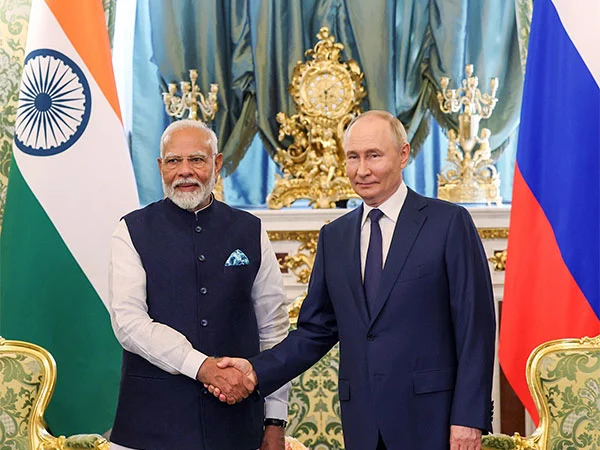
India and Russia on Thursday unveiled an expansive economic vision that aims to significantly strengthen bilateral cooperation by 2030. During a joint press interaction following high-level talks in New Delhi, Prime Minister Narendra Modi and President Vladimir Putin outlined goals to accelerate trade, expand energy ties, and fast-track negotiations for a Free Trade Agreement (FTA) between India and the Eurasian Economic Union (EAEU).
2030 Vision: A New Phase of Economic Engagement
Both leaders endorsed a long-term Economic Cooperation Programme that seeks to elevate bilateral trade to unprecedented levels by 2030. The roadmap includes plans to diversify exports, enhance industrial partnerships, and streamline investment flows across emerging and traditional sectors.
Central to this vision is the early conclusion of the India–EAEU FTA, which is expected to unlock new market access, reduce tariffs, and consolidate India’s position as a key economic partner in the Eurasian region. Officials from both countries described the FTA as a “priority instrument” for expanding trade volumes and easing regulatory frameworks.
Key Agreements Across Strategic Sectors
A series of agreements and Memoranda of Understanding were signed during the summit, reflecting the increasing breadth of cooperation. These include partnerships in fertiliser production, food safety, maritime logistics, pharmaceuticals, medical research, and port infrastructure.
One of the major highlights is a planned joint urea manufacturing project, underscoring India’s push for stable and long-term fertiliser supplies. The initiative also signals a shift toward deeper industrial collaboration beyond the conventional focus on energy and defence.
Energy Security and Transport Corridors
Energy remained a cornerstone of the discussions, with Russia reaffirming its commitment to ensuring reliable fuel supplies to India. The two sides also agreed to expand collaboration in nuclear energy, critical minerals, and clean-energy technologies.
Transport connectivity featured prominently, with renewed backing for the Chennai–Vladivostok maritime link and the International North–South Transport Corridor. These projects are expected to cut transit time, reduce logistics costs, and open new trade routes spanning South Asia, Eurasia, and Europe.
Defence, Technology and Currency Cooperation
The summit also emphasised enhanced defence cooperation, including joint ventures, co-production, and technology transfers aligned with India’s domestic manufacturing goals. Future collaboration in aerospace, shipbuilding, artificial intelligence, and space technologies was highlighted as both strategic and forward-looking.
Another important outcome was the decision to explore increased use of national currencies—the rupee and the rouble—for bilateral trade settlements. This move aligns with India and Russia’s broader attempts to build financial resilience and reduce exposure to external geopolitical risks.
Geopolitical Context and Strategic Significance
The renewed emphasis on a long-term partnership comes at a time of global volatility and shifting geopolitical alignments. For Russia, deepening ties with India reinforces its outreach to major non-Western economies. For India, strengthening its relationship with Russia fits within its broader policy of strategic multi-alignment, balancing global partnerships while protecting national interests.
Conclusion
The Modi–Putin press meet has set the stage for a more structured and ambitious phase in India–Russia relations. With a shared commitment to scaling up trade, accelerating connectivity projects, broadening technological cooperation, and advancing the FTA agenda, both nations have signalled a decisive push toward a stronger and more diversified economic partnership by 2030. The success of this roadmap will depend on sustained political will, timely execution of agreements, and continued alignment of long-term strategic priorities.

