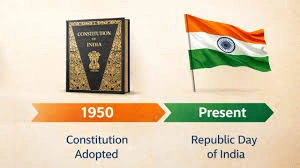
The Indian Constitution is still the greatest method to operate a democracy. It will help the country get ready for the big changes that will happen on Republic Day in 2026. This book talks about how people in India are happy and how the country is growing closer to being fair, having more power in the world, and coming up with new ideas.
A Little Bit from the Past
The Indian Constitution, which went into effect on January 26, 1950, ended colonial control and formed a country that had been very different from each other. It took Dr. B.R. Ambedkar about three years to write it. It was based on important papers from other countries, such as the U.S. Bill of Rights and the laws that govern Ireland. It also thought about how India’s economy and society are different from those in other regions of the world. This living language, which is the longest written constitution in the world, attempts to defend people’s rights while also doing what is best for everyone. Sardar Vallabhbhai Patel and Jawaharlal Nehru are two well-known figures whose thoughts helped shape it.
The preamble makes it clear that India is a democracy where everyone is free, equal, and has a say in how things are run. The rules changed for the first time in 1976, during the Emergency. They added “secular” and “socialist.” The language changed in the 1950s and the economy changed in the 1990s, but the essential notion has stayed the same. On Republic Day 2026, there will be parades along Rajpath in New Delhi that will show off the beauty of Indian culture and the strength of the military. The main purpose will be to talk about how the Constitution helped construct the country and how it promised freedom, justice, equality, and fraternity.
Key Aspects of Governance
Part III of the Constitution (Articles 12–35) lists the most significant rights, which are called Fundamental Rights. They stand up for people’s rights to free expression, free religion, and fair treatment by the government. Article 14 protects life and freedom of speech, while Article 21 does the same. Over time, the law has changed to include the right to privacy, the right to an education, and the right to a clean environment. Navtej Singh Johar v. Union of India is one of the most famous legal cases about these rights. It said that Section 377 rendered being gay illegal.
Part IV, Article 38 of the Directive Principles of State Policy specifies that the government should work for social justice by making sure that everyone gets the same amount of money and free legal counsel. You can’t take them to court, but they do have an effect on laws like the Mahatma Gandhi National Rural Employment Guarantee Act (MGNREGA), which has made millions of people in rural India feel safe at work. Digital India is one effort that uses the Constitution to bring together cities and villages for the benefit of everyone. These ideas will be even more important in 2026, when the economy is expected to grow by 7%.
Federalism is also a big part of the Constitution. The Seventh Schedule comprises three lists: Union, State, and Concurrent. These lists show how the Union and 28 states share their power. This method worked for both the GST rollout in 2016 and the COVID-19 pandemic. Article 370 was taken away in 2019. This is an example of flexible federalism because it embraced all of Jammu and Kashmir and started talks of self-rule.
Activism and changes in the law
The Constitution came to life with Articles 124 to 147. These articles made it possible for India to have its own courts. In the 1973 case Kesavananda Bharati v. State of Kerala, the Supreme Court developed the Basic Structure to keep Parliament from utilizing important ideas like democracy and secularism in the wrong way. This has stopped 99 efforts to change the Constitution, which proves that it is the most significant statute.
People can now sue for things like pollution and forced labor thanks to Public Interest Litigation (PIL). This has made it easier for everyone to achieve justice. In the case of Vishaka v. State of Rajasthan (1997), the Court set rules that rendered harassment against the law. In the end, these norms become laws. The courts will look at AI ethics, the Personal Data Protection framework based on Article 21, and the challenges that come with rising sea levels and the damage they inflict to coastal areas in 2026.
As of late 2025, there were more than 50,000 cases waiting to be heard in high courts. This displays how long people have to wait.Since the epidemic, e-courts and virtual hearings have sped up cases by 30%. Former Chief Justice D.Y. Chandrachud and other experts stress how vital the Constitution is for protecting the rights of minorities when people don’t agree.
Changes in the economy The Constitution tells us what to do.
The Constitution’s ideas about the economy are a mix of socialism and ways to make the market work better. Article 39(b)-(c) says that everyone should be able to get resources that are good for everyone. But the 1991 liberalization under P.V. Narasimha Rao was in line with this because it helped the economy grow. India has the fifth largest economy in the world, with a GDP of around $4 trillion. The Constitution’s Article 246A and other parts say that this is possible. This is the tax you pay on things you buy and use.
Article 19(1)(g) safeguards business freedoms, which will assist start more than 100,000 new firms by 2026. Both Flipkart and Byju’s are performing well as unicorns.
Make in India: Constitutional federalism lets states like Gujarat and Tamil Nadu construct groups of factories. These states have received $100 billion in foreign direct investment since 2014.
Self-reliance is like the Directive Principles, which are like semiconductor missions that aspire to make 7nm circuits by 2030.
These projects assist people get jobs. For instance, Article 41 says that 120 million farmers have the right to work, so PM-KISAN offers them money. There are still problems: The fact that 40% of the wealth is owned by the richest 1% of people goes against the fairness standard in Article 38. That’s why they want the richest people to pay taxes.
Fairness and justice in the world
According to Articles 15 and 16 of the Constitution, people should work to fix things that were wrong in the past. Job and school reservations for Scheduled Castes (SCs), Scheduled Tribes (STs), and Other Backward Classes (OBCs) have helped millions of people. For example, the percentage of SC college students went from 7% in 2000 to 14% in 2025.
The 73rd and 74th Amendments (1992) stipulated that panchayat reservations should be 33%, but presently they reach 50% in some states. This has made the sarpanchs and other leaders in Tamil Nadu more powerful.
Starting in 2018, Article 15 says that it will be against the law to treat LGBTQ+ individuals unfairly. It also lets people ask for same-sex marriage and makes conversion therapy less popular.
The Rights of Persons with Disabilities Act of 2016 added 21 more groups to Article 41.
The floats for Republic Day in 2026 will be considerably different from those in the states. According to Article 244, tribes in the Northeast will be able to join the rest of the country. Article 17’s ban on untouchability needs to be enforced more strictly because there are more than 50,000 cases of violence against Dalits every year.
Problems in the Digital Age
India is breaking the law right now by thinking about safety and technology. Article 19(2) declares that free expression is not allowed because of sovereignty. The rules for social media have shown that there is bogus news. Some people don’t like Article 20’s right to monitor in the 2023 Digital Personal Data Protection Act, which makes privacy real.
Climate change is bad for everyone and everything. Article 48A specifies that the environment must be safeguarded, however India’s NDC plans for 2030 depend on coal. Everyone has the right to vote, according to Article 326. Because of this, the ECI has found innovative ways to run elections that are less likely to be hacked. One of these is being able to vote from a distance.
Ayushman Article 47 didn’t do enough to keep people healthy during pandemics, thus Bharat serves 500 million people. Article 355 says that states must support one other when things go wrong in the world, including when there are problems with borders.
Cultural harmony despite divides
The opening sentence of the Constitution is, “India, that is Bharat,” which is a method to unite people together. There can be 22 official languages, according to the Eighth Schedule. Article 51A makes it clear how crucial it is to conserve cultural heritage. People from all throughout India, from Ladakh to Kerala, gather together for the Beating Retreat on Republic Day.
Articles 25 through 28 of the Constitution protect freedom of religion and make sure that everyone is treated the same, especially when they go to Sabarimala. During the 2026 legal case concerning the mosque and temple, the courts maintained brotherhood intact.
The Indian Constitution and how it still affects the country on Republic Day 2026