NASA’s early flights found water ice all around the solar system, from the black craters on the Moon to faraway frozen worlds. This goes against the idea that Earth is the only place where this important resource can be found. These new findings change how we think about how planets originate and make it more likely that we’ll find signs of life on other planets. As exploration picks up speed in 2026, it becomes more and more important to think about how it will effect astrobiology and space travel for people.
Where to Find Water on the Moon
NASA’s Lunar Reconnaissance Orbiter has found a lot of water ice on the Moon, even in locations that are always dark, like the south pole. These frozen materials exist in craters far away and might be used to generate drinking water, oxygen, and rocket fuel. This means that the Artemis program can set up bases on the moon.Scientists think that the ice is there due of ancient comet hits, reactions to solar wind, and moisture that is below the surface. The proposed VIPER rover, which Blue Origin will send to Mars in 2027, will map these resources exactly.
The Nobile Crater near the South Pole is a priority target because the temperatures there are so low that ice can stay there for billions of years. VIPER is a rover the size of a golf cart that has spectrometers on it. It will drill into the regolith to learn more about the ice’s distribution, origins, and how easy it is to get to. The Artemis astronauts, who are supposed to come back by the end of 2026, need this knowledge very much. They will take samples of the ice to make sure they can use it. It’s still not possible to stay on the Moon for a long period without these kinds of resources. This highlights how vital water ice is for goals in outer space.
Here is some important information regarding Moon water ice:
– Deposits are more widespread than we thought, even in craters that aren’t in the dark.
– Possible yield: Enough to protect ecosystems, give us oxygen to breathe, and power.
– Artemis integration: There are flat regions near ice on targets like Connecting Ridge where you can land.
Mars’s Old Frozen Oceans
In 2008, NASA’s Phoenix lander was the first to find water ice on Mars. There are large underground expanses of it, and Utopia Planitia alone possesses enough to fill Lake Superior. The SHARAD tool on the Mars Reconnaissance Orbiter employed ground-penetrating radar to find out that lobate debris aprons are made up of more than 80% pure ice. The rain made these aprons, and layers of debris kept them safe. These reserves, which are buried under the surface, show that Mars used to be wetter and may have had aquifers that supported microbes.
Recent research shows that glaciers used to be the most prevalent type of ice. Over time, they melted, leaving behind pure ice cores. NASA’s Perseverance rover is still searching for biosignatures in old lake beds. At the same time, data from space is making ice maps better for future crewed missions. There is only 0.03% of Mars’ original water left, but there may be enough water below the surface to support human colonies, which would make the planet livable.
The Big Sea Below Europa
Europa, one of Jupiter’s moons, has a salty ocean of liquid water that lies 40 to 100 miles deep beneath its frozen surface. This is twice as much water as all of Earth’s seas. NASA’s Europa Clipper, which will launch in October 2024, will confirm the ocean’s depth, salinity, and plumes that Hubble spotted venting water vapor into space as indication of ongoing geological activity. Astrobiologists are very interested in Europa because it has a thin atmosphere of oxygen and possible hydrothermal vents on the ocean floor.
The tidal heating from Jupiter makes Europa’s insides bigger, which stops it from freezing and might possibly provide life energy. In December 2026, Clipper will pass by Earth.This will help it reach to Jupiter faster. It will get there by 2030 and take samples of plumes without landing. This work uses information from the Galileo satellite to show magnetic disturbances that are consistent with an ocean layer that carries electricity. NASA’s Investigating Ocean Worlds project, which starts in 2026, argues that if organic molecules move across the ice, ocean, and bottom, it could suggest that a place is livable.
The water on Europa is between 60 to 150 kilometers deep, which is deeper than all of Earth’s oceans put together. It also contains plumes that let water vapor out so scientists can study the ocean directly, and a crust that is 10 to 30 kilometers thick that keeps the liquid safe from radiation.
The Moving Plumes of Enceladus
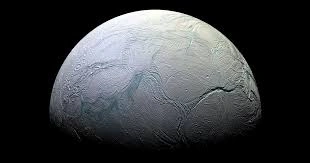
The “tiger stripes” on Saturn’s Enceladus spew water plumes up to 6,000 miles high from the south pole. Cassini took samples of these plumes and found that they were salty ocean spray that fed Saturn’s E-ring. NASA’s James Webb Space Telescope recently took photographs of these massive clouds of liquid. The pictures showed that there is a sea below the surface with hydrothermal activity and organic debris. The moon’s small wobbles reveal that the ice shell isn’t connected to the liquid water and is instead interacting with a rocky core that is full of nutrients.
Cassini fly-throughs revealed hydrogen and sodium salts, which are necessary for microbial life to survive near vents on the seafloor. ESA’s L4 mission, which is set for the 2050s, will send an orbiter and a lander to look at plumes and frozen ejecta on the surface. Recent studies have shown that geysers on small icy moons like Enceladus are driven by seas boiling and changes in pressure and temperature. NASA studies suggested that evidence of life might stay near the surface if they were safe.
Highlights of the Enceladus plume:
– 20 times the width of the moon is the height.
– The composition includes saltwater, organic materials, and possibly hydrothermal chemicals.
– Future access: The lander will be able to operate for two to four weeks following the launch in the 2040s.
More Cosmic Richness
Water ice can be found all around the solar system, from the mantle of Ceres to the clouds of vapor that surround exoplanets like HAT-P-11b. NASA’s Dawn mission suggested that asteroids with a lot of water could bring water to the inner planets. Kepler detected places that could support life and contained liquid water. Webb also discovers crystalline ice in disks around young stars. These stars are older than planets and came from the same place. Cloud experiments on Venus even demonstrate that ionic liquids can be utilized instead of water for life.
These observations make it more likely that life exists: ocean worlds like Europa and Enceladus may have their own biospheres, and plumes might be utilized as non-invasive probes. The Ocean Worlds project of NASA employs oceanography, modeling, and fieldwork to learn how organic matter moves from the ocean floor to space.
Making people think differently about life
Earth isn’t as special because water is so plentiful. This makes it more likely that there is life on other worlds because of liquid water, chemistry, and energy. Hydrothermal systems are like the places on Earth where germs initially showed up. Plumes go over thick ice, which makes it easier to look for biosignatures from a distance without having to drill.
But there are still problems: radiation breaks down biological molecules on the surface, and missions can only look at plumes or depths.The InvOW project in 2026 makes it easier to find things when the Europa Clipper flies by.
Missions in the Future and Human Frontiers
Artemis plans to send people back to the moon in 2026, close to ice craters, and use VIPER data to build fuel depots. In 2030, the Europa Clipper will arrive and assess if the moon can support life. In decades, landers will follow. It wouldn’t cost much for private corporations like SpaceX Starship to move water towers.
These projects make it possible for economies to exist on more than one Earth, employing water as currency for transportation and survival. Now Webb’s searches for exoplanets include trillions of ocean worlds.
NASA’s probes make science fiction a reality in a wet cosmos where there is water outside of Earth. As the expeditions continue, we move closer to showing that we’re not alone, with moon ice powering the trek. New discoveries will change how we live and make us desire to study more in 2026.
NASA missions have identified ice on the Moon, Mars, Europa, and Enceladus, which makes people think there might be life on other planets.