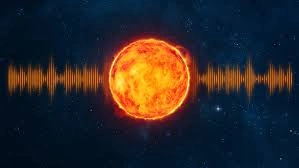
NASA’s amazing discovery of pressure waves that changed into audible frequencies call into doubt the long-held idea that space is a silent vacuum. They show that there are vibrations that can be felt in many parts of the universe.
The Myth of Silent Space
Sound waves need something to go through, like air. Space is empty, so sound waves can’t travel through it. But this makes the universe’s sound potential appear too easy. NASA’s tools can detect things like plasma waves and changes in pressure in thin gases. Then, using sonification, which is the process of translating data into sounds, they make these things sound. These “sounds of space” include weird whistles, chirps, and hums that suggest that vibrations are happening places you wouldn’t expect them to.
NASA’s Sonification Breakthroughs
NASA used sonification to make secret cosmic data public by translating electromagnetic fluctuations and pressure waves into sounds that people can hear. It all started with missions like the Van Allen Probes, which turned plasma waves—electromagnetic disturbances in charged particles—into tones that people could hear. The Chandra X-ray Observatory has been working on turning repeated X-ray observations into musical notes that span years of sky scanning. This strategy not only helps with analysis, but it also grabs the public’s imagination by converting raw data into cosmic symphonies.
Here are some notable examples that prove how smart NASA is:
– When electrons move across magnetic fields, they make chorus waves, which sound like birds chirping.
– Whistler waves are sounds that go lower when lightning strikes move through space.
– Plasma oscillations: Voyager’s sounds from space that tell us how dense the gas is outside of the heliosphere.
Plasma Waves Near Earth
NASA’s Van Allen Probes were sent to research radiation belts, but they can also pick up on what’s going on in Earth’s magnetosphere. Plasma waves change electric and magnetic fields, and the instruments pick up these changes. Plasma waves disseminate high-energy electrons. Chorus waves, which rise and fall like a choir at dawn, accelerate up particles to practically the speed of light. This causes auroras and puts satellites in danger. Researchers were astonished by a recent discovery that used information from a number of satellites. These chirps, which generally appear at high altitudes, were spotted much farther away in magnetic fields that weren’t straight.
This makes the range of chorus waves more than what was thought feasible. It also suggests that they form when electrons interact in places where there aren’t many other particles. Proton whistlers add lower levels that originate from lightning-proton dances. The effects are huge: better models of the radiation belt protect pricey satellites from damaging electrons.
From Afar: Cosmic Symphonies
Pressure waves work well in regions outside of Earth where there is a lot of gas. Chandra discovered waves in hot gas between galaxies that were created by black holes in the Perseus galaxy cluster, which is very far away. When you turn them up by a lot of octaves, they emit a scary groan. This is real sound waves passing through plasma that is a million degrees. Voyager’s interstellar plasma detections created sounds that went from lower heliospheric pitches to higher interstellar pitches. These sounds told us how thick the gas was in the distance.
Multi-wavelength sonifications reveal data layers: radio lows, visible mids, and X-ray highs. Brightness controls loudness. It sounds like marimbas when black holes are in faraway systems, and like purring when gas layers are there. These exhibit patterns that you can’t perceive with the human eye, such as jets, shocks, and mergers.
The noises are achievable because of amazing technology.
The Van Allen Probes and other instruments use electric antennas and magnetometers to pick up very weak signals in very strong radiation. A number of satellites transmit back high-resolution chorus data that shows energy traveling through empty gaps. Voyager’s plasma wave subsystem can sense changes in electron density without any real sound. Sonification algorithms assign pitches according on position, brightness, and wavelength. They could utilize strings that are invisible to the naked eye or bells that are visible. Recent catalog sonifications use time repetitions to make the harmonies deeper.
NASA’s open science projects make this available to everyone: tiered tracks look at data layers. Ethical sonification doesn’t employ shock value; it puts science before spectacle.
Consequences for Science and Practice
These detections impact how we guess what the weather will be like in space. Chorus waves charge belts during storms, which swiftly speeds up relativistic electrons. We can create models of planetary magnetospheres by understanding distant chirps. The presence of analogous whistlers at Jupiter indicates that this is a worldwide occurrence. Interstellar plasma maps focus at boundary shocks.
In actual life, vibrations can damage technology. For example, electrons can make currents that damage electrical grids and communications. But they do assist keep astronauts safe and guess when auroras may happen. Sonification speeds up discoveries since experts can uncover patterns in sound and graphics.
Some more general ideas: Plasma waves show how the universe has changed throughout time, from gas clouds to atmospheres on exoplanets. They illustrate how full of life space is, which is the reverse of how empty it is in a vacuum.
Echoes of the Universe in the Future
Sonification grows better when additional probes go into space. It is possible that AI could translate live signals in real time. You should hear choral waves from distant planets and black hole choirs from clusters. The expected solar maximum makes waves near Earth stronger, which is helpful for study.
Astronomy is entering a new era with pressure waves, where sound discloses things that sight overlooks. Space is quiet, but the universe is full with secrets.
Space Is Not Completely Silent: NASA’s Pressure Waves Reveal Cosmic Vibrations