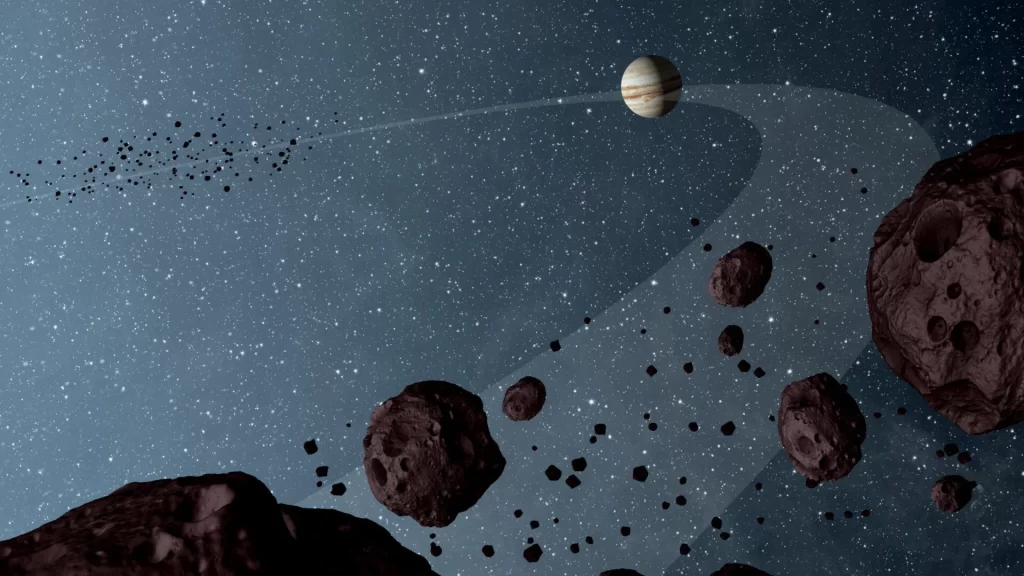
The biggest planet in our solar system is Jupiter. Its gravitational field works like a shield in space, stopping asteroids that could hit Earth from getting too close and changing their courses. Recent NASA research show how this protective mechanism works by combining old concepts about how to keep planets safe with fresh information.
The Strongest Pull of Gravity on Jupiter
The asteroid belt between Mars and Jupiter stays stable because Jupiter is so big—more than double the mass of all the other planets put together. There are millions of rocky bodies in this belt, and if they hit the inner planets, they may cause a lot of harm. NASA’s models reveal that Jupiter’s gravity keeps most items from moving inward, which maintains the orbits stable.
The planet’s gravity even attracts comets from the Oort Cloud, which is a long way away. Because of this, a few of them left the solar system. If we don’t obtain this help, crashes with Earth might happen a lot more often, maybe every million years instead of every billion years.
Some people call Jupiter the “cosmic vacuum cleaner” because it draws everything in 2,000 to 8,000 times quicker than Earth does. This action slows down everything that is coming toward Earth.
NASA is performing research to show that the story about the shield is not true.
NASA’s ongoing missions, including Juno’s orbit around Jupiter since 2016, help scientists figure out the paths of asteroids by giving them information on the planet’s atmosphere and gravity field. These studies reveal that Jupiter does protect itself from threats, but they also make simple “shield” stories less believable.
Our simulations showed that Jupiter and Saturn work together to change the paths of some particles so that they don’t hit Earth. This could make it more likely that short-lived comets will hit Earth. But Jupiter’s overall influence on asteroids, which are the main NEO problem, is good since it gets rid of unstable resonances in the belt.
NASA is trying to keep asteroids and other junk in orbit from reaching Earth. One way scientists try to figure this out is by looking at Jupiter to see how likely it is that something will hit it in 2025.Simulations show that a planet with the same mass as Jupiter makes it easier for worlds to exist by stopping too many impacts.
Mean-motion resonances help Jupiter maintain around 90% of the asteroids in the belt from moving.
It either fires out or catches about 95% of long-period comets before they reach too close to the inner solar system.
Models of comets reveal that they can hit Jupiter 8,000 times more often than they can hit Earth.
NASA argues that Jupiter has two jobs, yet these facts show that it is completely safe.
Historical Evidence of Protection: When Comet Shoemaker-Levy 9 hit Jupiter in 1994, it broke up in the atmosphere, which kept Earth unharmed. People saw wounds that were bigger than the Earth and sucked in energy equal to millions of megatons.
Paleontological data suggests that there were fewer collisions on the inner planets approximately 4 billion years ago, during Earth’s Late Heavy Bombardment, than scientists had thought. The gas titans shoved things out of the way. The solar system changed when Jupiter shifted, which made it easier for stable orbits to form on Earth.
Asteroid 2024 YR4, which is around 60 meters wide, almost hit us not too long ago, so we need to be on our toes. NASA’s infrared telescopes keep an eye on these kinds of things and think about how Jupiter’s gravity affects them. They don’t believe anything will happen when the orbits change in 2032.
Are you a troublemaker or a guardian? The Act of Balancing
Some people believe that a smaller Jupiter, possibly one-fifth the size of Jupiter, might hit Earth more often. But a full-sized Jupiter might not hit Earth as often. If we got rid of Jupiter, there might be fewer asteroid crashes, but there might be more comet strikes.
But most people think that the best thing to do is to protect: If Jupiter weren’t there, the asteroid belt would drag in debris. This doesn’t happen because of Jupiter. Without it, the inner planets would have two to three times as many problems.
NASA’s 2026 models make this vision better as the Europa Clipper mission continues on: The quadrupole gravity of Jupiter doesn’t change much, which makes it easy to plan missions like DART, which showed kinetic deflection in 2022.
More Effects on Life and Keeping the Earth Safe
Jupiter’s shield helped life begin by sending unstable ingredients to Earth and stopping sterilizing hits. The Grand Tack model of the early solar system describes how Jupiter left and returned to the solar system, bringing water-rich bodies to Earth.
NASA uses data from Jupiter to find 90% of “city-killer” asteroids that are wider than 140 meters. The NEO Surveyor will get into orbit in 2026. Jovian gravity makes it harder for more than 25,000 recorded near-Earth objects to get to us.
“Hot Jupiters” render the inner worlds unstable in other systems, but not in our system. There is a safe distance of around 5 AU between Jupiter and the Sun.
Future missions, such as Europa Clipper, which will launch in 2024, will look at oceans that are below the surface. These missions could show a link between the migration of large planets and the chance of surviving on them.
New threats and strategies to stay safe in the future
People use technology to help Jupiter deal with space traffic more effectively. For example, DART’s accomplishment changed Dimorphos’ orbit by 32 minutes, which proves that deflection is possible. NASA’s goal for 2025–2030 is to use ion beams and gravity tractors to protect us from hazards that originate from Jupiter.
We need to be powerful on Earth and in space because climate change makes us weaker and increasing sea levels could make things worse along the shore. The UN’s space committee works with other countries to keep an eye on things.
There are more than 1,200 near-Earth objects that are greater than 1 km that could be dangerous. Every year, Jupiter sends hundreds of them off track.
Every year, there are around 500 small airbursts on Earth and Jupiter.
Warnings from Jovian models are 99% right a year or more ahead of time.
The end: Thanks, Gas Giant
NASA studies have proven that Jupiter’s strong gravity has kept Earth safe for 4.5 billion years by pushing asteroids away and dragging comets in. This guardian of the planet keeps life going, but it may be hard, especially when things go wrong.
As missions like NEO Surveyor proceed forward in 2026–2027, people will use what they learned from Jupiter to make our defenses stronger. The gas giant in the vast universe reminds us that safety can come from places we don’t expect it to. That’s what keeps our blue planet alive.
NASA’s research shows that Jupiter acts like a cosmic shield to safeguard Earth from asteroids.