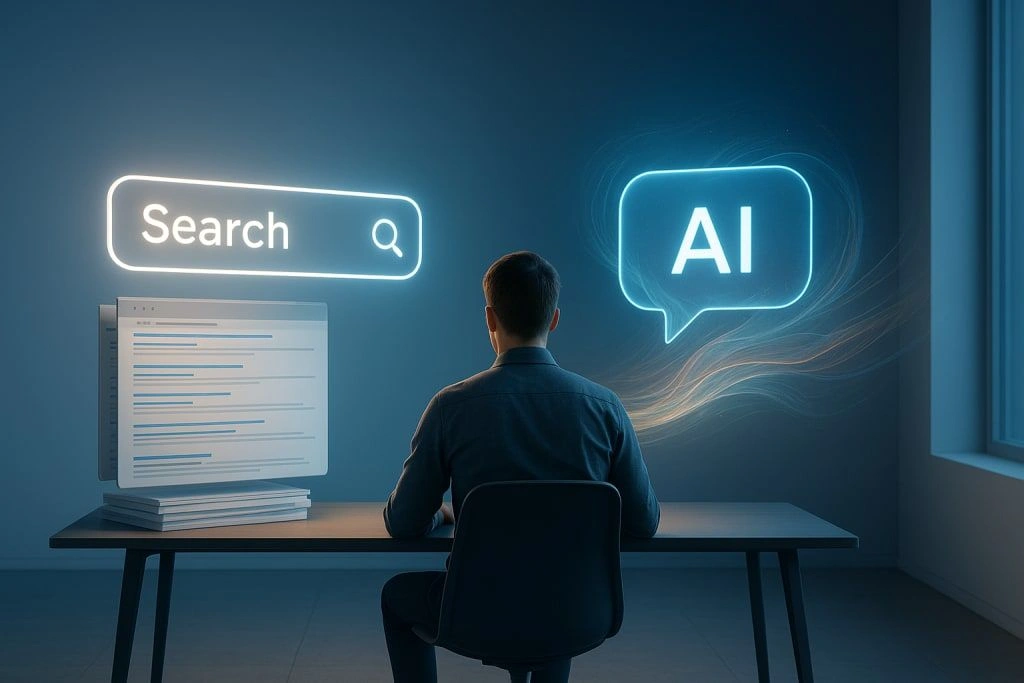
AI is changing the digital world by giving direct, synthesized answers instead of lists of links. This might make Google and other search engines less useful. People are anxious about how this change may influence locating things on the web, as well as traffic and accuracy.
The Growth of AI-Driven Search Engines
Keyword matching and page rankings have been utilized for a long time in normal internet searches. AI can do things like make conversational interfaces that know what you’re saying and why. Perplexity AI and ChatGPT are two tools that can now swiftly solve hard problems by getting information from a lot of different places.
In 2026, more than half of customers will use AI search engines on purpose. About 90% of the market is controlled by Google. Perplexity is an AI native with 30 million active users that ask 780 million questions every month. This is 66% greater than the year before.
People don’t appreciate search results that are full with ads and make them scroll for a long period, hence this change is happening. AI chatbots give “answer-first” experiences, which can cut the time it takes to investigate complex topics by as much as 30%.
Key Players Changing the Market
This change is feasible because of a number of AI technologies, each of which has its own merits. Perplexity AI looks for responses that come from sources and include citations. It’s great for doing in-depth research, answering questions in less than two seconds, and giving more than five references for each response, all without adverts for a clean interface.
ChatGPT Search lets you talk for longer, and it will remember what you said between searches. It sent 1.13 billion referral visits in the middle of 2025, which is 357% more than the year before.
Google AI Overviews and AI Mode give brief descriptions of regular search results. More than half of the inquiries show them, and they have tools like Deep Search that look through hundreds of questions to find answers that have already been given.
Some, like Copilot and Gemini, can take in a lot of various types of information and work with other apps, which is useful for people who work.
All of these platforms work together to destroy the previous search monopoly by putting relevance ahead of volume.
How AI makes things better
AI is better at answering tough questions that require more than one step than ordinary search engines. People like chatbots for searches that don’t need a lot of links, like “places in Chicago to hold events with river views and vegan options.”
According to surveys, 62% of consumers use AI chatbots every day, and 72% utilize Google’s AI Overviews when they are accessible. Chatbots are better at finding information since they can come up with answers, repair mistakes, and guess what queries will come next.
No advertisements and private interfaces make things more enticing. People trust Perplexity’s open sources more than results that are packed with SEO. For more complicated situations, response times are often less than 2 seconds. That’s quicker than how long it takes for sites on Google to load.
But the precision isn’t always the same. Perplexity says that 92% of the time, the sites it links to are reputable ones. There is a 15% possibility, on the other hand, that Google summaries are wrong.
What it means for people who work for publishers and those who visit websites
The fact that fewer people are clicking shows that the silent replacement is working. AI Overviews lowered CTR from 34% to 70% for the greatest results. Fashion, travel, and education sites, which are all pages that teach you something, lose the most traffic—up to 70%.
Chegg and other companies lost 49% of their traffic from customers who didn’t sign up, which led to litigation against Google. Pages that are featured get more visitors, but pages that aren’t featured lose a lot of visitors. Organic visits usually vary when people get solutions without clicking.
To make it easier for AI to find their work, publishers need to pay attention to citations and confirmation of competence. This is because AI referral traffic converts 14.2% more often, even though it doesn’t happen very often.
Gartner thinks that by 2026, the average number of searches will go down by 25% because chatbots turn a lot of questions into discussions.
The Age of AI and the Rise of SEO SEO has changed from focusing on keywords to making AI easier to locate. AI now utilizes “source-worthiness” as a new standard for content that it thinks is trustworthy. It takes the place of old ways, including making links.
When marketers declare they want to sell something, they employ words that don’t imply anything. B2B, on the other hand, is all about agentic AI that gives ideas based on cues like “buyer’s guide for [product].”
Use Perplexity to study in depth. Google can help you shop and find things in your area. These are hybrid methods that are getting more and more common. AI is growing faster than Google searches, even if Google searches dropped by 22% in 2024.
Half of individuals think that AI will completely replace search engines, while the other half think that people would use them more.
Problems and Criticism
AI’s ascension isn’t going well. People don’t trust Google as much because hallucinations happen all the time and Google’s summaries occasionally make up facts. The user needs to check AI’s synthesis, but a regular search will provide you links that you can use to check.
Bias in the training data changes the outcomes, and smaller AI systems can’t keep up with real-time or expert coverage. Publishers are quite unhappy about losing money because 35% to 50% of all inquiries don’t get any hits.
People want sources that are clear, and the government is paying more attention to how data is used and abused.
How AI is slowly taking the place of regular online searches