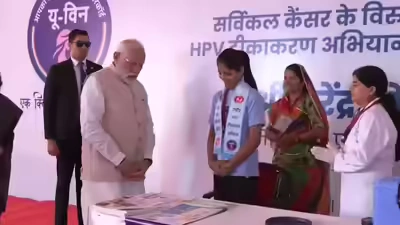
In New Delhi on February 28, 2026 Today, Prime Minister Narendra Modi will kick off the National HPV Vaccination Drive in Ajmer, Rajasthan. This is a huge step toward getting rid of one of the most common causes of death for women in India. This massive public health project will give free HPV vaccines to more than 20 million girls between the ages of 9 and 14. It will focus on the HPV strains that cause practically all occurrences of cervical cancer in the world. This effort is a huge step forward in India’s fight against cervical cancer. Parents all around the country are trying to figure out who can get free HPV vaccines and how safe they are. It brings together the latest science with easy access for everyone.
This announcement emphasizes how important preventive health care is to the government. By 2030, they intend to provide shots to 21.2 million teenage girls. India has the highest number of cervical cancer deaths in the world, with more than 75,000 deaths each year. This initiative comes at a very important time because health experts throughout the world say it might lower the number of cases by up to 90% in immunized groups.
The Importance of the National HPV Vaccination Campaign
Cervical cancer is still a hidden pandemic in India, and it hits women in rural and low-income areas the worst since they don’t have as much access to screening and early detection. The condition is most common in people between the ages of 30 and 50, and it is mostly caused by long-term HPV infection. Getting vaccinated can help prevent you from it. PM Modi’s push for HPV vaccinations is the product of years of work that have made India a world leader in large-scale immunization efforts.
Health Minister J.P. Nadda talked about the breadth of the campaign and how it fits with the World Health Organization’s (WHO) objective of 90% HPV vaccination coverage by 2030 to get rid of cervical cancer as a public health threat. “This is more than just a vaccination program; it’s a revolution in women’s health,” Nadda added. He talked a lot about how the free HPV vaccines will help make India’s healthcare system more fair.
The outbreak has made people more aware, which is one of the key reasons for this urgency. A 2025 study in The Lancet indicated that India is responsible for 18% of all cervical cancer deaths in the world. There could be 600,000 more instances by 2040 if nothing is done. The national HPV vaccination effort fights this by focusing on girls who go to school. This is possible since India’s strong immunization system already offers routine shots to 90% of kids.
Who Can Get Free HPV Shots and How They Work
Parents are most worried about whether their kids can get free HPV shots. The program is for females between the ages of 9 and 14, especially those in grades 5 through 10, even if they have never been exposed to HPV before. This age range is excellent because HPV vaccines function best before a person has sex for the first time, which is when the risk of getting the virus usually starts.
Main Requirements for Being Eligible:
Girls between the ages of 9 and 14 (up to 14.3 years in some test periods, and then all of the country).
Girls who are a little older and live in high-risk areas can obtain catch-up doses even if they haven’t had vaccines before.
Everyone is welcome, but kids from government schools and poor neighborhoods will receive first pick.
The deployment begins in Ajmer, where PM Modi gives out the first medicines at a large immunization site. across the next three months, 41.58 crore pills would be bought and given out through 1.6 lakh outreach events across 700 districts. Cities like Mumbai and Delhi will do the same. Rural areas will get mobile units with cold-chain logistics to keep the vaccinations strong.
Parents can enroll up for the program through the Ayushman Bharat Health Account (ABHA) app or by attending to Anganwadi centers or primary health clinics (PHCs). It’s easy to get in because you only need an Aadhaar card or birth certificate. School-based camps are easier for working parents because they send reminders through SMS and the U-WIN site.
Safety standards are strict: Girls under 15 will get the vaccine in two doses, six months apart. The vaccinations will be WHO-prequalified quadrivalent or nonavalent formulations, such as Gardasil or Cervavac. The last one is India’s own vaccine, which came out in 2022.
Answering Parents’ Questions About the Safety of the HPV Vaccine Head-On: Every parent should be most concerned about the safety of free HPV shots. A lot of research throughout the years backs up the vaccines’ good safety record. The World Health Organization (WHO), the US Food and Drug Administration (FDA), and India’s Central Drugs Standard Control Organization (CDSCO) all concur that HPV vaccines are safe. More than 120,000 people around the world have tried them, and less than 1 in 10,000 doses cause problems.
The bad effects that happen most often are the same as those of normal vaccines:
Mild pain or redness at the injection site (80% of the time, it goes away in 48 hours).
Less than 10% of people get a low-grade fever or feel weary.
Anaphylaxis is quite rare (1 in 1 million), and qualified ASHA staff take care of it on the spot.
The Serum Institute of India did its own Cervavac tests in India and discovered that 97% of the 2,200 teens who took part had a seroconversion and no serious negative effects. Long-term trials that span 15 years show no correlations to infertility, autoimmune diseases, or long-term health problems. These are misconceptions that have been promoted by incorrect information, yet research that has been peer-reviewed and published in journals like The New England Journal of Medicine has shown them to be inaccurate.
Dr. Soumya Swaminathan, who used to be the WHO’s Chief Scientist, is one of several specialists who support the project. She explains, “HPV vaccines are some of the safest vaccines ever made. They not only protect against cervical cancer, but also anal, oropharyngeal, and genital warts.”” Cervavac is made in India, which costs ₹200 per dose instead of ₹2,000 for imports. This provides Indian parents who are apprehensive about “foreign” vaccines peace of mind.
To urge people to stop being apprehensive, the government is initiating a multimedia campaign with Bollywood stars and local influencers, as well as community myth-busting events. Early trials in Rajasthan and Gujarat had an 85% acceptance rate, which suggests that education makes people follow the rules.
Stopping cervical cancer and other things that are bigger
The PM Modi HPV vaccination campaign accomplishes a lot more than only stop cervical cancer. These shots protect against HPV types 16 and 18, which are responsible for 70% of oropharyngeal cancers and a lot of anal cancers. They also impact men more than women because of herd immunity.
The initiative will save a lot of money. The National Health Mission says that treating advanced cervical cancer costs India ₹1.5 lakh per patient each year. By 2035, stopping the disease will save the country ₹50,000 crore in medical costs. It provides girls more control over their futures, reduces the percentage of girls who drop out of school because of health problems, and promotes equality between the sexes.
India’s move gives hope to people all over the world. The GAVI Alliance’s goals of justice are helped by the fact that the world’s most populated country is giving away free HPV vaccines. This could lower the number of cervical cancer cases in South Asia by half.
There are still concerns, though. In some parts of the Northeast, infrastructure is lacking, and social media is making individuals less willing to get vaccinated. But the COVID-19 campaign worked, and now India has what it needs to grow.
Voices from the Ground: Stories of Hope and Willpower
Priya Sharma, 14, lives in Ajmer and is delighted to get her dose. “My mom passed away from cervical cancer last year.””This vaccine gives me a chance she never had,” she says. Meena Devi, a health worker who provides hundreds of immunizations every week, says, “Parents ask about side effects, but seeing healthy girls grow up makes them stop worrying.”
Dr. Ravi Mehrotra, an epidemiologist at ICMR, says that data is very important. For example, among vaccinated groups like Australia’s, cervical pre-cancers reduced by 50% in less than ten years. If India keeps up the coverage, it can accomplish this again.
PM Modi Starts National HPV Vaccination Drive: Girls 9 to 14 Can Get Free HPV Vaccines to Help Prevent Cervical Cancer