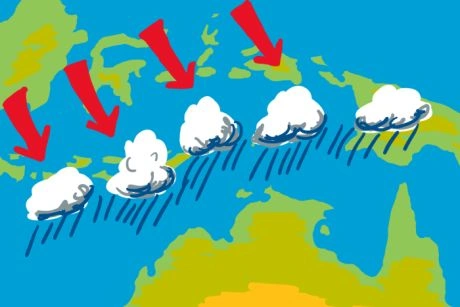
Meteorologists all over the world are saying the same thing about Monsoon 2026: there will be a lot of rain, maybe 5–10% more than usual. The IMD’s first report, together with data from global models like the European Centre for Medium-Range Weather Forecasts (ECMWF) and the United States’ Climate Prediction Center, suggests that La Niña conditions will be good. This is a really significant moment since monsoons have been acting abnormally in the past few years, making floods and droughts worse. The Monsoon 2026 projection is good news for a country where 600 million people depend on farming that needs rain, but it also highlights how crucial it is to be ready for bad weather.
Changing climate factors that change the weather forecast
The Monsoon 2026 forecasts are based on patterns in the weather around the world. La Niña is projected to show up around the middle of 2026. This will cool the Pacific Ocean’s waters and normally make the Indian monsoon stronger by bringing in moist winds from the Arabian Sea. Mrutyunjay Mohapatra, the Director General of IMD, stated in a recent update that ensemble models show a 70% possibility of this shift, which would reverse the El Niño impacts that rendered rains weaker in the past.
People are even more hopeful because of how the Indian Ocean Dipole (IOD) works. A positive IOD, which is expected to happen, would raise the sea surface temperatures in the western Indian Ocean, sending more vapor to the subcontinent. These things, together with a possibly weaker Madden-Julian Oscillation (MJO), suggest that the monsoon would move steadily from Kerala’s commencement in early June to the foothills of the Himalayas by July.
But climatic change induced by people makes things less stable. As temperatures rise around the world, which are now 1.2°C above pre-industrial levels, the Clausius-Clapeyron relations say that the amount of moisture in the air goes up by 7% for every degree Celsius. In locations where it rains a lot, this might entail torrential rain, which would make cities like Mumbai and Chennai more likely to flood.
Winners and Losers by Region
The Monsoon 2026 forecast says that a variety of various things would happen in India’s diverse agro-climatic zones. Punjab, Haryana, and Rajasthan are all in northwest India. This area is anticipated to experience 110–115% of the long-period average (LPA) rainfall. This would help a lot with the kharif changes from wheat to rice in this critical food security area that had 20% less grain in 2024. Central India, which includes Madhya Pradesh and Maharashtra, is anticipating 105–110% of the long-term average (LPA). This might bring to record soybean and cotton yields if the rains are spread out evenly. In the past, production has gone up by 15% for every 10% more rain.
In the Northeast and East, like Assam, Bihar, and West Bengal, above-normal rains of 115 to 120% LPA make people worry about flash floods, like in 2025 when 1.5 million people had to abandon their homes. Early warning systems will be highly crucial in these weak areas. The South Peninsula, which includes Karnataka and Tamil Nadu, is expecting normal to above-average rainfall of 100–110% LPA. This would be good for coffee farms and delta areas, but cyclones in the Bay of Bengal might disrupt things in ways that are impossible to predict.
Heavy rains that come out of nowhere can flood cities like Delhi-NCR. These floods are made worse by heatwaves that came before them. The IMD wants to make these sub-divisional forecasts better by May by employing high-resolution models like GFS and UKMO.
How it affects farmers and the future of food security
The Monsoon 2026 forecast would be quite excellent for farming, which employs 42% of people in India. Rains that occur at the correct time are very important for kharif crops like rice, legumes, maize, and sugarcane, which cover 110 million hectares. A monsoon that is 10% above average usually adds 8 to 12 million tonnes to production to keep prices and exports consistent.
Rice is India’s most important crop, and its production might reach 45 million hectares, with yields of 2.7 tonnes per hectare in the irrigated Gangetic plains. In 2025, pulses and oilseeds, which obtain 60–70% of their water from rain, might be able to recover from shortages. This might save more than $10 billion a year on imports. The government says that short-duration, flood-tolerant kinds like DRR Dhan 44 can help rice become more resilient.
There are still challenges, like too much rain early on that makes it hard to plant seeds or dry spells in the middle of the season that make it hard for areas like Vidarbha that rely on rain. The Agriculture Ministry has two backup plans: micro-irrigation subsidies and crop insurance through PMFBY. They helped 5 crore farmers last year.
How the economy affects other areas
RBI models that connect rainfall to rural demand predict that a strong Monsoon in 2026 might boost GDP growth by 0.5% to 1%. Wholesale prices may rise by 4–5%, which would help keep food costs from going up too quickly, as they did in 2025 when they hit 9%. High farm incomes, which effect 60% of cash flows, help rural consumption, which makes up 45% of GDP.
During severe monsoons, when reservoirs are full and industries are functioning, hydropower generation, which accounts up 12% of capacity, could go up by four times. Textiles and fast-moving consumer goods (FMCG) are expected to grow because of strong rural markets. However, extended rains could raise transportation costs by 10–15% since rail networks could get inundated.
Investors are getting more hopeful. After the projection came out, stocks that are linked to the monsoon, including Mahindra & Mahindra and ITC, went up by 5% to 8%. As more individuals find work on farms, this extra money may mean that less money is spent on programs like MGNREGA.
How ready are the water resources and infrastructure?
The monsoon season in 2026 will bring substantial rainfall that would fill around 5,000 large reservoirs. This is essential because their capacity plummeted to 20% in 2025. The Ganga and Godavari, two of the greatest rivers, might surge 20 to 30 percent above usual. This would assist water 40 percent of the area that is cultivated. Steady inflows will help projects like the Ken-Betwa river link, which started in 2025.
Cities are making their defenses stronger. For instance, following the 1,000 mm flood in 2024, Mumbai’s BMC put aside ₹2,000 crore to clear the sewers. Smart city projects in Bengaluru and Hyderabad use AI flood prediction models that send out alerts 48 hours before a flood.
NDMA’s measures for disasters include 1,500 early warning stations and drones that keep an eye on things. Using new high-performance computers, the National Monsoon Mission increases IMD’s nowcasting to a resolution of 1 km.
Things to think about for your health and the environment
The strong rains of the 2026 monsoon season make vector-borne infections more likely. After the floods, the number of dengue and malaria cases went up by 30% to 50%. This led to massive fumigation under the Urban Malaria Scheme, which attempts to cover the whole area.
Heavy rain makes erosion happen faster in the Western Ghats, which puts 20% of biodiversity hotspots at danger. Check dams and agroforestry are two techniques to hold on to 15–20% more water. The System of Rice Intensification (SRI) is a sensible way to deal with climate change that cuts methane emissions by 30% and raises yields at the same time.
Plans from the government and advice from experts
Union Minister Ashwini Vaishnaw talked about “proactive monsoon management” in Parliament and said that ₹50,000 crore would be spent on building infrastructure in rural regions. Starting in April, the INSAT-3DR satellite will give IMD’s weekly extended-range predictions more data.
M. Rajeevan, a former secretary of the Ministry of Earth Sciences, says, “La Niña helps with overall rain, but climate change makes extremes worse—district-specific strategies are necessary.” The 1,200 community wells in Gujarat are an example of a success that can be imitated.
What the Most Recent Global Weather Forecasts Mean for India in Monsoon 2026