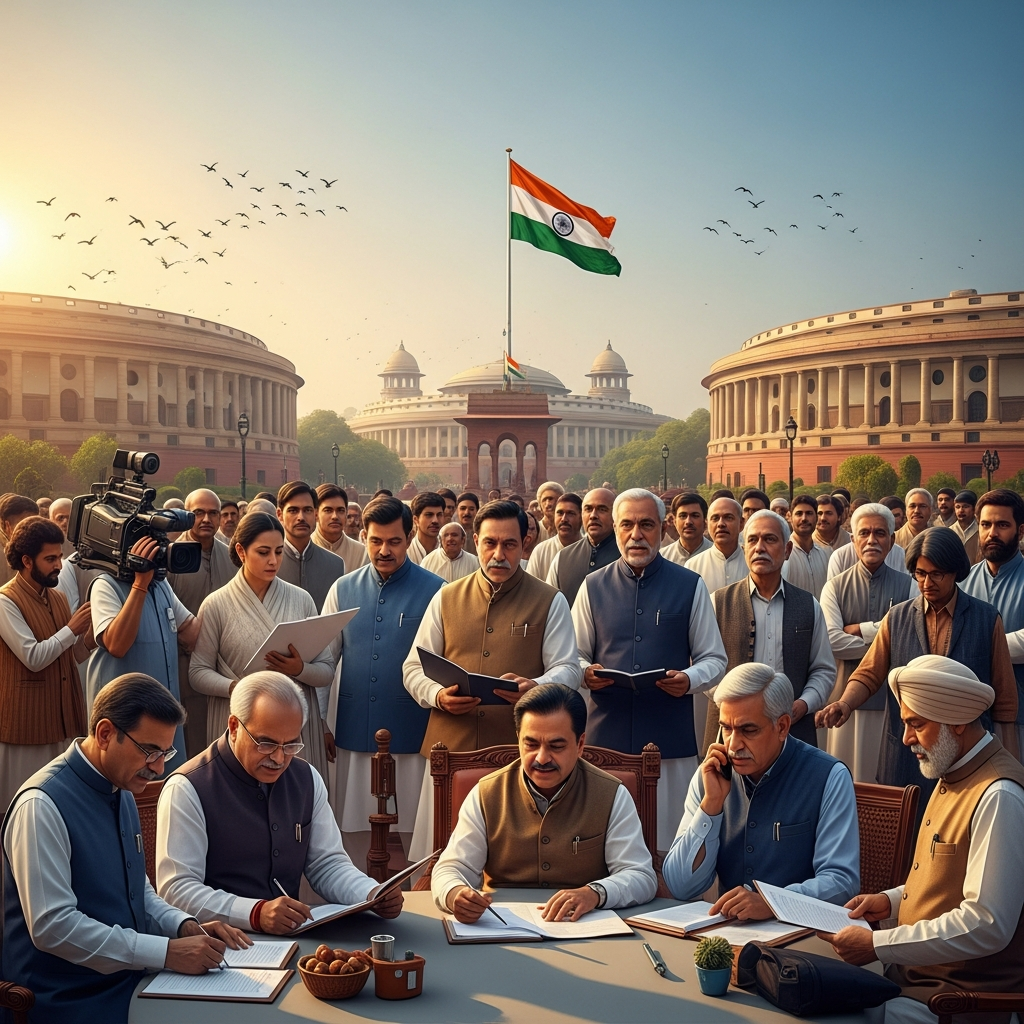
New Delhi is busy, and it’s not just because it’s hot. There is a lot of ambition, argument, and high-stakes policymaking going on in the halls of Parliament that could affect India’s future for years to come.
When India’s Budget Session starts each year, there is a certain excitement in the air around Sansad Marg. Reporters are gathered outside North Block. Economists carefully read every word that comes from the Finance Ministry. Industry groups make their wish lists more specific. In the middle of all the political theater and policy substance, a country with 1.4 billion people is waiting to see which way its government will go.
This year, it seems like the stakes are higher than usual. Prime Minister Narendra Modi called the 2026 India parliament session the “first Budget of the second quarter of the 21st century.” It’s not just another yearly event. And the policy choices made by the Indian government in those famous rooms will have effects that go far beyond the fiscal year.
The Meeting That Sets the Mood
The Budget Session of Parliament, which started on January 28, 2026, will take place in two parts over 65 days and 30 sittings. The first phase lasted until February 13. After that, the session was put on hold so that parliamentary committees could look at the ministry-wise Demands for Grants. The House then met again for the second phase, which lasted from March 9 to April 2, 2026. That two-phase structure is important. It’s not just easier for the government to do its job; it also gives parliamentary committees real time to look at where the money is going, what changes are being suggested, and whether the government’s stated priorities match the money it actually spends. That kind of scrutiny is not a formality for a session that has the weight of national ambition. This is what democracy is supposed to do.
At the beginning, Prime Minister Modi set the tone by saying that his government has been focused on “reform, perform, transform.” He said that the Budget Session and the next few years are directly related to India’s long-term goal of becoming a developed nation by 2047. He called this “a decisive phase” for the country. “One-fourth of the 21st century has already passed, and the second quarter is just starting. He said, “These next 25 years are very important if we want India to be developed by 2047.” That framing—Viksit Bharat, or Developed India—has become the main idea behind almost every major announcement of Indian government policy this session.
The Budget: Where Dreams Meet Reality
The Union Budget 2026-27, which Finance Minister Nirmala Sitharaman presented on February 1, was the main focus of the parliamentary session. This made her the first finance minister in Indian history to present nine Union Budgets in a row. Prime Minister Modi called it a proud moment in the country’s parliamentary history.
The budget was made during a time of uncertainty in the global economy, changes in supply chains, and changes in how investments work. The Finance Minister called it a “Yuva Shakti-driven Budget” because it focused on strengthening domestic manufacturing, scaling high-growth services, and improving infrastructure as key drivers of long-term economic growth. Business Standard: The numbers that support the vision are important. The government said that it would spend ₹5,000 crore on each City Economic Region over five years to encourage growth through agglomeration and make urban economic clusters stronger. A ₹10,000 crore SME Growth Fund was set up to help small and medium-sized businesses become future champions. The Self-Reliant India Fund also got a ₹2,000 crore top-up to help micro businesses. Business Standard: These numbers are not small. They are a planned bet on India’s urban future and the productive capacity of its small business ecosystem. Political news India watchers have said that these are two key parts of the government’s strategy for creating jobs and growing the economy.
Economic Reforms: Going Beyond the News
There is a bigger plan for reform behind the Budget speech that has been slowly gaining support. India’s economy is ready for more macroeconomic reforms through 2026, thanks to low retail inflation (less than 1%) and a loosening of monetary policy. To help the economy grow, the Reserve Bank of India has already lowered its repo rate to 5.25%. ICG
The Economic Survey 2025–26 pointed out a historic milestone: The average retail inflation rate in India from April to December 2025 was 1.7%, which is the lowest rate since the Consumer Price Index series began. DD News For regular Indians, this means that the cost of living pressure that has been so bad in recent years has gotten a lot better. It also gives the government a lot of room to make decisions. When inflation is under control, the government can spend more freely without causing a price spiral that makes people lose faith in the economy.
During the session, there was a lot of talk about the Union Budget New Kerala, and both houses of Parliament passed the Industrial Relations Code (Amendment) Bill, 2026. This is a big piece of labor reform legislation that has been in the works for years and shows that the government wants to modernize India’s employment framework before a big increase in manufacturing.
India in the World
India’s growing international trade footprint may be the best example of how ambitious this parliamentary session is. In his speech to the Rajya Sabha, Prime Minister Modi talked about trade deals with the EU and the US. He said these deals show that people around the world trust India’s economy to stay stable and grow. He was sure that Indian manufacturers would benefit from the deal with the EU. He also said that a new market has opened up that offers high-quality goods to 27 EU member countries.
India has also finished important trade deals with the UK, Oman, and New Zealand ICG. These are all diplomatic victories that make India not only a viable manufacturing alternative to China, but also a trustworthy, rules-based partner for the developed world.
What Political Analysts Are Keeping an Eye On
People who follow Indian politics are keeping a close eye on two major issues that are dividing this session. The first is the relationship between the government and the opposition. There has been some tension during the Budget Session. PM Modi spoke to the Rajya Sabha while the Opposition shouted slogans, and he took a jab at Congress leader Mallikarjun Kharge and said the party lacked vision. CNN disagreements over budget priorities, welfare allocations, and the speed of reforms have caused predictable but sometimes useful parliamentary heat.
The second problem is delivery. The easy part is making the policy known. The harder part, which will determine how the Indian government’s policy agenda for 2026 is judged in the end, is putting it into action. India has a lot of daring plans. Supporters of this government say that what sets it apart is that it is putting more and more emphasis on execution metrics, direct benefit transfers, and accountability frameworks that were not very common in Indian governance before.
A Country at a Crossroads: Choosing Ambition
This moment in Parliament is truly historic. The government wants to “turn aspiration into achievement and potential into performance,” as Finance Minister Sitharaman said when she presented the budget. Business Standard Behind that carefully crafted phrase lies a country that knows exactly what it wants to become — and is, for perhaps the first time in its modern history, developing the institutional confidence to believe it can actually get there.
The 2026 session of the Indian parliament sends a clear message to investors, businesses, and people watching from inside and outside India: this government is betting big on India’s potential. The policy framework is being built, the reform agenda is moving forward quickly, and the political will seems to be strong, no matter what people think of the politics.
No matter how well-written the Budget speech is, it can’t fully answer the question of whether that ambition will lead to the broad-based prosperity that 1.4 billion Indians are waiting for. The villages, factories, schools, and hospital hallways where Indian government policy meets Indian reality will give us that answer.
New Delhi has said something. The real work starts now.