
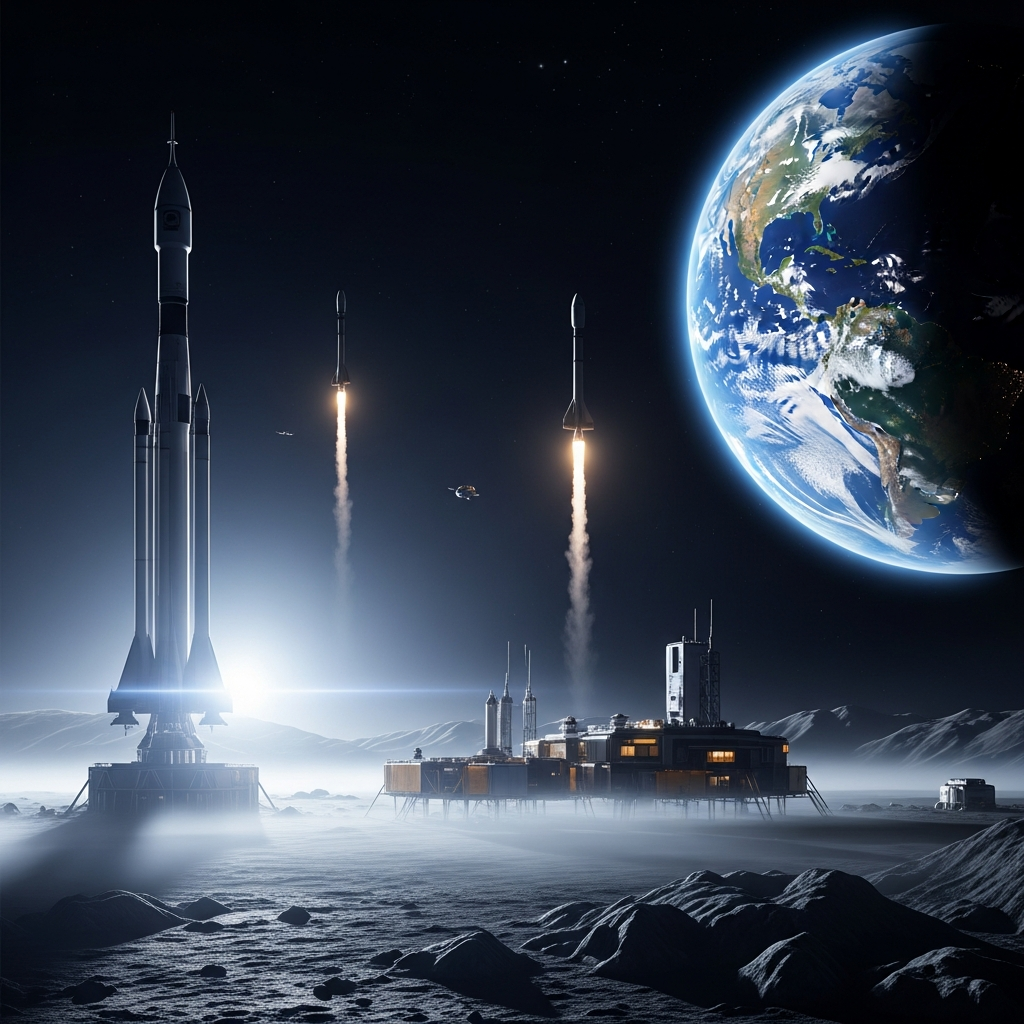
For the first time in more than half a century, human beings are preparing to leave Earth’s neighbourhood. The countdown has begun.
There is something deeply human about looking up at the night sky and asking: what is out there? For generations, that question lived in the realm of poetry and philosophy. Then, for a brief and extraordinary window between 1969 and 1972, it became an engineering problem that humanity actually solved. And then — for reasons of politics, budget, and shifting priorities — we stopped going.
In 2026, that long pause is finally ending. Space exploration news is no longer about ambition or planning. It is about rockets on launchpads, astronauts in training, and missions already in flight. The new age of human spaceflight has arrived — and it is more ambitious, more collaborative, and more commercially driven than anything that came before it.
Artemis II: The Mission That Changes Everything
The Artemis II mission will launch no earlier than April 1, 2026, carrying NASA astronauts Reid Wiseman, Victor Glover, and Christina Koch, along with Canadian Space Agency astronaut Jeremy Hansen, on a free-return trajectory around the Moon and back to Earth — the first crewed deep space mission since Apollo 17 in 1972, and the first since then to reach the Moon’s vicinity.
The historic firsts embedded in this single mission are remarkable. Victor Glover will become the first person of color, Christina Koch the first woman, and Jeremy Hansen the first person not from the United States to reach deep space and the vicinity of the Moon. These are not symbolic gestures — they are a statement about what the next era of exploration will look like and who it will include.
The Artemis II mission will carry astronauts farther from Earth and closer to the Moon than any human has been in over half a century, and its science operations will lay the foundation for safe and efficient human exploration of both the Moon and Mars.
NASA has also doubled down on the program’s long-term ambition. The agency announced it is increasing its cadence of Artemis missions, adding an additional mission in 2027 and committing to at least one surface landing every year thereafter — a pace that would make sustained human lunar presence not a distant vision but a near-term operational reality.
The Moon Is Getting Crowded — and That Is a Good Sign
Beyond Artemis, the Moon in 2026 has become one of the most contested and exciting destinations in the solar system. In early 2026, NASA and Blue Origin plan to launch Blue Moon Pathfinder Mission 1, the first uncrewed mission of the Blue Moon Mark 1 craft, intended to test technologies needed for future crewed lunar landers. In July, NASA and Astrobotic plan to launch Griffin Mission One, aiming to land near the Moon’s south pole — a region of extraordinary scientific and strategic importance due to the presence of water ice.
Intuitive Machines plans its third Nova C mission, IM-3, launching on a Falcon 9 in the second half of the year, carrying payloads for NASA, the European Space Agency, and the Korea Astronomy and Space Science Institute. In late 2026, Firefly Aerospace plans Blue Ghost Mission 2, targeting the far side of the Moon — a mission that will also deliver ESA’s Lunar Pathfinder communications satellite and debut the world’s first operational radio telescope on the lunar surface.
And it is not just American companies and agencies pressing toward the Moon. China plans to launch Chang’e 7 in late 2026 to explore the lunar south pole, with a mission that includes an orbiter, relay satellite, lander, rover, and a mini-flying probe. The lunar south pole is becoming the most valuable real estate off Earth — and every major spacefaring nation knows it.
Mars: The Horizon Goal Comes Into Sharper Focus
While the Moon dominates near-term space exploration news, Mars remains NASA’s ultimate destination for human missions — and 2026 is setting the scientific groundwork for the journey ahead.
NASA’s twin ESCAPADE satellites, launched in November 2025, will use Earth’s gravity to slingshot toward Mars, where they will study how space weather affects the Martian magnetosphere and how the planet lost its thick atmosphere. This data will be essential to long-term safe habitation on Mars, enabling mission planners to understand and mitigate the effects of dangerous space weather in an environment that will depend on artificial life support systems.
Japan’s Martian Moons eXploration mission, MMX, will launch in 2026 to perform a sample-return mission at Phobos, one of Mars’s two moons, with the retrieved samples expected to reach Earth for study in 2031. Those samples could answer fundamental questions about the early solar system — and potentially about the origins of life itself.
Mars remains NASA’s horizon goal for human exploration precisely because it is one of the only other places in the solar system where life may have once existed. What we learn about the Red Planet will tell us more about Earth’s past and future, and may help answer whether life exists beyond our home world.
A Genuinely Global Endeavour
Perhaps the most striking feature of 2026’s space exploration surge is how international it has become. Artemis II, India’s Gaganyaan crewed mission, and China’s ongoing crewed Tiangong station flights together reflect a renewed global push toward human exploration beyond Earth orbit — one in which governments and commercial partners alike are laying the groundwork for longer missions and a sustained human presence in space.
The Artemis Accords — the international framework governing peaceful lunar exploration — now include 60 participating nations and continue to expand, a quiet but significant sign that the international community is choosing cooperation alongside competition as it ventures deeper into space.
Yet for all the competition, space science remains profoundly collaborative. Japan’s MMX mission carries instruments from NASA, ESA, and France. International teams share data, expertise, and the sheer wonder of discovery. The universe, after all, belongs to no one nation.
Why This Moment Matters
It is easy to get lost in rocket specifications and orbital mechanics and forget what space exploration actually means for ordinary people back on Earth. The technologies developed for deep space missions — from water purification systems to medical monitoring devices to advanced materials — routinely find their way into everyday life. The economic ecosystem surrounding the new space race, from satellite services to space tourism to in-space manufacturing, is already generating industries that did not exist a decade ago.
But perhaps more importantly, space exploration does something that very few human endeavours can: it gives a species that is increasingly divided by politics, conflict, and fear a reason to look up together.
From the search for habitable worlds around distant stars to plans for returning humans to the Moon, the work is global — and the sky is shared by all.
In 2026, four astronauts are preparing to fly around the Moon for the first time in more than fifty years. Rovers are heading for the lunar south pole. Twin satellites are racing toward Mars. And somewhere in the data that comes back from all of these missions, humanity may find the answers — and the inspiration — that only the universe can provide.
The countdown is not just on a launchpad screen. It is on the clock of human ambition. And it is running.

