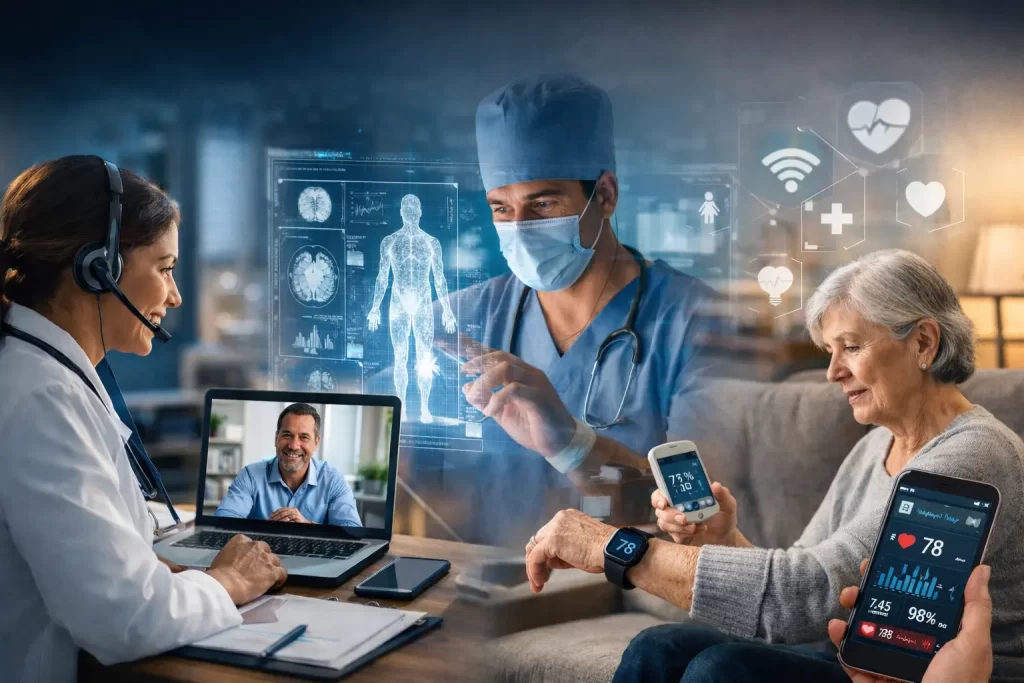
Imagine a grandmother living in a small town three hours away from the nearest specialist who has to keep an eye on a long-term condition. A few years ago, she didn’t have many choices: go on the trip, miss the appointment, or hope for the best. She can now talk to a doctor, send real-time health data from a wearable device, and get a diagnosis based on AI—all without leaving her home—thanks to her smartphone and a reliable internet connection.
That change isn’t something that will happen in the future. Right now, in communities all over the world, telemedicine and digital health technology are growing and becoming a permanent part of how the world delivers healthcare. The change is not even, perfect, or finished yet. But there is no doubt about where it is going, and the effects on billions of people will be huge.
From a temporary fix to a permanent part of the infrastructure
Telemedicine didn’t start with the COVID-19 pandemic; tools for remote consultations had been around for years before 2020. But it did something that had taken decades of slow adoption to do: it made healthcare systems, regulators, insurers, and patients see digital health technology as a legitimate, primary way to get care instead of just a niche addition to in-person medicine.
Hospitals that had been testing telehealth programs on a small scale suddenly rolled them out on a large scale. Regulatory barriers that had made it harder to adopt were temporarily, and in many cases permanently, eased. Patients who had never thought about a video consultation found that they liked it better for regular appointments. Doctors who were unsure found that a surprising number of clinical interactions worked well in remote formats.
The healthcare industry is now making the temporary changes that the pandemic forced them to make into permanent parts of their buildings. It is no longer possible to plan for remote healthcare services. They are becoming the main parts of the infrastructure, and the money going into that infrastructure shows how seriously the sector is taking this change.
AI Enters the Exam Room
Artificial intelligence is becoming more and more the analytical engine behind telemedicine. AI healthcare tools are moving from research to clinical practice at a speed that would have seemed impossible ten years ago. In carefully chosen cases, they are also becoming more effective.
AI-based diagnostic systems are now able to analyze medical images with the same level of accuracy as, and in some cases even better than, human specialists. Algorithms trained on millions of data points can find early signs of diabetic retinopathy, some cancers, heart problems, and neurological conditions. This lets doctors intervene sooner and get better results.
AI is being used for more than just imaging; it’s also being used to help decide which symptoms need immediate attention and which can be safely handled from a distance. It is the driving force behind symptom-checking tools that give patients more information before they even talk to a doctor. It looks at patterns in patient health data to find problems before they get worse.
None of this takes the place of a doctor’s judgment. The most thoughtful people who work in this field make sure that AI is seen as a tool that helps doctors do their jobs better, not as a replacement for them. But in most places, where specialist capacity is stretched thin, the ability to extend that capacity with smart digital help is a big deal. It is a significant growth in what healthcare systems can provide.
The Promise for Communities That Don’t Get Enough Help
Of all the ways that digital health is changing medicine, its ability to help communities that traditional healthcare systems have always failed is probably the most important.
People living in rural areas of all income levels have known for a long time that geography determines access to healthcare. Distance from hospitals, a lack of specialists, and a lack of transportation infrastructure are all problems that have directly led to worse health outcomes for generations of people whose only disadvantage was where they were born.
Digital health monitoring systems and platforms for remote consultations don’t completely get rid of those barriers. But they make them a lot lower. A patient in a remote area who can use a digital health platform can now get expert help that would have taken days of travel and a lot of money before. You can manage chronic conditions that need regular monitoring all the time instead of just when they flare up. You can catch and deal with early warning signs that would have gone unnoticed until they became emergencies.
The growth of telemedicine around the world is closely linked to improvements in mobile connectivity in developing areas. These two trends coming together creates real opportunity. As more people in Africa, South Asia, and Latin America get smartphones, the number of people who can use remote healthcare services grows. The infrastructure problem is still big, but the direction things are going in is very positive.
The Friction That Is Still There
To be honest, you have to admit that digital health technology hasn’t solved everything yet. The digital divide, which is the difference between people who have reliable internet and devices and those who don’t, means that the communities that need healthcare the most often can’t use these tools. The internet connection that brings you an AI diagnostic platform is what makes it useful.
Data privacy is another thing that makes things more complicated. Health information is one of the most private types of data that people make. New digital health monitoring systems make it easier to get health information, but they also make it easier for hackers to steal it. In many countries, the rules and regulations are still catching up to the technology, which makes it hard for patients and providers to know how data is stored, shared, and protected.
The way that providers and patients work together, as well as the way that they interact with each other, also cause problems that slow down adoption below its theoretical ceiling. Changes in healthcare happen more slowly than changes in consumer technology. This is partly because of bureaucracy and partly because it’s smart — the risks of getting it wrong are high.
A Change That Is Worth Following
Even with those problems, it’s clear that digital health technology is on the rise. Telemedicine is growing, AI healthcare tools are getting better, and connectivity infrastructure is getting better. All of these things are making it possible to get better healthcare in ways that weren’t possible before.
The grandmother who lives three hours from the nearest specialist is no longer a rare case that the healthcare system regrets but can’t fix. She is becoming a person that medical innovation is purposefully and actively designing around. The most important thing happening in medicine right now might be the change in how people think about healthcare. Instead of seeing it as something you can only get to if you’re close by, people now see it as something that can reach you anywhere.