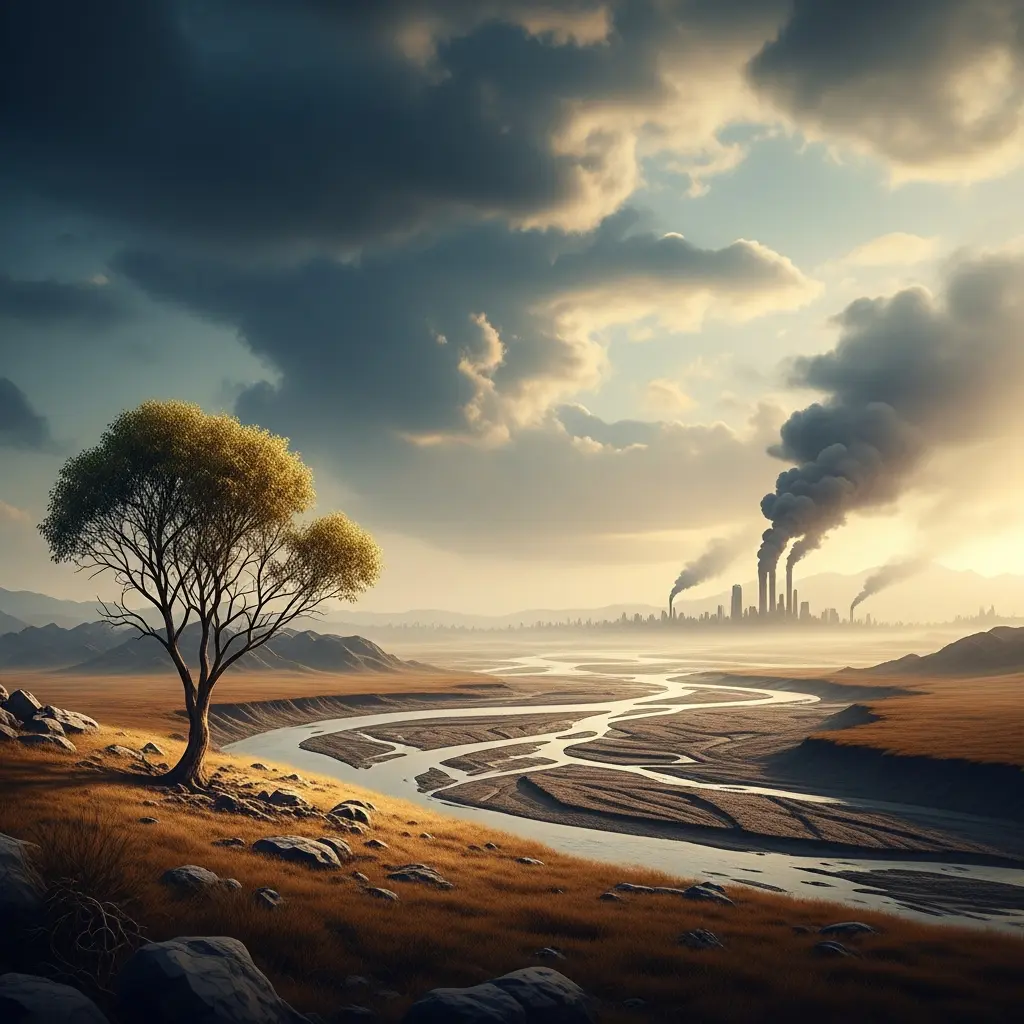
The Longest Emergency: Why Climate Change Refuses to Wait While the World Looks Away
There is a particular frustration that climate scientists have been living with for years, and it is perhaps best captured in a single observation from Davos 2026, where Johan Rockström, Director of the Potsdam Institute for Climate Impact Research, addressed a room full of the world’s most powerful decision-makers. “We are at a really, really decisive juncture,” he told them. “Time is running out — but it’s not too late.” It was not the first time those words had been spoken in rooms like that one. It will not be the last. And that is precisely the problem. Climate change does not pause while geopolitical crises compete for attention. It does not yield ground because global summits produce insufficient agreements. It simply continues — deepening, widening, and compounding — regardless of where the headlines point.
The World Economic Forum’s Global Risks Report 2026, published in January, delivered a finding that is both reassuring and deeply unsettling in the same breath: environmental risks have slipped slightly in the short-term rankings, falling from second to fourth position in the two-year outlook, as geopolitical conflict and economic instability dominate immediate policymaker attention. But over the ten-year horizon, the picture is unambiguous and unchanged. Extreme weather events rank as the single most severe global risk through to 2036. Biodiversity loss and ecosystem collapse rank second. Five of the top ten long-term global risks are environmental. The WEF’s warning is pointed: do not mistake a shift in short-term attention for an easing of underlying exposure. The risks have not diminished. The world has simply looked away.
The Real Price of Extreme Weather
Extreme weather is no longer a category of future risk. It is a present operating condition for economies, governments, and communities around the world. Annual insured losses from weather and climate events now consistently exceed $100 billion globally, with wider economic losses — most of which remain uninsured — reaching approximately $500 billion in Europe alone. These are not numbers drawn from disaster scenarios. They are drawn from recent years’ actual claims, rebuilding costs, crop losses, and disrupted supply chains. For every dollar paid out by an insurer after a flood or wildfire, there are many more dollars of damage absorbed silently by individuals, municipalities, and national budgets that never show up in a headline.
Climate scientists warn that 2026 is shaping up to intensify these patterns further. Warming oceans are supercharging tropical cyclones, leading to rapid intensification. These storms can go from manageable to devastating in just a few hours, which makes it hard to evacuate people and strains disaster response systems. Simultaneously, forecasts for this year’s dry spell suggest that regions dependent on seasonal precipitation will face escalating water shortages.
Agriculture, rural communities, and food systems are bracing for extended dry spells, a situation that will only worsen as desertification takes hold.
Scientists monitoring atmospheric conditions note that every degree of global warming allows the atmosphere to hold more moisture — meaning that when rain does arrive, it arrives harder, faster, and in volumes that aging infrastructure was not designed to absorb.
Biodiversity Loss: The Engine That Is Grinding to a Halt
If extreme weather is the most visible face of the climate emergency, biodiversity loss is the most quietly catastrophic. A landmark study published in Nature Communications in February 2026 by researchers at Queen Mary University of London produced a finding that upended conventional assumptions: despite accelerating global warming, the rate at which species are replacing each other in local ecosystems — a process known as species turnover — has actually slowed by approximately one-third since the 1970s. The study’s lead researcher described the situation with striking clarity. Nature, he said, functions like a self-repairing engine, constantly swapping out old parts for new ones. But that engine is now grinding to a halt. This is a troubling possibility: ecosystems that seem stable on the surface might actually be losing the biodiversity needed to survive, making them more fragile as human activities increase.
The economic stakes of biodiversity decline are not separate from the climate story — they are the same story told from a different angle. The UN Environment Programme’s State of Finance for Nature 2026 report revealed a staggering imbalance at the heart of current investment patterns: for every single dollar invested in nature-based solutions globally, approximately thirty dollars are spent on activities that destroy natural systems. This ratio is not sustainable by any measure. Forests, fisheries, wetlands, and grasslands underpin the food and income security of hundreds of millions of people, particularly across Africa, Asia, and Latin America. Their degradation does not simply reduce biodiversity — it directly strips the economic foundations of the communities most dependent on natural systems for survival.
The Dangerous Gap Between Ambition and Delivery
Perhaps the most troubling dimension of the 2026 climate picture is not what the science is saying — it is the widening gap between what governments have committed to and what they are actually doing. The UK’s Office for Environmental Protection, one of the more rigorous independent environmental watchdogs in the world, published its latest progress report in January finding that the government remains largely off track to meet its own key environmental targets. The Environmental Audit Committee’s response was direct: it called for concrete results, not further commitments. Meanwhile, the United States Environmental Protection Agency revoked its foundational 2009 greenhouse gas endangerment finding — the scientific determination that underpinned virtually all of America’s climate regulation for fifteen years. That single regulatory reversal has significantly weakened the legal architecture supporting US sustainability goals at precisely the moment when global cooperation on climate is most urgent.
The World Economic Forum’s Global Risks Report 2026 flags this lack of cooperation as a particularly perilous structural flaw of our time. Countries are leaning more heavily on their own national agendas, sidelining the need for unified climate efforts. This trend, as noted in the Global Tipping Points Report 2025, is gaining momentum at a time when a coordinated global response is desperately needed.
Scientists expect that within the next three to five years, the planet will conclusively breach the 1.5 degrees Celsius warming barrier that the Paris Agreement identified as the threshold beyond which impacts become significantly harder to manage. That window is not closing slowly. It is closing fast. And the political attention that should be focused on holding it open is, in 2026, overwhelmingly directed elsewhere.
Reasons to Act, If Not Reasons for Optimism
The picture is not entirely without grounds for action. The High Seas Treaty formally entered into force in January 2026 — the first legally binding global framework to protect marine biodiversity in international waters, covering an ocean area that represents nearly half the Earth’s surface. The Intergovernmental Science-Policy Platform on Biodiversity and Ecosystem Services released a major new assessment offering one hundred concrete actions for governments, businesses, and civil society to measure and reduce their impacts on nature. AI-powered weather forecasting systems — including Hong Kong University’s new DDMS model, which predicts extreme weather up to four hours ahead with fifteen percent improved accuracy — are beginning to give communities better tools to prepare for the conditions that global warming is making more frequent and severe. These are not solutions. But they are foundations.
The fundamental challenge of the climate crisis has always been its relationship with time. Its causes are accumulated slowly. Its consequences arrive gradually, then suddenly. Its solutions require sustained commitment across political cycles that reward short-term attention and punish long-term investment. The world’s decision-makers are not ignorant of the risks — the WEF, the IPCC, the UN, and dozens of the world’s most credible scientific institutions have been precise and consistent about what is coming. What the 2026 moment reveals, uncomfortably, is that awareness and action are not the same thing. The longest emergency in human history does not need more reports. It needs decisions — made now, not after the next election, the next conflict, the next economic disruption. The window, as Rockström reminded Davos, has not yet closed. But it is not waiting.
The Longest Emergency: Why Climate Change Refuses to Wait While the World Looks Away