
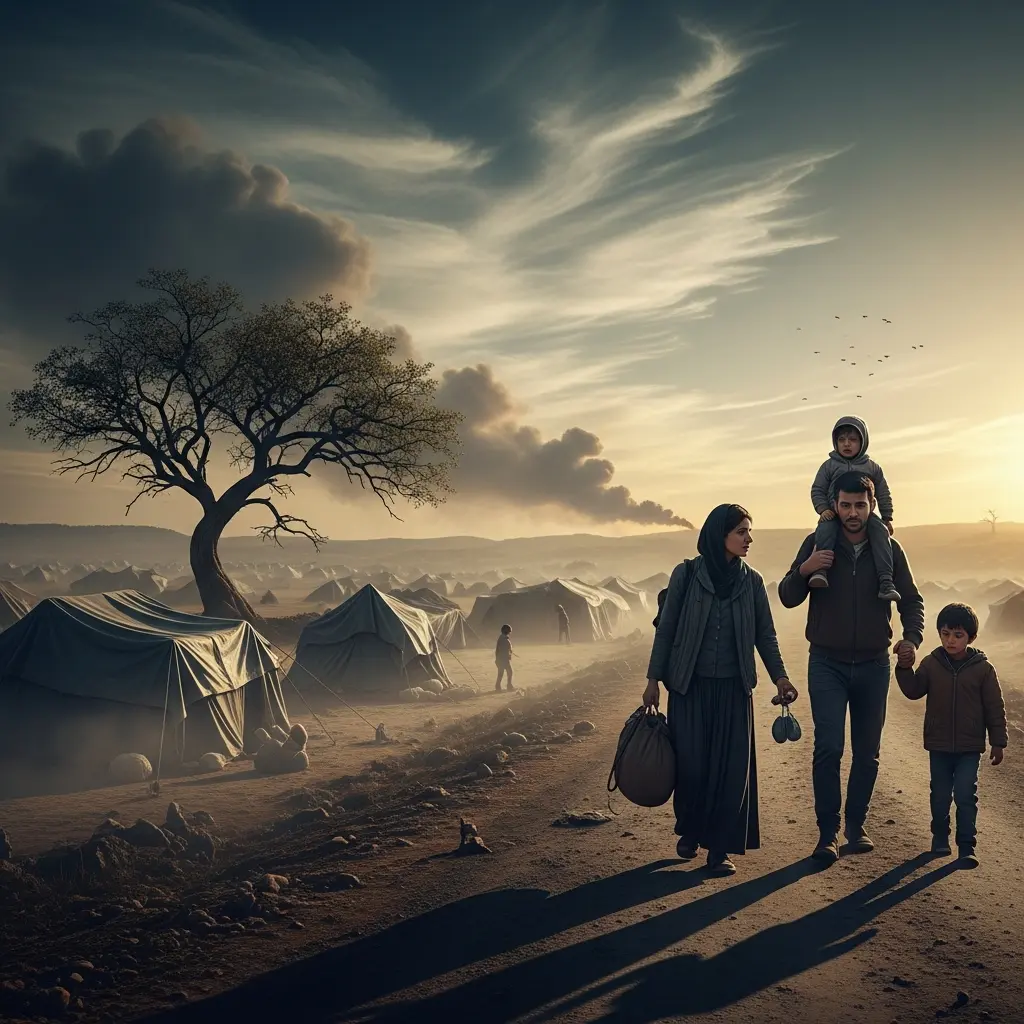
She was looking for milk for her newborn. That is what one displaced Lebanese mother told aid workers from the International Rescue Committee this week, standing outside a shelter that was already full, her infant bundled against the cold. She was not looking for a ceasefire agreement or a diplomatic breakthrough. She just needed milk. And she could not find any. In the calculus of a refugee crisis, it is these unbearably small, utterly human details that tell you more than any statistic — though the statistics, in this case, are staggering enough on their own.
Since the United States and Israel launched strikes on Iran on February 28, 2026, the Middle East war has generated a humanitarian emergency unlike anything the region has seen in decades. According to UNHCR, the UN refugee agency, up to 3.2 million people — representing between 600,000 and one million Iranian households — have been forcibly displaced inside Iran alone since the war began. Most are fleeing Tehran and other major urban centres, moving north toward rural areas in search of safety. These are not people choosing to relocate. They are people running from the sound of aircraft overhead.
A Crisis Built on Top of a Crisis
What makes the current displacement so devastating is the terrain it has fallen onto. The Middle East was already carrying one of the heaviest humanitarian burdens on earth before a single bomb dropped on Tehran. Across the broader region, more than 24.6 million people were already forcibly displaced due to conflict and instability — refugees, internally displaced persons, and recent returnees crowded into countries that were themselves struggling to survive. Lebanon, which hosts approximately 1.5 million Syrian refugees among a population of just four million people, had already seen over 70 percent of its population fall into humanitarian need before the March 2026 escalation. Its shelters were already strained. Its funding was already short.
Now, since renewed hostilities erupted in Lebanon on March 2, entire suburbs of Beirut have emptied. At least 84,000 people are sheltering in collective sites — schools, churches, and makeshift camps — across the country. More than 30,000 newly displaced people have crossed from Lebanon into Syria, seeking safety in a country that itself has never fully recovered from over a decade of civil war. Among those newly displaced are Syrian refugees who had already fled conflict once, rebuilt fragile lives in Lebanon, and are now being forced to flee again. For many of them, this is the second or third time they have lost everything.
Aid Agencies on the Edge
Humanitarian organizations are racing to respond, but the obstacles they face are extraordinary. The near-total shutdown of maritime traffic through the Strait of Hormuz — a critical oil transit route that also carries enormous volumes of commercial and humanitarian cargo — has practically halted the movement of emergency supplies by sea. The World Health Organization’s regional director confirmed that much-needed medical and relief supplies simply cannot transit through the Strait. The WHO was fielding more than 50 emergency supply requests across 25 countries simultaneously affected by the disruption, including Lebanon, Yemen, and Somalia.
The funding crisis compounds the supply crisis. UNHCR requires $454.2 million in 2026 to protect and assist forcibly displaced people across Afghanistan, Iran, Pakistan, and Central Asia alone. As of the end of February — before the war even began — only 15 percent of that figure had been received. The United States, historically the largest single donor to international humanitarian aid, sharply reduced its foreign assistance in 2025 under a broader spending review. The organisations left to fill that gap are doing so with empty hands. The Jesuit Refugee Service has reported that funding cuts are forcing partners across the region to scale back services, reduce staff, and triage their work down to only the most urgent immediate needs.
Europe Braces — and the World Watches
Beyond the immediate region, the global response to this unfolding refugee crisis is being shaped by a politics that is increasingly hostile to displacement. The European Union Agency for Asylum had already warned, before the war began, that a sustained conflict in Iran could produce refugee movements of an unprecedented scale into Europe. Analysts have estimated that if the conflict becomes prolonged, hundreds of thousands of Iranians could eventually seek protection in European countries — an influx that would arrive precisely as the EU is tightening its asylum rules and shifting toward more restrictive deportation policies.
For now, the primary movement is internal and regional. UNHCR has declared a major humanitarian emergency requiring an immediate regional response, with its director for emergencies, Ayaki Ito, warning of significant population movements spreading across the region and into Southwest Asia. UNHCR is coordinating cross-regional preparedness across three of its bureaux — Asia and the Pacific, the Middle East and North Africa, and Europe — working with national authorities to plan for border crossings that could see sudden, massive surges. Afghanistan and Pakistan together already host nearly 25 million displaced people. The arrival of large numbers from Iran into these already-overwhelmed systems would be catastrophic.
The Children Who Carry the Weight
In Pakistan’s displacement centres, data collected this week reveals that 57 percent of internally displaced persons are children. Among Afghan returnees assisted by UNHCR from Iran and Pakistan in 2026, 75 percent are women and children — the most vulnerable, always the last to leave and the first to suffer when they do. The UN’s IOM has warned that without rapid humanitarian aid, the risks to the health and safety of displaced families will escalate dramatically. These are not abstractions. They are children sleeping in cars because official shelters are full. They are mothers who cannot find milk.
The international community has issued its customary calls for cooperation and restraint. Humanitarian organisations have published their alerts and launched their emergency appeals. The machinery of global response is moving — but moving slowly, underfunded, and into a crisis that is growing faster than anyone’s capacity to contain it. What the Middle East war has produced, in three weeks, is not just a military conflict but a humanitarian emergency with roots stretching back decades and consequences that will ripple outward for decades more. Every day this continues, the distance between people and home grows a little wider — and the road back a little harder to find.

