From fuel prices to foreign policy, the ruling party and the opposition are locked in a battle of ideas and accountability that is shaping India’s political landscape — and offering voters a preview of battles yet to come.
India’s Parliament has always been a living, breathing institution — chaotic at times, theatrical often, but never truly quiet when the nation has something at stake. And right now, with fuel prices straining household budgets, global tensions reshaping foreign policy calculations, and an election horizon concentrating every political mind in the building, the debates ringing through both Lok Sabha and Rajya Sabha carry a particular intensity. This is not routine parliamentary business. It is India’s democratic engine running at full throttle.
The Parliamentary debate that has unfolded over recent sessions touches on issues that land squarely in the everyday lives of ordinary Indians. At the centre of it all is the question of fuel prices — the single most politically charged economic variable in a country where the cost of petrol and diesel ripples into everything from bus fares to vegetable prices at the local mandi. The opposition has pressed hard, demanding policy clarity on how the government intends to shield consumers from the inflationary effects of global oil market volatility.
However, this structural issue doesn’t exempt elected officials from the need to explain their actions clearly and to act decisively.
When a working-class family in Patna or Pune sees their fuel bill rise, they are not especially interested in the geopolitics of the Strait of Hormuz. They want to know what their representatives in Parliament are doing about it. That demand for accountability is exactly what the opposition is channelling — and what the government must credibly answer.
“The quality of a democracy is measured not only by how it votes, but by how fiercely it debates. On that count, India’s Parliament is doing its job.”
Foreign policy has emerged as an equally charged front in the government vs opposition exchanges. India’s carefully maintained posture of strategic autonomy — engaging with Russia, the Gulf states, the United States, and other partners simultaneously without formally aligning with any bloc — is being scrutinised with new intensity as global fault lines deepen. Opposition lawmakers have questioned whether this multi-alignment approach is as coherent as it appears, pushing for greater transparency on the terms of bilateral energy agreements and asking pointed questions about India’s diplomatic positioning in multilateral forums.
The ruling party’s defence has been robust. Ministers have argued that India’s ability to secure discounted oil from multiple sources, to maintain functioning relationships across geopolitical divides, and to speak credibly at international tables is precisely the dividend of the foreign policy approach being questioned. The India governance debate, in this sense, is partly a debate about national identity — about what kind of country India wants to be in a fractured world, and whether its current leadership is navigating that complexity wisely or recklessly.
Beyond the theatre — what the debates reveal
India’s Parliamentary operates through two houses — the Lok Sabha (House of the People, directly elected) and the Rajya Sabha (Council of States, indirectly elected). Together they form the arena where India’s most consequential policy debates are formally contested. Sessions are broadcast nationally and followed closely by a politically engaged electorate of nearly a billion eligible voters.
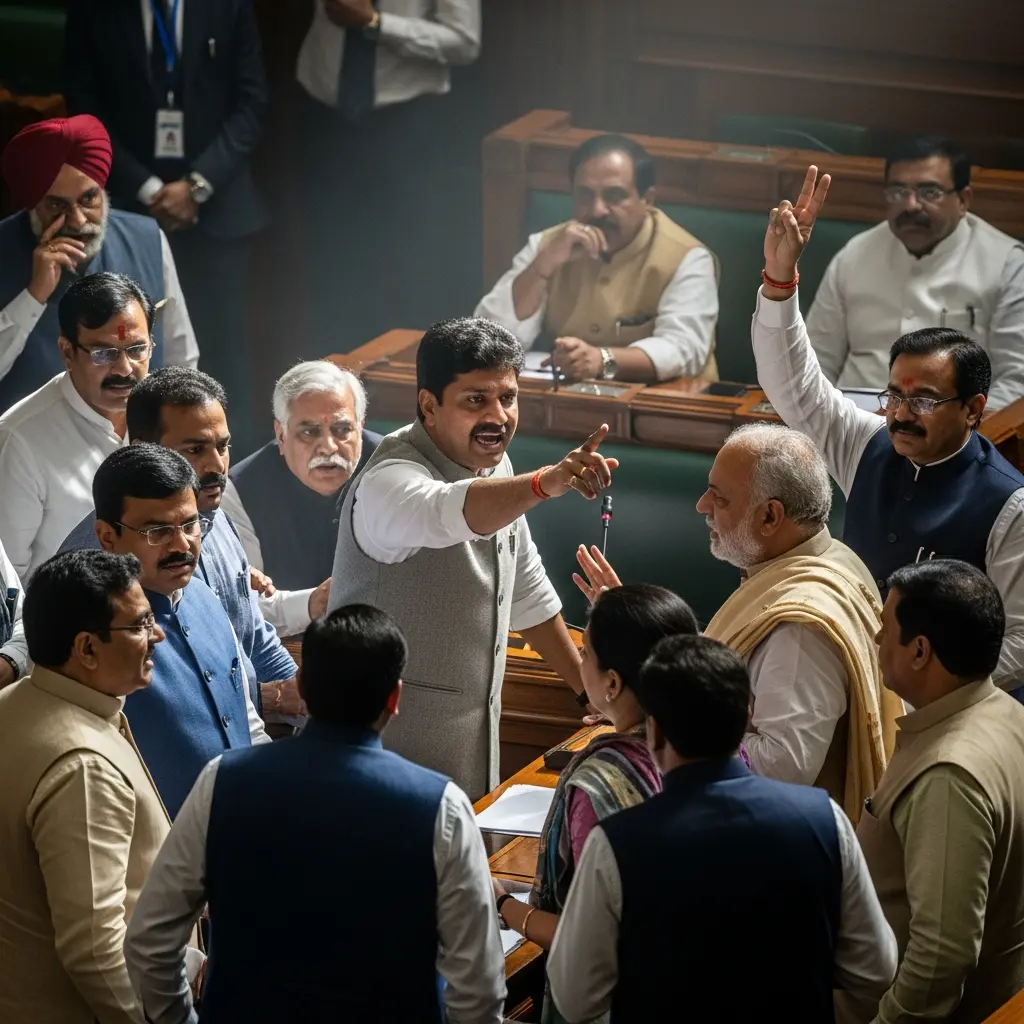
It would be easy to dismiss some of what happens on the floor of Parliament as performance — and some of it clearly is. The walkouts, the raised voices, the carefully timed adjournment motions: these are familiar instruments of political theatre that every democracy deploys in its own idiom. But beneath the theatre, something more substantive is happening. Lawmakers from across party lines are genuinely grappling with Indian politics at a moment of real consequence — a moment when the decisions made in New Delhi about energy, foreign relations, and economic management will have measurable effects on people’s lives.
The growing political competition ahead of elections sharpens every exchange. The ruling party uses it to demonstrate competence. The result, at its best, is a genuine contest of ideas that forces both sides to sharpen their arguments and their policies.
India’s democratic process has always been messier, louder, and more unpredictable than its admirers sometimes like to acknowledge. But it is also more resilient, more genuinely participatory, and more consequential than its critics tend to give it credit for. The heated Parliamentary debate playing out right now — over fuel, foreign policy, and the fundamentals of India governance — is proof that a democracy of 1.4 billion people, with all its complexity and contradictions, is still doing the essential work of holding power to account. In the end, that is exactly what a Parliament is for.