
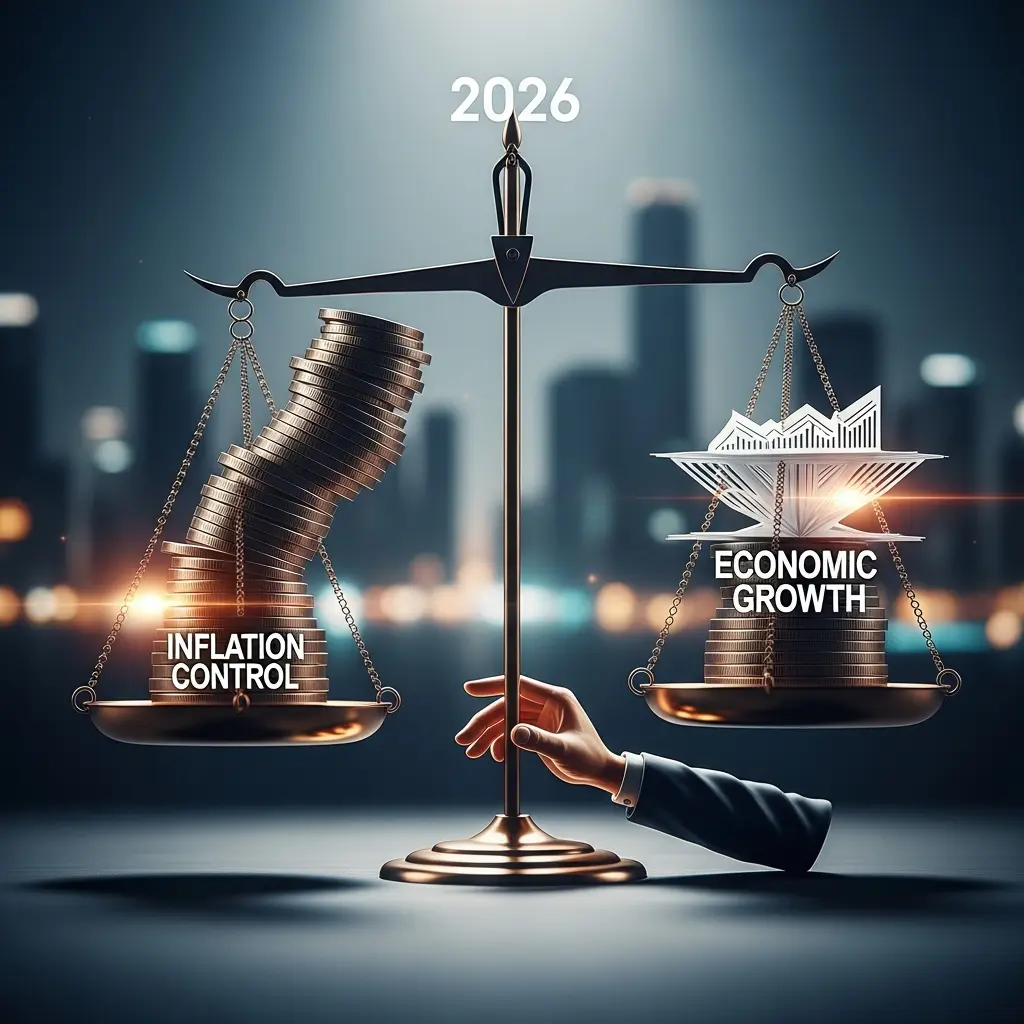
The world’s most powerful monetary institutions are navigating a moment they were not designed to handle — where inflation hasn’t fully surrendered, geopolitical risk won’t sit still, and the cost of getting the next move wrong is painfully high.
There is a word that keeps appearing in the statements, minutes, and press conferences of the world’s central banks right now, and that word is “cautious.” The Federal Reserve is being cautious. The European Central Bank is proceeding cautiously. The Bank of England is exercising caution. The Reserve Bank of India is taking a calibrated, which is to say cautious, approach. It is tempting to read this as bureaucratic evasion — the language of institutions that do not want to be held to anything. But in 2026, the caution is real, it is earned, and understanding why it exists tells you a great deal about the state of the global economy.
Central banks spent the better part of 2022 and 2023 doing something they had not done in a generation: raising interest rates aggressively to bring inflation under control after the post-pandemic surge. It was painful and necessary, and it largely worked — inflation in most major economies came down substantially from its peaks. But “largely worked” is not the same as “problem solved.” Headline inflation numbers have moderated, but core inflation — the kind that strips out volatile food and energy prices — has proven stickier than policymakers hoped. With the Middle East simmering and energy supply lines strained once more, the possibility of inflation picking up speed again is no longer just a hypothetical.
It is sitting right there in the data, waiting.
This is the trap that monetary policy finds itself in for economy 2026. Cutting interest rates too aggressively risks reigniting inflationary pressure at exactly the wrong moment. Holding rates too high for too long risks choking off the economic growth that governments desperately need to manage debt loads, fund public services, and deliver the kind of living standard improvements that their populations are demanding. There is no clean exit from this dilemma — only a series of judgment calls made under uncertainty, by committees of economists who know that they will be judged harshly either way.
The hardest part of central banking isn’t raising rates or cutting them. It’s resisting the pressure to act when the honest answer is that the picture isn’t clear yet.
Financial markets, as they often do, refuse to sit idle until the picture becomes clear. Each central bank gathering, each release of inflation statistics, and every employment report now sparks a fresh assessment of interest rate forecasts, sending ripples through bond markets, stock indices, and currency exchange rates almost immediately. Traders are, in effect, conducting a constant, real-time poll on their predictions of central bank actions – and these expectations, in turn, shape the very economic landscape that central banks are attempting to influence. This creates a feedback mechanism that makes the task of controlling inflation both more apparent and more perilous than ever before.
The geopolitical dimension adds a layer of complexity that no interest rate model can fully capture. When oil prices spike because of tensions in the Gulf, central banks face a particularly uncomfortable choice. Energy-driven inflation is, in theory, a supply shock rather than a demand-driven phenomenon — and aggressive monetary tightening is a blunt instrument for a supply problem. But if energy price rises feed into wage demands and broader inflation expectations, the second-round effects can be just as damaging as the initial shock. Central banks are watching those expectations with extreme care, because the moment inflation becomes self-fulfilling in people’s minds, the task of containing it becomes dramatically harder.
For ordinary households, the prolonged period of elevated interest rates has already extracted a significant toll. Mortgage costs have risen sharply in countries where variable or short-term fixed rates are common. The cost of borrowing for cars, home improvements, and small business investment has climbed. Governments, carrying the debt accumulated through pandemic-era spending, are facing higher refinancing costs that squeeze fiscal space for the very public investments that might help address long-term inflation drivers. The interconnections between monetary policy, fiscal policy, and household financial health have rarely been more visible — or more fraught.
What central banks are really communicating with their cautious stance is something that markets often struggle to accept: that the next move is genuinely uncertain, and that pretending otherwise would be irresponsible. In a world where geopolitical risk can reprice energy markets overnight, where consumer confidence can shift on a single data release, and where the scars of recent inflationary experience are still fresh in both policymaker and public memory, caution is not timidity. It is the only intellectually honest position available. The year 2026 will test whether that honesty is enough.

