
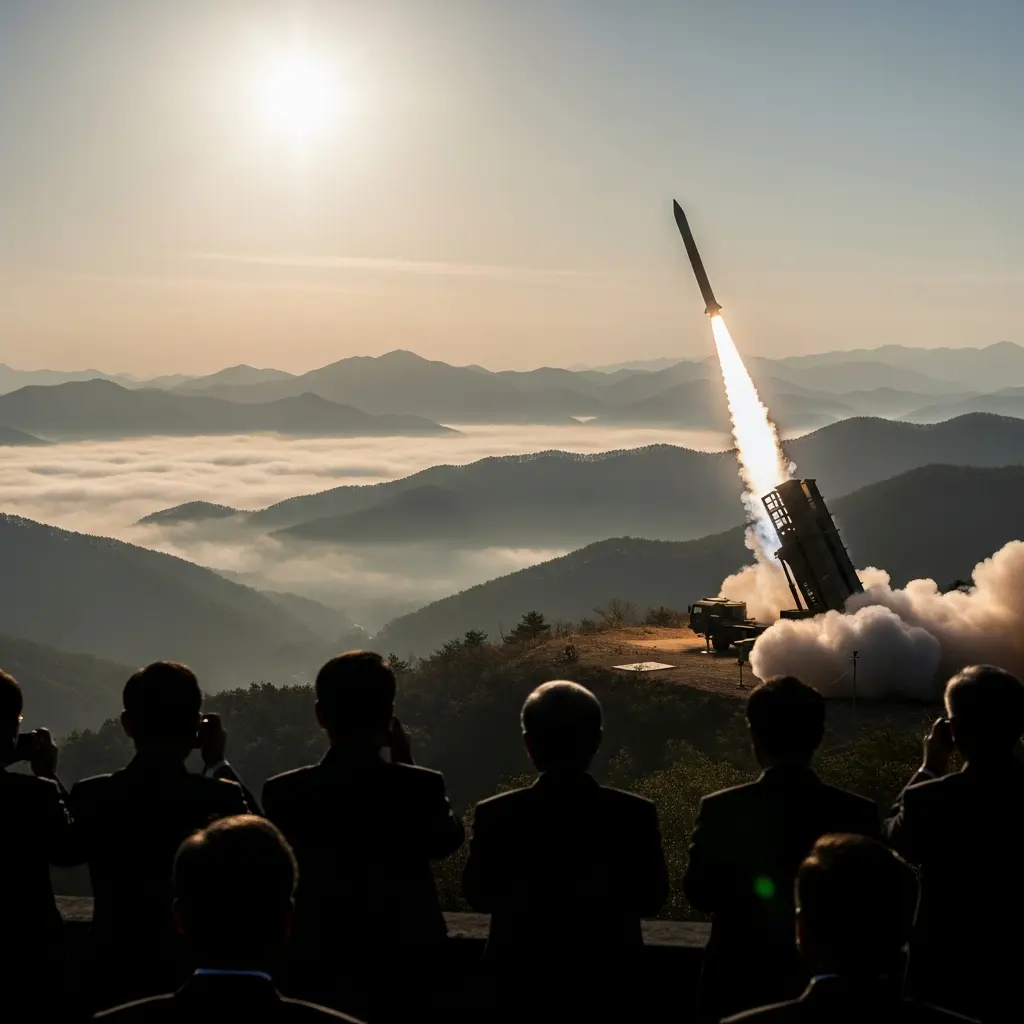
There’s a rhythm to North Korean provocation that analysts have long learned to read. A joint military drill between the United States and South Korea begins, and within days — sometimes hours — Pyongyang fires back with missiles. What changed on March 14, 2026, was the volume. Not one missile. Not three. Ten ballistic missiles, launched simultaneously into the Sea of Japan, in what has become one of the most dramatic shows of force the Korean Peninsula has seen in years.
This is no longer a regional concern. In a world already stretched thin by war in Europe, conflict in the Middle East, and fracturing alliances, North Korea’s latest missile tests have added another layer of tension to an already volatile global landscape.
A Calculated Provocation — or Something More?
The launches coincided precisely with the annual US-South Korean Freedom Shield training exercise, a computer-simulated command post drill that ran through March 19. North Korea has long treated these exercises as a red flag — or rather, as an excuse. North Korea has long described the allies’ drills as invasion rehearsals and often uses them as a pretext to dial up its own military demonstrations or weapons testing.
But the scale this time was unusual. The North has typically only fired off one to three missiles during shows of force, though there have been exceptions — including a barrage of at least 10 missiles in May 2024. This wasn’t routine muscle-flexing. By increasing the volume of the launch to 10 missiles, Pyongyang was signaling its refusal to be sidelined by the crises in the Middle East and Europe.
The weapon of choice was the KN-25, a system that straddles the line between rocket launcher and ballistic missile. 600 millimetres in diameter, eight metres long, and weighing three tonnes, it flies on a controlled ballistic trajectory and can carry a conventional warhead — or a Hwasan-31 nuclear warhead, as confirmed by Pyongyang in 2023. Its operational range covers almost the entire South Korean territory.
Kim Jong Un personally oversaw the drill. State media KCNA said the leader presided over the exercise involving 12 600mm-caliber multiple rocket launchers and two artillery companies. Kim said the weapons are means of “deterring war” but that North Korea would use them as a means of a “massive, destructive strike” in response to provocation.
A Year of Escalating Tests
March’s barrage didn’t come out of nowhere. In January 2026, North Korea launched what it claimed to be hypersonic missiles into the Sea of Japan. Kim stated that nuclear deterrence was necessary due to the “recent geopolitical crisis and complicated international events.” That was the year’s first test. The March launch was its third.
North Korea is prohibited by United Nations resolutions from launching or testing ballistic missiles of any range. Despite the resolutions, Pyongyang has stepped up its missile testing significantly in recent years.
The pattern is not just about military development. Analysts point to an important domestic dimension as well. Ahead of a landmark congress of the ruling party — its first in five years — Kim Jong Un ordered the expansion and modernization of the country’s missile production and the construction of more factories to meet growing demand. These launches serve as both external signal and internal theater: a demonstration to the North Korean people that their leadership is strong and unintimidated.
Regional Fallout and International Condemnation
The reaction from neighboring countries was swift. Japan lodged a strong protest with North Korea and condemned their actions, stating the launches violated relevant Security Council resolutions and constitute a serious issue concerning the safety of Japanese citizens
South Korea’s national security council called the launches a provocation that violated UN Security Council resolutions banning any ballistic activities by North Korea.
Washington has responded with measured concern. US Indo-Pacific Command issued a statement acknowledging the test launch and said the command was coordinating with allies, but that the launch did not pose an immediate threat.
What makes this moment particularly charged is the broader geopolitical backdrop. The tests added to global geopolitical risks that were already mounting after the US and Israel attacked Iran. The world is not watching a single flashpoint anymore — it’s watching several simultaneously, and Pyongyang knows it.
The Bigger Picture: Nuclear Threat and the Arms Race
Perhaps the most unsettling aspect of the current situation is how it feeds a wider arms buildup across the Asia-Pacific. Japan has accelerated its own defense spending. South Korea is expanding its military capabilities. This latest launch follows the classic North Korean playbook: utilizing allied military exercises as a pretext to refine its arsenal and consolidate domestic loyalty.
The nuclear threat is no longer hypothetical. The KN-25 system is explicitly nuclear-capable, and Kim has made it clear that he views these weapons as the foundation of North Korea’s survival strategy. Analysts say North Korea’s missile drive is aimed at improving precision strike capabilities, challenging the United States as well as South Korea, and testing weapons before potentially exporting them to Russia.
That last point — weapons exports — has drawn particular alarm from Western intelligence agencies. North Korea has already deepened its military relationship with Russia over the war in Ukraine, and the prospect of proliferation adds another dangerous dimension to what is already an explosive situation.
Diplomacy on Life Support
The launches came hours after South Korean Prime Minister Kim Min-seok met US President Donald Trump in Washington and expressed hope for renewed diplomacy between Washington and Pyongyang. The timing could not have been more pointed. Whatever appetite exists for dialogue, Pyongyang’s answer — for now — appears to be ten missiles fired into the sea.
The Korean Peninsula has existed in a state of frozen conflict for over seven decades. But “frozen” no longer feels like the right word. The ice is cracking — and what lies beneath remains one of the world’s most dangerous geopolitical fault lines.

