
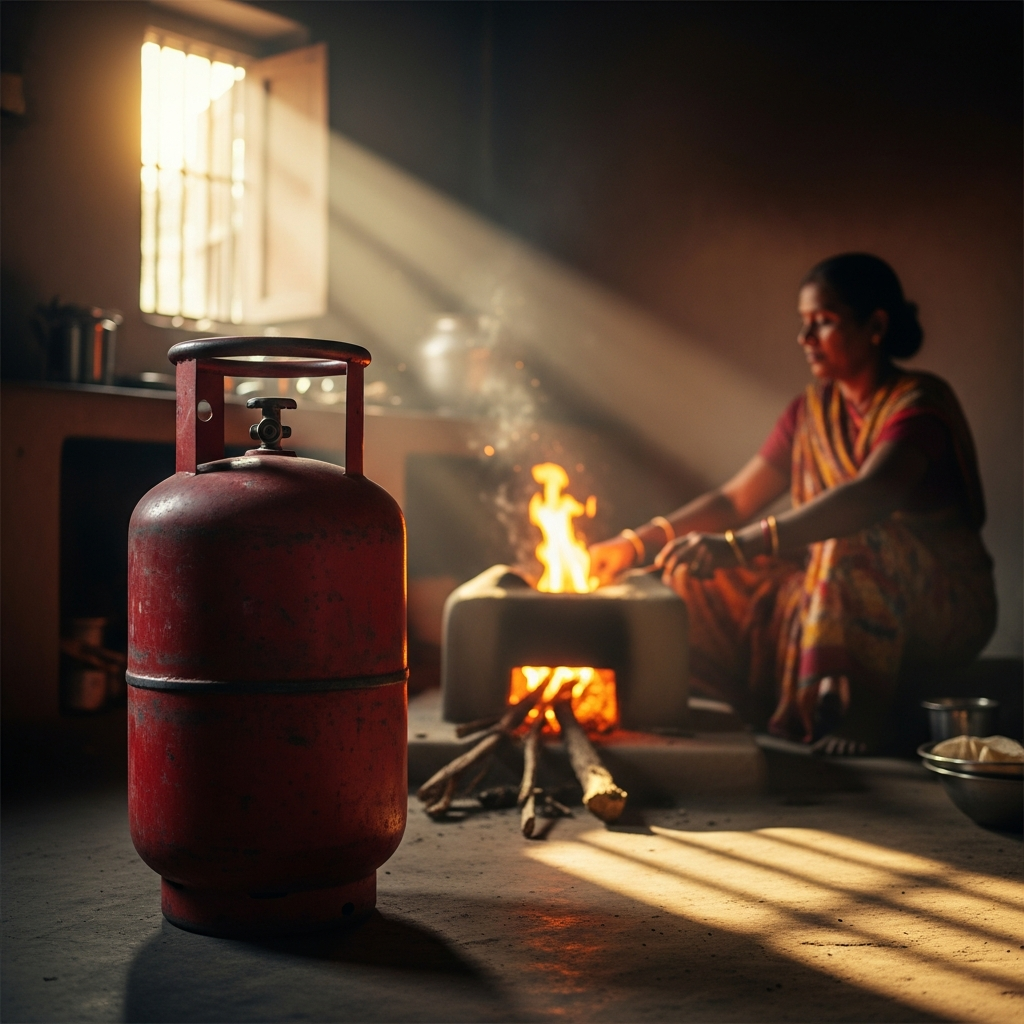
For most Indian families, the cooking gas cylinder is not a political object. It sits quietly in the corner of the kitchen, tucked beneath the stove, taken for granted — until suddenly it isn’t there. In early March 2026, millions of Indians woke up to a reality that felt deeply unsettling: the cylinders weren’t coming. And when they did, they cost more. And when politicians were asked why, the answers were contradictory, evasive, and — depending on who was speaking — either a story of decisive government action or one of catastrophic mismanagement.
India’s LPG supply crisis is, at its roots, a consequence of the war between the United States, Israel, and Iran. But the political firestorm it has ignited at home is entirely homegrown.
A Structural Vulnerability No One Fixed
The crisis didn’t emerge from nowhere. India is the world’s second-largest importer of LPG and consumed 31.3 million metric tons of the fuel in the financial year 2025. The country imports roughly 67 percent of its LPG requirements, with about 90 percent of those imports transiting through the Strait of Hormuz.
Because LPG must be stored under pressure or at very low temperatures, building large storage facilities is far more complex and expensive than storing petrol or diesel. India’s LPG storage capacity of around 1.34 million tonnes can cover only about two weeks of national consumption. This means the supply system relies heavily on continuous imports arriving on schedule. When shipments are disrupted, the limited storage buffer means supply pressure can emerge relatively quickly.
That buffer ran out fast. In early March 2026, India experienced severe disruptions in LPG supply, affecting households and businesses across major cities nationwide. These shortages emerged due to the geopolitical conflict in the Middle East, which disrupted energy shipments through the Strait of Hormuz. Al Jazeera For a country of 1.4 billion people, where hundreds of millions depend on affordable cooking gas as their primary household fuel, this was not an abstract policy problem. It was dinner.
The Government’s Response — and Its Contradictions
The Modi government moved quickly — but not before a damaging period of denial. As recently as March 6, the Petroleum Minister had said there was “no shortage of energy in India, no cause for worry for energy consumers.” One day later, the domestic cooking gas price rose by ₹60.
It was only on March 18 that the government acknowledged that the LPG situation in the country was “worrisome.” In between, queues had formed outside gas agencies in cities like Prayagraj. Black market prices had surged. Restaurants across the country — particularly in Tamil Nadu — were threatening closure.
When the government did act, the measures were sweeping. The LPG Control Order issued on March 8, 2026 directed all refineries to maximise LPG yields and channel the entire output of propane, butane, and related hydrocarbon streams exclusively to the three Oil Marketing Companies for domestic cooking gas. Within five days, LPG production had been increased by 28 percent through refinery directives.
The government also issued the Natural Gas Control Order on March 9, 2026 under the Essential Commodities Act, establishing a clear national priority sequence. Hospitals and educational institutions were placed on uninterrupted priority LPG supply. Anti-diversion raids were conducted and cases registered in multiple states.
Consumer prices, the government insisted, were being shielded. Despite the Saudi Contract Price rising 41 percent between July 2023 and March 2026, the price for beneficiaries under the PM Ujjwala Yojana scheme had actually fallen 32 percent in the same period.
But critics asked a pointed question: why did it take a crisis to act, when the vulnerability had been visible for years?
Opposition Finds Its Voice — and Its Moment
LPG supply is a politically sensitive issue in India, closely linked to Prime Minister Modi’s flagship social welfare scheme that offers subsidized cooking gas to poorer households. The price of cooking gas is a hotly debated issue during elections — and five Indian states are due to go to the polls in the first half of 2026.
The opposition wasted no time. On March 16, West Bengal Chief Minister Mamata Banerjee led a massive protest rally in Kolkata, where participants carried cut-outs of cooking gas cylinders and chanted slogans criticizing the Modi government’s failure to maintain LPG supply. “Why didn’t the government prepare an action plan in advance?” Banerjee demanded.
In Tamil Nadu, the attack was even sharper. Chief Minister M.K. Stalin alleged that the severe LPG shortage happened because of the Modi government’s “wrong decisions,” including foreign policy failures. “No foresight. No precautionary measures either. It is the public who suffers trouble because of them,” Stalin said, as his party organized protest rallies across the state.
The foreign policy dimension of the critique cuts deep. India’s longstanding civilizational and energy ties with Iran had weakened as its relationship with the US and Israel grew. Critics noted that Prime Minister Modi had visited Israel less than 48 hours before the US and Israel launched their military strikes on Iran — a visit that, in hindsight, sits uncomfortably close to the trigger of India’s worst energy supply crisis in decades.
The Real Cost: Restaurants, Jobs, and Kitchens Going Cold
Beyond the parliamentary debates and protest rallies, the LPG supply crisis has had immediate, tangible consequences for ordinary Indians — particularly the 90 percent of India’s restaurants that depend on LPG cylinders to run their kitchens. Industry bodies including the National Restaurant Association of India warned that continued disruptions could cause closures and job losses across a sector that employs over 8 million people and generates an annual turnover of over 5.7 trillion rupees.
Commercial LPG cylinders, mostly the larger nineteen-kilogram units, became scarce or delayed, forcing many hospitality businesses to reduce operations. Restaurants switched to induction stoves or temporarily modified their menus due to irregular deliveries.
An Energy Policy Reckoning
What this crisis has made undeniable is that India’s energy policy carries a structural fault line that no amount of emergency directives can fully paper over. The longer-run problem concerns energy security more broadly. A country of India’s scale cannot allow clean-cooking resilience to depend excessively on a single imported fuel passing through a single strategic chokepoint.
Diversification is underway — India has increased LPG sourcing from the US, Norway, Canada, and Russia, and had already arranged a 2.2 million tonne annual US LPG deal for 2026. But the arithmetic is still concerning.
The government’s response debate will rage in Parliament for months. But for the family in Chennai waiting three weeks for a cylinder that used to arrive in two days, the debate is already settled. The kitchen is the most personal space in any home. When government policy fails to keep it running, no amount of parliamentary assurance makes the gas flame come back on.

