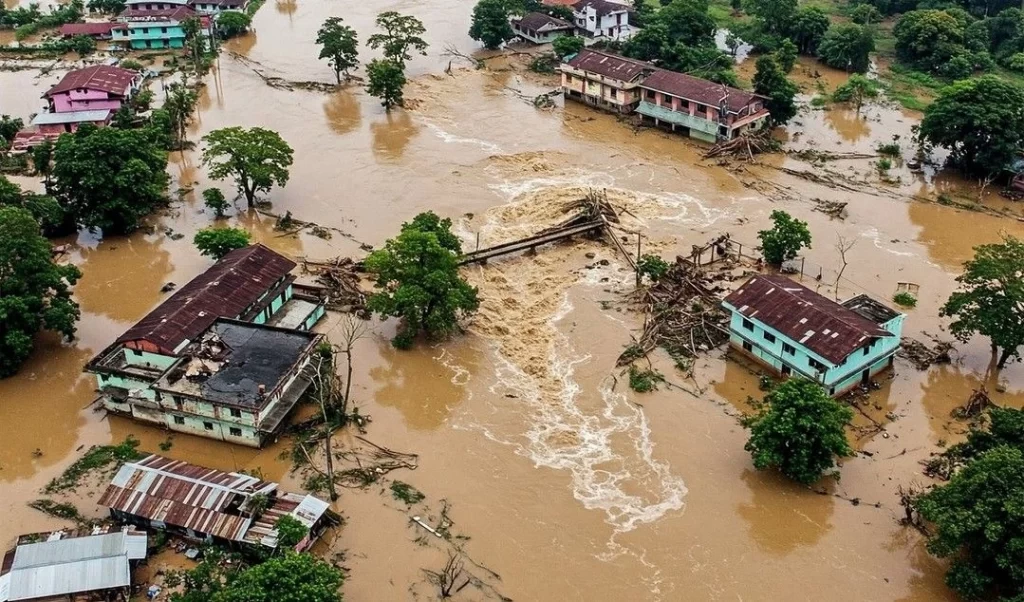
Something weird is going on in the enormous Pacific Ocean. The warm waters are moving like an invisible force, and they can turn India’s life-giving monsoon into a distant drizzle. El Nino is a change in the weather that has dried up crops, risen food prices, and put a strain on water supplies across the subcontinent. The India Meteorological Department (IMD) is getting set to make its official monsoon forecast for 2026, but early simulations reveal that things may not proceed as planned. If you know what El Nino is in basic words, you’ll understand why your home’s water tank, kitchen supplies, and electricity bills can be higher this summer.
The Warm Pacific Waters Phenomenon: What El Nino Means
El Nino is a large fluctuation in the temperatures of the ocean in the equatorial Pacific. Trade winds frequently push warm surface water west toward Australia and Asia. This permits colder, nutrient-rich water surge up from the coast of South America. La Nina is the name for when this happens more strongly. But every few years, these winds slow down or shift direction. This makes warm water pile up in the eastern Pacific. El Nino, which means “the child” in Spanish, is what this is called. It happens most often around Christmas.
Imagine a global thermostat that has gone crazy: sea surface temperatures rise by 0.5°C or more over normal throughout a wide area from 5°N to 5°S and from 120°W to 170°W for at least five months in a row. The U.S. National Oceanic and Atmospheric Administration (NOAA) indicates that the Niño 3.4 index has been held around +0.8°C since March 2026. This means that a mild El Niño declaration could come by the middle of the year. This heat doesn’t stay put. It sends waves through the air that modify jet streams, rainfall patterns, and even the trajectories of cyclones around the planet.
This strange thing in the Pacific isn’t simply a scientific curiosity for India; it directly affects the southwest monsoon, which brings 70 to 80 percent of the country’s yearly rain from June to September. The monsoon isn’t just rain; it’s what makes farming, electricity, and safe drinking water for 1.4 billion people possible.
Historical Nightmares: How El Nino Has Ruined India’s Monsoon
We can learn a lot about how El Nino affects the Indian monsoon from the past. When you look at records, you can see trends that are disturbing. Niño 3.4, one of the strongest El Ninos ever recorded, reached a peak of +2.3°C in 1997, which led to a 5% drop in rainfall across the country. Maharashtra got 37% less rain, and Gujarat and Rajasthan got even less. This devastated harvests of rice, lentils, and cotton. Food costs rose by 10 to 15 percent, and the levels of reservoirs fell, which led Mumbai and Delhi to limit their water use.
Another moderate El Niño (Niño 3.4 at +1.6°C) in 2009 lowered monsoon rainfall by 22%, the most since 1972. Central India was struck the hardest, with Madhya Pradesh experiencing a 49% deficit. The amount of Kharif went down by 8%, which caused the prices of rice and wheat to go up by 20% to 30%. When the hydroelectric plants in the northeast and west ran out of water, power disruptions spread. The country had to rely on costly coal imports.
The event in 2023 was a recent gut punch. A strong El Nino led the monsoon over India to be 6% short by reaching a peak of +2.0°C. Things got better in the northwest, but southern regions like Tamil Nadu and Karnataka were still 20–30% short. Prices for edible oil went up by 12% because the harvests of groundnuts and sugarcane fell by 15%. These things indicate how awful the figures are: The IMD’s 50-year analysis found that during moderate to strong El Ninos, India has less rain during the monsoon 70% of the time.
A quick glance at the most important consequences in history:
1997: 5% deficit; food prices rose by 12%; drought affected more than 300 locations.
22% deficit in 2009; GDP growth decreased by 1.5%; rural poverty reached its peak.
2023: 6% deficit; vegetable prices went up 25%; Bengaluru faced a water crisis.
These aren’t just random happenings; El Nino has caused 40% of India’s weak monsoons since 1950.
Models say that IMD’s monsoon projection for 2026 is not very reliable.
Right present, the IMD’s 2026 monsoon forecast is very crucial. As of the end of March 2026, models from IMD, NOAA, and the European Centre for Medium-Range Weather Forecasts (ECMWF) all agree that a minor El Nino would linger until the monsoon season. Mrutyunjay Mohapatra, the director of IMD, indicated at a recent briefing that dynamical models show a 55–60% possibility of below-normal rainfall. The Niño 3.4 index is expected to be between +0.7 and 1.0°C by June.
The IMD’s long-range forecast, which generally comes out in April, will make this better. The Current Climate Forecast System (CFSv2) indicates that the monsoon rains will be 94–96% of the long-term average, which is 89 cm. The IRI/CPC multi-model probabilities imply that a La Nina flip is still unlikely before July (only a 25% chance). The Madden-Julian Oscillation (MJO) is getting stronger, but the Indian Ocean Dipole (IOD) is not changing. This might assist, but El Nino is in charge, so the scales are tipped.
M. Rajeevan, a former head of the IMD, says that “even a small El Nino influences the Walker Circulation, which decreases monsoon troughs across central India.” Satellite data from INSAT-3D backs this up by indicating that convection is feeble over the Pacific near the equator.
States on the Frontline: Charting the Dangers of Little Rain
The effects of El Nino on the Indian monsoon produce different kinds of scars in different places. Historical data illustrates where the hotspots are:
Central India (Madhya Pradesh, Chhattisgarh, Maharashtra): 60% of mild El Nino years have 20–40% deficits here, which is the heartland of the monsoon trough. Models predict there is a high risk in 2026, which might lower the yields of soybeans and grams.
Northwest (Rajasthan, Gujarat, Haryana): The damage is worst when the land is dry. In 1997, half of the crops died. In 2026, the same scenario will happen, but it will affect cotton and bajra.
In the South Peninsula (Karnataka, Tamil Nadu, and Andhra Pradesh), 30–35% of crops are frequently short. Coffee, black pepper, and mangoes are especially at risk.
Northeast and East: Not too bad, although showers that don’t happen all the time could produce floods in some places.
IMD’s maps of susceptibility by district put these at the top of the list for emergency planning. People in Maharashtra who herd buffalo and people in Gujarat who fish are already getting ready for tough times.
The Domino Effect: Prices of food, water, and electricity all at risk.
A weak monsoon doesn’t just make the crops wet or not; it also impacts India’s economy. Agriculture employs 45% of the workforce and contributes 18% to GDP. According to ICRIER, a 10% decline in rainfall has traditionally led to a 5–7% drop in kharif output and an 8–12% rise in food prices.
Food costs went raised because of El Nino. For example, rice prices could go up 15% and pulse prices could go up 20%, like they did in 2023. Vegetables like onions and tomatoes, which are already unstable, might double, which would impact the poor in cities the most. The wholesale pricing index (WPI) for food went raised by 10% after 2009.
Water Supply Strains: The monsoon fills up 60% of the groundwater and 70% of the reservoirs. There would be rationing in the summer of 2027 since there wasn’t enough. After 2023, the Yamuna River in Delhi dropped by 40%. The same event happened in Chennai and Hyderabad.
Power Crunch: Hydropower, which makes up 12% of capacity, falls by 20–30%. There isn’t enough coal, and tariffs have gone boosted by 10 to 15%. Businesses in Tamil Nadu and Karnataka used to have to deal with power outages.
People moving to cities, the stock market going down for agricultural equities (5–10% in 2023), and curbs on rice and sugar exports are some of the bigger repercussions. The Price Stabilization Fund and other government buffers help, but climate change puts those limits to the test.
Adaptation Strategies: India’s Fightback Arsenal India isn’t just sitting back. The National Mission on Sustainable Agriculture backs crops that can tolerate dry spells, like short-duration rice and millets. Micro-irrigation now covers 12 million hectares, which is 50% more than it did in 2020. The Meghdoot app offers real-time advise from IMD to 50 million farmers. So far, cloud seeding tests in Maharashtra have gone well, and the area has seen a 15% increase in rainfall.
AI-powered models from IITM make predictions better all across the world. The Prime Minister’s crop insurance program has helped 5 crore farmers, and after 2023, the total amount of money paid out would be ₹1.5 lakh crore.
What El Nino implies for India’s 2026 monsoon and how it will affect your life