The Artemis II mission, NASA’s bold step back to the Moon with humans aboard, is finally eyeing liftoff this month after a string of setbacks. With launch windows opening April 1 through 6 and another on April 30, the pressure is on to get the crew around the lunar surface for the first time since 1972.
A Historic Crew Prepares for Deep Space
Four astronauts make up the Artemis II team: NASA commander Reid Wiseman, pilot Victor Glover, mission specialist Christina Koch, and Canadian Space Agency’s Jeremy Hansen. Wiseman, on his second flight, leads the pack with Glover at the controls, Koch handling key systems, and Hansen marking Canada’s first deep-space voyager.
These folks aren’t newbies. Glover flew on Crew-1 to the ISS, Koch holds the women’s single spaceflight record at 328 days, and Hansen brings CSA expertise. Together, they’ll break barriers—Glover as the first person of color to the Moon, Koch the first woman, Hansen the first non-American.
What does it take to strap into Orion knowing you’re heading farther from Earth than anyone since Apollo? The crew suited up in custom orange gear, complete with touch-screen gloves and better cooling, before boarding on April 1.
Technical Glitches That Pushed Back Liftoff
Delays hit hard. Early February 2026 targeted a launch, but a wet dress rehearsal on February 2 revealed a liquid hydrogen leak at the core stage’s service mast, plus valve issues on Orion’s hatch.
Teams rolled the stack back to the Vehicle Assembly Building after a helium flow problem in the upper stage. A second rehearsal went smoother on February 19, but weather and fixes extended the wait.
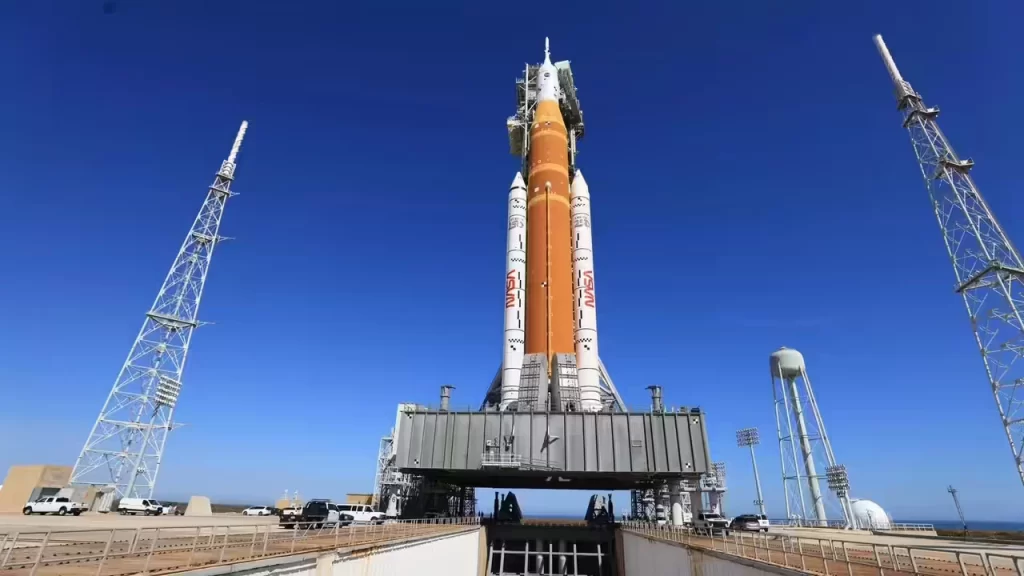
By March 12’s Flight Readiness Review, NASA locked in those seven two-hour windows starting April 1 from Kennedy’s Pad 39B—the same spot as Apollo and Shuttle blasts. On March 20, high winds delayed rollout, but the SLS-Orion stack made it.
Heat shield woes from Artemis I’s 2022 reentry—unexpected char loss—forced trajectory tweaks for a steeper entry, skipping the “skip reentry” plan. Engineers tested fixes, confident Orion’s AVCOAT holds up at 25,000 mph reentry speeds.
Launch Day Drama Unfolds
April 1, 2026, brought the moment. Countdown kicked off March 30, tanking started early with cryogenic chilldowns for 700,000 gallons of LOX and LH2 in the core stage.
Crew woke at 9:25 a.m., suited up by 1:15 p.m., played cards (commander lost for luck), and walked out at 2 p.m. They boarded amid hatch checks and sensor tweaks—a flight termination comms glitch briefly held things at T-5 hours.
Closeout crew sealed hatches by 5:57 p.m., polls went “go,” and at 6:35 p.m. EDT, SLS roared with 8.8 million pounds of thrust. Boosters separated at T+2:09, core cutoff at T+8:02, upper stage took over.
Solar arrays deployed post-separation, spanning 63 feet for power. A minor T-10 hold extended prep time in the two-hour window.
The 10-Day Journey Around the Moon
Artemis II isn’t landing—it’s a 10-day test flyby on a free-return path, looping the Moon via gravity sling without orbit.
Day 1: Earth orbit checkouts, proximity ops with the spent ICPS stage for docking practice.
Days 2-4: Trans-lunar injection burn, manual flight tests, trajectory corrections.
Day 6: Lunar closest approach ~4,700 miles from the far side, max distance 252,757 miles from Earth—beating Apollo 13.
Days 7-10: Return burns, reentry, Pacific splashdown near San Diego.
Crew tests life support, optics comms at 260 Mbps, and payloads like AVATAR organ analogs for radiation effects, plus CubeSats from Germany, Argentina, Korea, Saudi Arabia on space weather.
Orion’s European Service Module handles burns; experiments track sleep, immunity via saliva samples. Public names flew on an SD card, and mascot “Rise” rode inside.
Tech Marvels: SLS and Orion in Action
SLS Block 1, tallest rocket at 322 feet, packs twin boosters and four RS-25 engines reused from Shuttle days. Orion, aptly named Integrity, protects the crew from the harsh radiation of deep space.
An optical communications demonstration using ground-based lasers is expected to significantly increase data transmission rates. After launch, the arrays are locked, and the adjustments to perigee and apogee set the stage for the translunar injection burn.
India’s participation, cemented by the Artemis Accords signed in 2023, encompasses ISRO-NASA agreements. These agreements cover ISS astronaut missions and the use of Chandrayaan-2 data to aid lunar endeavors. This partnership, watched with great interest from Pune, bodes well for upcoming collaborative Moon missions.
The global significance of this mission, and what comes next, is unmistakable. This flight confirms the systems designed for Artemis III, which aims to land on the Moon in 2027. The hurdles encountered, including setbacks, have yielded useful lessons, resulting in refinements to seals and valve torques. The successful execution of this mission opens the door to the Gateway station, lunar outposts near the south pole, and the eventual exploration of Mars.
From hydrogen leaks to hatch pressurization, every fix sharpens the edge. India’s Accord role? Could mean ISRO tech in future habitats or rover teams.
As Orion slings past the Moon today, one wonders: will these windows close without a hitch, or test resolve again? The crew’s now equidistant Earth-Moon, pushing human limits.
Eyes on the Future Horizon
Artemis II revives Moon dreams post-Apollo 17. With launch nailed despite odds, NASA eyes sustained presence—science outposts, resource mining, Mars stepping stones.
Challenges built resilience; the stack’s rollout, tanking precision, crew grit shone through. Glover, Koch, Hansen, Wiseman aren’t just flying—they’re trailblazing for all.
Back on Earth, billions track via streams. Splashdown April 10 caps it, but the real win? Proving we can go back, farther, together. For space fans in Mumbai to Melbourne, this April’s windows opened a new era—no turning back now.
NASA Sets Multiple Launch Windows in April for Long-Delayed Artemis II Moon Mission Amid Technical Hurdles