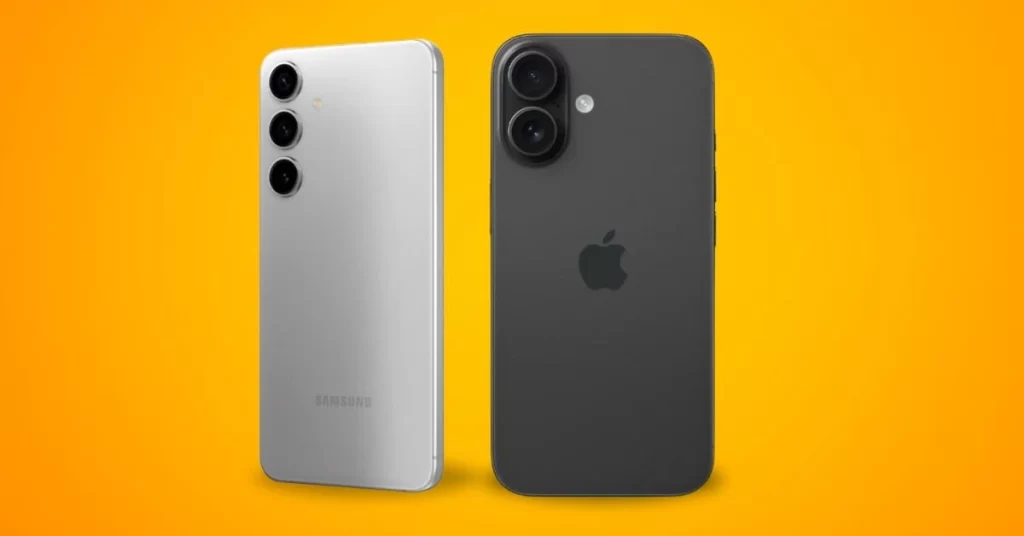
Two significant things. One screen. A lot of choices. In 2026, the battle between Apple and Samsung isn’t as much about who makes the finest phone as it used to be. It’s more about who can affect the way you live, work, and even think about your phone. New flagship launches from Cupertino and Seoul aren’t just incremental upgrades; they’re part of a high-stakes battle for control of the ecosystem, AI, and customer loyalty.
This tournament is more significant than ever for people in India and all over the world. There are a lot of smartphones you can buy right now that will keep you connected to apps, services, and smart gadgets for years to come. Some examples are the iPhone 18 series, which is said to be out in 2026, and Samsung’s Galaxy S26 and foldable line-up.
The battlefield is evolving; it’s not just about the specs.
The Apple-Samsung arguments appear to go on and on if you only look at the numbers, such the size of the screen, the quantity of RAM, or the number of megapixels in the camera. But the real fight is happening behind the scenes in 2026.
Now, let’s focus on the most important things for 2026.
Apple’s 2026 roadmap: iPhone 18 and beyond.
Whispers and expert opinions suggest Apple’s focus is shifting. The company seems more interested in refining the camera, extending battery life, and integrating AI capabilities, rather than completely overhauling the phone’s appearance.
It looks like the iPhone 18 series will have some interesting new features.
There will be a new A19 series processor that should greatly improve the performance of the neural engine for AI apps that run on devices.
A new camera system is also on the way. This will use computational photography to make Night mode better, make portrait detection more accurate, and give video stabilization more intelligence.
It might have a different design, a bigger screen, and a new carbon-lithium battery setup that lets you use it for longer.
Apple’s main goal seems to be to be “less showy, more reliable.” The company is betting on those who care more about reliability, app compatibility, and long-term support than the highest megapixel count. This story about how long the iPhone lasts is a perfect way to sell it in India, where second-hand iPhone markets are doing nicely.
Apple is also trying to improve its AI-powered assistant suite, Apple Intelligence, so that it can handle more tasks directly on devices. This shift is in keeping with people’s growing worries about privacy.
This shift could totally impact how Indian consumers utilize the service. They are more anxious about data privacy now, even though they prefer smart services like voice reminders, quick translation, and photo editing.
Samsung has plans for S26, foldable phones, and AI in 2026.
Samsung has great plans for the year 2026. The Galaxy S26 line is coming out in early 2026. It will focus on “proactive intelligence,” which is an AI model that can work on both devices and in the cloud.
The following are some of the most important improvements that are expected:
Depending on where you live, the top-of-the-line Snapdragon 8 Elite-series or Exynos 2600 CPUs can have up to 12 GB of RAM and 512 GB of storage.
Better camera systems, with the Ultra version perhaps keeping a 200-megapixel main sensor but growing better at low light and zoom.
Better integration of Galaxy AI features like Circle to Search, real-time translation, and AI-assisted note-taking on phones, tablets, and watches.
Ecosystems that don’t get along: users who are stuck or users who can switch?
The ecosystems, not the technology, are what make the Apple-Samsung competition so strong.
Apple’s ecosystem has a lot of lock-in. You could want an iPad, an Apple Watch, AirPods, or a MacBook at some point if you buy an iPhone. You can send messages from your watch, AirDrop from your Mac, and FaceTime from your iPad without any hassles. Most firms can’t compete because of this.
Samsung, on the other hand, is part of the greater Android ecosystem. You won’t lose access to your essential apps whether you go from Samsung to OnePlus, Xiaomi, or even Google in the future. The Galaxy Buds, Galaxy Watch, Galaxy Tab, and Samsung DeX that come with Samsung’s ecosystem seem more like “luxury add-ons” than items you need.
This is very important for Indian customers.
Apple’s ecosystem is great for people who want consistent, high-quality service, but it usually costs more.
The Samsung ecosystem is more adaptable and often a better price, especially in the mid-range where the Galaxy A and M series are the most popular.
More and more Indian customers are having this problem: Should they buy a new phone for thousands of rupees that locks them into its environment or one that allows them switch if something better comes along?
AI is the new frontier: privacy versus features.
AI won’t only be a craze by 2026.
It is secretly incorporated into everything from personal assistants to camera software.
Apple is adding Apple Intelligence as a layer to existing iOS features that focuses on privacy. The goal is to accomplish more things on the device itself, like shortening long messages, generating images, and changing photos, without sending anything to the cloud. This strategy works well in regions where rules around data privacy are getting stronger or where people are starting to wonder how companies generate money from their data.
Samsung’s Galaxy AI, on the other hand, has more functions. The startup is advertising features like real-time call translation, AI-assisted note-taking, and smart photo editing that can correct blurry photographs, add items to pictures, and even take things out of pictures. At first, these features may seem more powerful, but they rely more on cloud processing and data sharing.
For a writer in Mumbai, a student in Delhi, or the head of a business in Ahmedabad, the choice is a little trade-off:
Apple: fewer flashy features, better promises of privacy, and stronger connections across devices.
Samsung: better tools, more chances to try new ideas, and a little more openness regarding how data is utilized.
Points of view from around the world and India
Apple and Samsung are still the top brands in the high-end market around the world, but Chinese companies like Xiaomi, Vivo, and Honor are putting pressure on them. Experts estimate that the global smartphone market will only grow modestly in 2026 because consumers are keeping their phones for longer. That makes the main contest much more significant because every sale counts for two.
In India, things are more complicated. Apple is becoming more and more popular in the high-end market, but Samsung still has a substantial share, notably in the mid-range and online-only segments. Samsung has a clear edge in reaching a lot of people because it offers huge discounts during holidays and online sales, as well as bundles that focus on Jio and Airtel.
Apple is slowly addressing the impression that an iPhone is “too dear” for most Indians by opening more stores and offering trade-in schemes. For a young worker in Nashik or Jaipur, a mid-range iPhone or a refurbished model can suddenly seem like a real improvement, not just a luxury dream.
Things the average person should think about: This doesn’t indicate that one brand is “winning” in 2026. It’s a good thing that there is competition among smartphone users.
If you’re trying to decide between Apple and Samsung right now, here are a few things to think about:
Budget and ecosystem: How much are you willing to spend over the next three to five years, not just today?
Do you care more about having a lot of AI-powered tools or about keeping your data safe?
Longevity and support: Which brand makes you sure that your phone will still work well in the future?
And here’s another thing to think about: Should a smartphone be a stable, quiet tool, or should it be a platform that changes all the time and gets new features every few months? Your answer could quietly point you toward Apple, Samsung, or something in between.
The New Smartphone War: Apple vs. Samsung 2026 Changes How You Upgrade