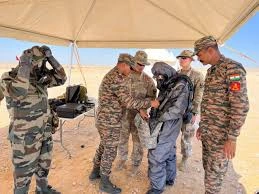
This week, soldiers from India and Egypt are going to the training grounds together for the next round of their joint military exercise, “Cyclone.” This isn’t just another drill; it’s happening at a time when both countries are looking for closer ties to deal with security issues that affect both of them, like terrorism and instability in the region. As the world watches crises flare up in the Middle East and elsewhere, this exercise feels timely—a subtle hint of developing military friendship between two ancient civilizations that are now working together on the modern battlefield.
The drill started on April 7 at the Mahajan Field Firing Ranges in Rajasthan. It involved elite special forces from India’s parachute brigade and Egypt’s commando battalions. Officials say it’s all about getting better at working together, discussing strategies, and creating trust. India’s growing engagement with Africa, alongside Egypt’s move toward non-Western partners, signals a change in the landscape of international diplomacy.
But what does this mean for the average citizen?
Could these drills lead to real-life partnerships when things go wrong?
The Beginning of a Growing Partnership
India and Egypt have been friends for a long time. The past is fueling a resurgence in the here and now.
In 1947, diplomatic connections officially began, but military ties truly took pace in the 2000s. The first “Cyclone” exercise took place in 2019 near Cairo and was focused on fighting terrorism. Since then, it has moved back and forth between the two countries every two years, becoming a regular part of their defense calendar.
Egypt, which is between Africa and the Arab world, has been an important part of India’s efforts to reach out to Africa. New Delhi sees Cairo as a gateway because it is stable, powerful, and eager to work with tech companies. Do you remember when President Abdel Fattah Sisi went to India in 2015 and 2017? Those set the stage with agreements on weapons, planes, and training. India, on the other hand, gives Egypt BrahMos cruise missiles and has trained hundreds of Egyptian officers. “Cyclone” fits nicely in with this, turning paperwork into useful talents.
This year’s version is even better. There are about 250 soldiers on each side. Indian paratroopers are recognized for their high-altitude operations in Ladakh and Siachen, while Egyptian commandos are battle-hardened from fighting ISIS affiliates in the Sinai Peninsula. The drill lasts until April 20 and includes both classroom time and live-fire training. It’s a chance for both sides to see how well they can work together, which is what interoperability means.
What’s on the menu for training?
The main goal of “Cyclone” is to create special forces scenarios that are like real threats. Imagine fighting in fake villages in the city, moving around in the desert under the hot sun of Rajasthan, and attacking from helicopters. What is the focus? Counter-terrorism, hostage rescues, and sharing intelligence are all abilities that are in the news right now.
Key parts are joint planning drills where teams use maps and intelligence to plan attacks on terrorist camps; tactical maneuvers like night raids, sniper engagements, and close-quarters battle with gear like India’s advanced drones and Egypt’s tough ATVs; live-fire integration with AK-series rifles, Egyptian-made small arms, and Indian INSAS in coordinated volleys; and tech sharing with demos of night-vision gear, UAVs for reconnaissance, and basic cyber defense.
It’s hard labor. Soldiers deal with 45°C heat, long nights, and linguistic gaps that are crossed by English and hand gestures. One Indian officer said that the Egyptians were good at fighting in the desert because they had done it before. Egyptians, on the other hand, learn how to battle in the mountains from India. It’s not just theory; it’s muscle memory being developed, so no surprise coordination feels electrifying.
Have you ever thought about how two armies from different continents can work together so quickly? The main problem is that both countries have to deal with jihadist groups, smuggling networks, and neighbors who aren’t stable. India has groups that come from Pakistan and Myanmar. The Sinai conflict has killed thousands of people in Egypt since 2013.
Why Now? Geopolitics in Action: Timing is Important “Cyclone” starts in a world that is on edge. The crisis in Ukraine has raised energy prices, which has hurt Egypt’s Suez Canal profits. The fighting between Israel and Hamas is affecting the whole region and putting Cairo’s role as a mediator to the test. India needs trustworthy friends like Egypt to help it diversify while also balancing its Quad relations with arms sales with Russia.
From India’s point of view, this accords with “Neighborhood First” and “Act East” going west. Egypt has been a BRICS partner since January 2024, together with India, China, Russia, and others. Last year, trade was $7.2 billion, up 20%, with a lot of it coming from military. Egypt imports Indian wheat, medicine, and now replacement parts for the military. In return, India gets a foothold in North Africa, which goes against China’s Belt and Road Initiative.
It’s a multipolar flex around the world. The US sells the most weapons to Egypt ($1.3 billion a year), but Cairo is branching out with French Rafales, Russian MiGs, and now Indian tech. India is the world’s biggest importer of weapons, but now it’s the biggest exporter, with Egypt among the 80+ buyers. “Cyclone” makes that credibility stronger.
India-specific angle: Rajasthan’s ranges are a hub for these kinds of drills. For example, “Yudh Abhyas” with the US or “Mitra Shakti” with Sri Lanka. Hosting “Cyclone” here shows off India’s infrastructure, from its huge deserts that look like Sinai to its cutting-edge firing technology.
The Modern Edge: Technology and Strategy
Don’t be fooled by the sand and heat; “Cyclone” is a powerful weapon. India is showing off its Akashteer air defense system and swarm drones, which are important after recent fights at the border. Egypt learns from using Chinese Wing Loong UAVs in operations in Libya. India sends Heron TP drones and tactical UAVs for reconnaissance, as well as BrahMos missiles and ATAGS artillery. Egypt sends surveillance equipment that works in the desert, Sakr rockets, and small arms experience. India’s close-quarters fighting and high-altitude techniques are taught to Egypt, while Egypt’s urban counter-insurgency skills are taught to India.
This isn’t a one-way street; it’s a two-way street. According to reports from around the world, Egypt’s military has been involved in counter-terrorism operations for more than 10,000 hours since 2011. India learns about threats in the Red Sea, where Houthi strikes stop 12% of international trade.
Women in uniform add something else. For the first time, Indian women are joining the paratroopers, which is similar to Egypt’s quest for gender equality. It’s a tribute to being open-minded in the macho world of special ops.
Problems and Real-World Effects
Things aren’t always going well. Logistics get in the way of multilingual communication, and the different ways of thinking about defense in India and Egypt lead to good debates. Weather is unpredictable; Rajasthan dust storms have stopped helicopters in the past.
What are the wider effects? If they get along better, they might patrol the Indian Ocean together, where piracy is a problem. For Indian companies like HAL and Bharat Dynamics, exports are quite important. Defense agreements produce jobs, which is good for the economy. Think about the 5,000 jobs that the defense corridor in Rajasthan created.
India’s relationship with Africa is equally interesting. Egypt is a crucial participant because of the “Cyclone” exercise, which involved more than fifty activities across the continent. Prime Minister Modi’s 2023 visit to Egypt yielded a dozen agreements. The following actions showcase their execution.
What Comes Next After the Drill?
Expect more when “Cyclone” ends. There are rumors of a 2027 version in Egypt’s Western Desert, possibly with naval support from INS Vikrant and Egypt’s Mistral carriers. In the long run, it might turn into trilateral drills with the UAE or Saudi Arabia, similar to India’s I2U2 group.
This isn’t only time for soldiers to play. It’s countries betting on a broken planet. India strengthens its southern border, and Egypt moves away from Western ties. It implies safer commerce routes and fighting terrorism together for civilians.
In the end, “Cyclone” teaches us that defense isn’t a zero-sum game. Two soldiers, sweating next to each other, show that old allies can learn to battle again. Will this start a defense boom between India and Africa? Only time and more practice will tell.
The “Cyclone” military exercise between India and Egypt has begun, marking a new chapter in defense ties at a time of global tensions.