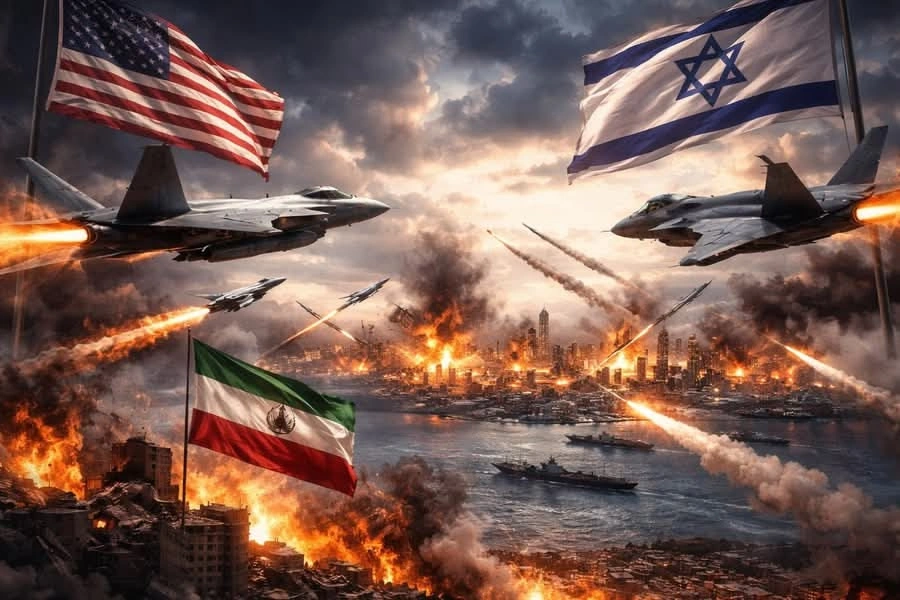
The delicate ceasefire, brokered with Pakistan’s assistance on April 8, 2026, between the US and Iran is teetering on the edge. Israel’s intensified military operations against Hezbollah in Lebanon could reignite the Middle East conflict. This two-week truce, initially hailed as a diplomatic triumph, was intended to reopen the Strait of Hormuz and restore stability to global oil supplies.
However, fighting across borders has made it harder for either side to control. This fragile peace is now on the line, and the potential of anarchy spreading beyond the borders of Israel and Lebanon is growing.
A Ceasefire That Had to Happen
The deal between Washington and Tehran came about after a standoff that started in early 2025, when Israel’s war against Iran’s proxy forces in Lebanon turned into a full-blown regional war. President Donald Trump issued a warning to Iran, stating that he would target its infrastructure, such as bridges and power plants, if the Strait of Hormuz, a vital waterway for international energy transport, remained closed. Pakistan’s involvement helped broker a deal, effectively halting hostilities between the United States and Iran.
Iran promised to reopen the Strait of Hormuz, while the US promised to give the two sides 15 to 20 days to reach a lasting agreement. The pact also includes talks about nuclear limits and easing of sanctions, but Iran’s complete 10-point proposal calls for an end to hostilities without any conditions and the lifting of all sanctions.
Lebanon: The Flashpoint
Lebanon is the ceasefire’s weak point since Israel is still fighting Hezbollah even though the ceasefire is in place. Since 2026, the ceasefire between Israel and Lebanon that took effect in November 2024 has been under pressure. It required Hezbollah to leave the area north of the Litani River and for Israel to completely leave southern Lebanon. Israeli bombings have intensified recently, and whispers suggest that “Operation Eternal Darkness” is now targeting Hezbollah positions in southern Lebanon and the outskirts of Beirut.
The Lebanese government calls these strikes war crimes because they are killing civilians and forcing them to flee to the north. Since 2025, the International Committee of the Red Cross says that more than 1,400 people have died in Lebanon and more than 1 million have been forced to leave their homes. This is a humanitarian disaster that makes people in the region angry.
Hezbollah has acted quickly: the group says it has stopped attacking Israel, but it can still hit back if Israel keeps attacking. Rocket attacks on northern Israel, particularly Kiryat Shmona and Manara, have put the area on edge. The fundamental cause of the tension is that Israel won’t fully pull out of southern Lebanon and is keeping five vital border outposts, even though the ceasefire rules say they should. This “security buffer zone” proposal, backed by far-right ministers like Aryeh Deri, shows how determined Israel is to get rid of Hezbollah’s menace, even if it means breaking the larger peace.
Effects on the region and the world
The stakes are much higher than just the Middle East. The Strait of Hormuz, which carries 20% of the world’s oil and gas, is practically closed even though there is a ceasefire. Iran is charging ships $1 million in fees. On the first day of the truce, only four dry cargo ships sailed through, compared to the typical 20 tankers a day. This hurt global energy markets and inflation. Leaders in Europe have raised concerns about the possibility of fresh supply disruptions, while India, a big importer of energy, has called for a quick resolution to ensure that commerce can continue without interruption.
Iran’s “Axis of Resistance” supporters, including Houthi rebels in Yemen, militias in Iraq, and parties in Syria, have launched drone and missile attacks on Gulf governments including the UAE and Saudi Arabia. This makes the US–Iran ceasefire even more fragile. Bahrain and Kuwait have condemned these attacks, which have targeted oil infrastructure and set fires in Abu Dhabi’s Habshan complex and a Saudi pipeline. The Gulf’s response shows how dangerous it is to escalate: one mistake might set off a chain reaction that brings in additional regional actors and makes it harder for the US military to keep its obligations.
Horrific humanitarian situations and political calculations
The humanitarian cost in Lebanon is huge. According to Lebanon’s Civil Defense, hospitals are full because of recent Israeli strikes that killed more than 254 people and hurt 1,165 more. The Geneva-based International Committee of the Red Cross said that healthcare facilities have been “regrettably damaged,” and the Lebanese Red Cross is raising money for the victims. The war has destroyed the Beqaa Valley, the southern suburbs of Beirut, and towns in the south including Bint Jbeil and Kafra, where families are living in temporary shelters. UN humanitarian chief António Guterres has urged all parties to fully honor ceasefire agreements, emphasizing the need to safeguard civilians. However, achieving this in practice has proven difficult.
The ceasefire itself highlights divisions among political allies.
Pakistan’s Prime Minister Shehbaz Sharif says that Lebanon is part of the cease-fire, while Trump and Israel’s Prime Minister Benjamin Netanyahu say it isn’t. Netanyahu’s position shows that hardliners in Israel see Hezbollah as a threat to their own existence, even though French President Emmanuel Macron says that occupying southern Lebanon is not possible. Iran’s leadership, on the other hand, calls the ceasefire a “success,” saying that Trump has agreed to its 10-point proposal, which includes lifting sanctions and pulling US troops out of the country. But Iranian hardliners, like Mojtaba Khamenei, are against what they see as concessions because they are afraid the US will use the truce to carry out further attacks in the future.
Will the truce last?
There are a number of things that need to happen for the truce to last. First, Israel needs to calm down its campaign in Lebanon, which is hard to do because Hezbollah has a lot of rockets and Iran supports them. The US may put pressure on Israel through diplomacy or arms sales, but this is harder to do because Trump is close to Netanyahu. Second, Iran must fully reopen the Strait of Hormuz without charging tolls. This might make Gulf states and Europe happy. Third, countries in the region, like Qatar and Russia, need to keep mediating and building on what Pakistan has done.
The human cost shows how important it is. As the strikes go on, one must wonder: How many more people will die before there is a lasting peace? The answer might be another ten years of fighting in the Middle East or a tentative new beginning of peace. For now, the truce is a shaky bridge across a chasm of violence—one wrong move might lead to more upheaval in the region.
US–Iran Ceasefire on the Brink as Israel–Lebanon War Grows