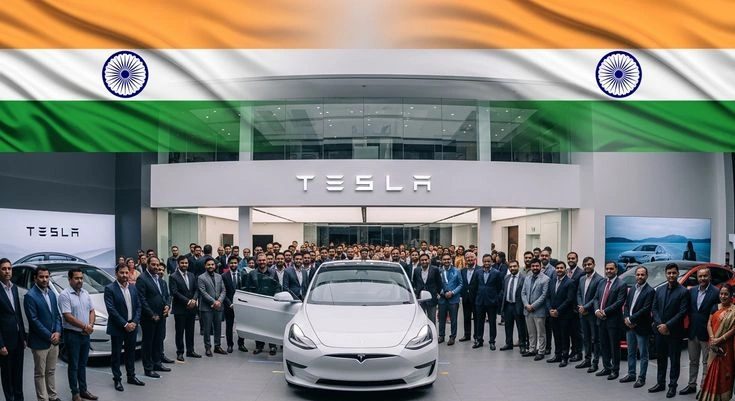
India is preparing for Tesla’s electric aspirations. Elon Musk’s American EV company is reportedly negotiating to set up a large factory, potentially its first in the country. This isn’t just idle speculation; it’s a significant development that could accelerate India’s transition to green transportation, generate thousands of jobs, and position the nation as a global hub for electric vehicles.
The government is offering incentives for electric vehicles, and Tesla is looking for places to build them. This is the perfect time for a big step forward. Why does this matter right now? India is trying to cut down on oil imports and emissions as quickly as possible. Tesla’s presence could change the game.
Reliable sources say that Tesla officials have been to possible sites in Gujarat and Maharashtra, two states that are already busy making cars. Musk himself alluded to India during a business earnings conference in late 2025. He said the company was “working through” import tariffs and restrictions for making things in India. In early 2026, negotiations with federal ministries are moving along quickly. The business intends to spend billions of dollars to build a Gigafactory-style factory that makes automobiles, batteries, and maybe even gear for storing energy. This is the kind of news that makes investors happy and government officials agree.
India isn’t wasting any time. The government’s Production Linked Incentive (PLI) program for cars, which was extended in 2025, offers up to ₹26,000 crore in subsidies to electric vehicle (EV) producers that agree to make their cars in India. Tesla’s move makes great sense: import tariffs on fully built EVs are between 70 and 100%, but they go down a lot for EVs made in the US. Do you remember when Musk tweeted about India’s high tariffs in 2021? Things have changed. Tesla sees a way forward now that the EV policy limits duties at 15% for companies who invest $500 million and start making cars in the US within three years.
The Search for the Right Place: The Fight Between Gujarat and Maharashtra
Where will the Tesla India electric vehicle factory be built? That’s the million-dollar question that many in the car industry are asking in boardrooms and on WhatsApp. Gujarat is in the lead. Last month, the state, which is home to Tata Motors’ Sanand plant and several suppliers, rolled out the red carpet. There, officials offered a 1,000-acre area in Ahmedabad that had access to a port and renewable energy systems. In February 2026, Chief Minister Bhupendra Patel met with Tesla representatives and promised them single-window permissions and places to train people.
Maharashtra isn’t backing down. The state has an industrial belt between Mumbai and Pune and gives tax breaks and land in Chakan or near Nagpur’s MIHAN hub. In March, Tesla’s team looked at both places to see how they could help with logistics and find workers. Pune, in particular, gets a lot of attention because it has a lot of workers from old companies like Bajaj and Mahindra. One person on the inside joked, “Maharashtra has the engineers, and Gujarat has the ports.” Tesla chooses the winner.
Choosing a site isn’t easy. Tesla factories need to be huge, with roofs that are powered by solar panels and water recycling plants. India is learning from Tesla’s Shanghai Gigafactory, which made 950,000 cars a year in less than two years. A nearby plant might do the same thing, aiming for 5 lakh EVs per year by 2030.
Jobs, supply chains, and the ripple effect on the economy
Imagine a Tesla plant in India making Model 3s and Cybertrucks that are perfect for Indian roads. It’s more than just a pretty face; it’s an economic powerhouse. According to estimates, there will be 20,000 direct jobs in manufacturing and 100,000 indirect jobs in batteries, semiconductors, and logistics. That’s a big deal for young engineers in Pune or Ahmedabad, many of whom want to work with the newest technology.
The supply chain for electric vehicles in India also gets a boost. Tesla would need lithium cells, rare-earth magnets, and steel, and it would be best to get these things from nearby sources. Ola Electric is already building a gigafactory in Odisha, while companies like Reliance New Energy and Adani are ramping up battery production. Tesla’s arrival might bring these together, lowering prices and dependence on imports. India now imports 80% of the parts for its electric vehicles. A Tesla India EV plant changes that.
According to NITI Aayog, India’s auto industry employs 37 million people, but electric vehicles might add $200 billion to GDP by 2030. The $2–5 billion investment from Tesla fits with that vision.
A quick look at possible wins:
Creating jobs: more than 20,000 direct jobs in assembly, research and development, and testing.
Supplier growth: More than 500 local merchants sell everything from tires to software.
Export potential: India is Tesla’s low-cost base for Asia-Pacific and Africa.
Have you ever thought that your next car could be “Made in India, driven across the world”?
India’s push for green mobility: Tesla as the spark
Tesla isn’t coming out of nowhere. India is putting a lot of money into electric vehicles to address pollution and climate change. The air in New Delhi is choking, and 30% of pollutants come from transportation. The FAME-III program, which started in 2026, puts ₹10,000 crore into charging stations and subsidies. States like Tamil Nadu and Karnataka are requiring that 30% of all new cars sold be electric vehicles by 2030.
Tesla makes this worse. The Model Y only uses 15 kWh of electricity per 100 km, while petrol SUVs use 25 kWh. Prices go down when things are built locally. A Model 3 made in India may cost ₹30 lakh, which would put it in competition with the Tata Nexon EV or the Mahindra XUV400. Next would come Musk’s Supercharger network, which would make it easier to drive on routes from Mumbai to Delhi without worrying about running out of gas.
There are problems ahead, though. India’s infrastructure is having a hard time keeping up with the demand for electric vehicles. Only 5% of it is fueled by renewable energy right now, compared to Tesla’s solar-heavy plants. The lack of water in Gujarat could stop mega-factories. And what about the laws about workers? Tesla has had problems with unions in other places, and India might be one of those places. The draw is still strong, though. PM Modi’s “Atmanirbhar Bharat” motto loves technology from other countries that has its origins in India.
This is in line with Tesla’s plans around the world. India’s 1.4 billion market—projected 10 million annual EV sales by 2030—is too good to pass up after China and Germany. Competitors like BYD are already in, and Hyundai and Kia build cars in the area. Tesla joins, or it could lose ground.
Roadblocks: Tariffs, Talent, and Tech Gaps
Until it’s done, no deal is done. Tesla wants duty savings to last for five years, but India wants localization to happen faster, with 50% of parts coming from India in the first year. Negotiations are taking a long time, but things are moving forward. Musk’s trip to Asia in January 2026 included visits in Delhi, which made many hopeful.
Another piece is talent. India graduates 1.5 million engineers a year, but there aren’t enough EV experts. At first, Tesla might bring in expertise from other countries. Then, like in Berlin, it might train locals through schools. The infrastructure is also behind; there are only 12,000 public chargers in the whole country. A Tesla plant speeds up repairs.
It’s good for the environment, but it’s also hard. Mining for batteries destroys land, and India needs lithium from Jammu’s sources that won’t run out. Tesla’s promise to recycle could establish norms.
Tesla is eyeing a massive electric vehicle factory in India, a move that could significantly boost the nation’s green transportation efforts.