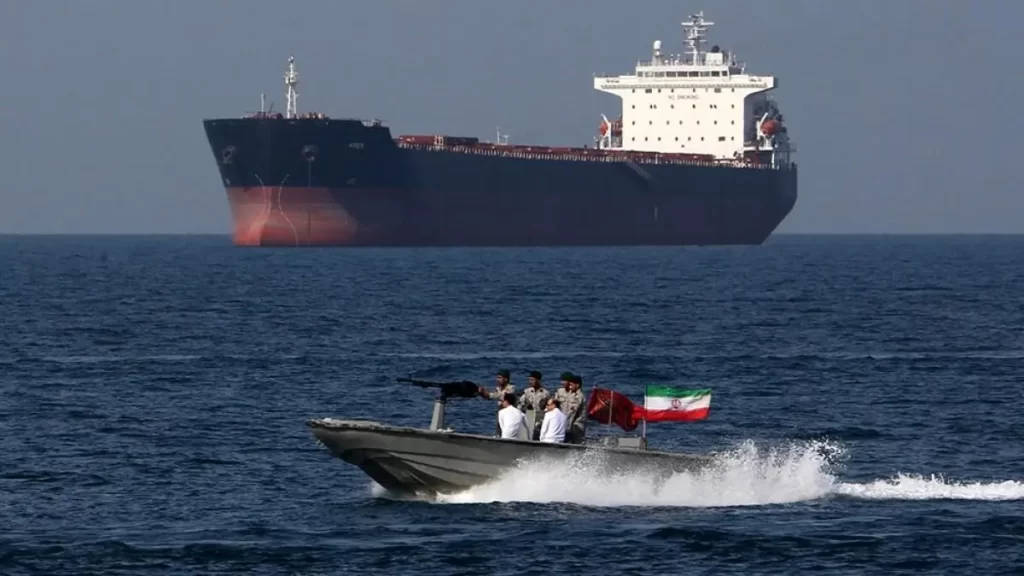
Iran’s navy released footage of its vessels confronting US warships in the Strait of Hormuz — a narrow passage that carries a fifth of the world’s oil. Both sides tell very different stories about what happened next.
There is a stretch of water between Iran and the Arabian Peninsula that is only 33 kilometres wide at its narrowest point, yet it holds the global economy hostage more than any trade agreement, sanctions package, or diplomatic summit ever could. The Strait of Hormuz is not merely a geographical feature. It is a pressure valve — and this week, Iran chose to tighten the grip. Iranian naval vessels approached US warships transiting the strait, issuing on-camera warnings that Tehran wasted no time broadcasting to the world. The footage, released deliberately and strategically, was a message dressed as a maritime incident.
Two versions, one strait
Washington’s account is straightforward: its vessels were conducting lawful transit operations in internationally recognised waters, as they have done for decades. The US Navy maintains a continuous presence in the Persian Gulf, and American officials are adamant that nothing about this passage was unusual or provocative. Tehran sees it entirely differently. Iranian authorities describe the American warships as acting aggressively, encroaching on waters Iran considers within its sphere of influence, and deliberately testing its patience at a moment of already elevated regional tension. The Iran-US conflict, never truly dormant since 1979, has once again surfaced with striking visibility — this time on camera, for a global audience.
“What happens in the Strait of Hormuz does not stay in the Strait of Hormuz — it ripples through every fuel pump, every shipping invoice, every market index on earth.”
What makes this particular confrontation different from earlier standoffs is the deliberateness of Iran’s decision to film and release the encounter. This was not an accidental leak or a third-party recording. Tehran chose to make this public, which means it chose to make this political. The video serves multiple purposes at once: a pointed message to Washington, a call to arms for those at home, and a clear signal to neighboring countries keeping a close eye. Iran isn’t just responding; it’s actively shaping its own story of power in a part of the world where image and the ability to deter are tightly linked.
The chokepoint the world cannot afford to lose
The naval tension unfolding in the Strait of Hormuz would be serious enough on purely military grounds. The Strait is more than just a waterway; its significance goes far beyond the ships that pass through it.
Every day, about a fifth of the world’s oil finds its way through this narrow strait, translating to roughly 17 million barrels.
Saudi Arabia, Iraq, the UAE, Kuwait, and Iran itself all depend on the strait to export their energy to markets in Asia, Europe, and beyond. Any significant disruption to that flow — whether through a prolonged standoff, an accidental exchange of fire, or a deliberate blockade — would trigger an oil route crisis that economies from Tokyo to Berlin are simply not equipped to absorb without serious pain.
The global trade implications extend beyond crude oil. Liquefied natural gas shipments, container vessels, and tanker routes that use the strait as a transit point collectively represent hundreds of billions of dollars in annual commerce. Insurance premiums for ships operating in the region have already climbed in response to previous Iran-US tensions. Another escalation would drive those costs higher still, feeding into the price of goods far removed from anything resembling a warship or a naval standoff. Markets understand this, even when political leaders pretend the situation is contained.
The pattern that never quite breaks
Iran and the United States have danced on the edge of this particular cliff before. In 2019, Iranian forces seized a British oil tanker. In 2020, the assassination of General Qasem Soleimani brought the two countries to what many believed was the threshold of open war. Naval confrontations in the Gulf have occurred periodically for years, each one generating headlines, each one eventually subsiding without a catastrophic exchange — but also without any fundamental resolution of the underlying tensions. The Iran-US conflict persists because its root causes — nuclear ambitions, sanctions, regional proxy competition, and mutual distrust — have never been seriously dismantled. They have only been managed, imperfectly and temporarily, until the next flashpoint.
That pattern offers some cold comfort. History suggests neither side wants a full military confrontation in the strait. Iran cannot afford the retaliatory consequences. America cannot afford another open-ended conflict in the Middle East. And yet history also shows that miscalculations happen — that a warning shot misread, a vessel that veers too close, a commander who acts faster than his orders, can undo decades of careful deterrence in a matter of minutes. The Strait of Hormuz does not forgive imprecision. The world, watching anxiously from the other side of rising fuel prices and fragile supply chains, can only hope the people navigating it understand that.
A Warning in the Strait: Iran, America, and the World’s Most Dangerous Waterway.