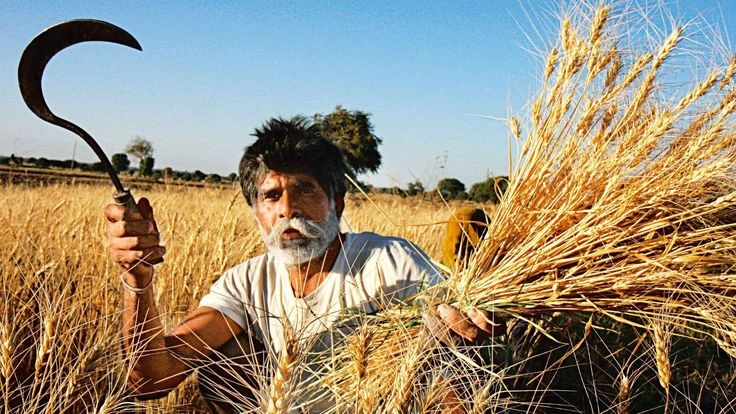
Punjab’s fields are usually seen as the green backbone of India’s food security, but in 2025 and 2026 the state’s farms have begun to look more like risky front‑lines in a battle against climate change. Across the Malwa and Doaba belts, farmers no longer just worry about prices, pests, and power cuts—they worry about whether the sky will ruin their season. In this new reality, the state government is under mounting pressure to introduce a dedicated crop insurance scheme that actually protects farmers from climate‑related losses, rather than relying on ad‑hock relief that rarely matches the damage.
A State Without an Insurance Safety Net
Punjab is one of the few major agricultural states in India that has neither launched its own crop insurance programme nor fully opted into the Centre’s flagship Pradhan Mantri Fasal Bima Yojana (PMFBY). Under PMFBY, farmers typically pay a nominal premium—2% for Kharif crops, 1.5% for Rabi, and 5% for horticultural and commercial crops—while the rest of the cost is shared between the Union and state governments. By mid‑2025, the scheme had paid out over ₹1.92 lakh crore in claims since 2016, suggesting that for many states, crop insurance has become a basic financial shock‑absorber.
In Punjab, however, farmers are left in what agricultural economists and farmer‑unions describe as an “insurance void.” When floods, untimely rains, or heatwaves strike, they cannot fall back on a structured payout system. Instead, they depend on ex‑post relief announcements—often announced after political pressure—which frequently arrive late, are calculated on incomplete data, and barely cover input costs, let alone loan repayments.
When the Climate Strikes
Punjab’s farmers are feeling the heat, and it’s not just from the sun.
Take 2022, for instance. A sudden March heatwave, arriving just before the wheat harvest, scorched the grain, resulting in yield losses of roughly six quintals per acre in many places. That single event was enough to shake the local farming community, a stark reminder of how quickly a season’s earnings can vanish.
The situation deteriorated significantly in 2025. Two separate flooding incidents, both triggered by heavy rainfall in July and August, affected multiple districts.
The flooding submerged extensive stretches of rice paddies, vegetable farms, and stock feed.
The state government announced ₹20,000 per acre as compensation, but many farmers estimate their actual losses at roughly ₹60,000 to ₹70,000 per acre, factoring in not only crop damage but also the cost of delayed re‑sowing, waterlogged fields, and disrupted planting cycles.
“If the state wants to protect farmers, why are we treated like beggars?” asks Gurpreet Singh, a farmer from Maachiwara in Ludhiana district. “We invest lakhs of rupees every year in seeds, pesticides, diesel, and labour. When the floods come, the government gives us a token amount and calls it compensation. What is that supposed to do—help us survive the next season or just survive the next month?”
Why Ad‑Hoc Relief Doesn’t Work
Punjab’s current approach to crop loss management is largely reactive: flooding hits, images of submerged fields go viral, farmer unions hold protests, and the government then announces per‑acre compensation. This model has several drawbacks. First, it treats every disaster as a unique event, instead of building a sustainable system. Second, the compensation is often calibrated more to political optics than to real agronomic and economic loss. Third, the process is slow and opaque, with many farmers complaining that they either receive nothing or far less than promised.
Civil society groups and policy analysts have pointed out that such relief also fails to address the psychological and financial strain on small and marginal farmers, who carry most of the debt burden. A farmer who has just taken a loan for a new tractor or for tube‑well repairs finds that a single flooded season can throw their entire repayment plan off course. In many cases, the only “insurance” left is to cut back on nutrition, borrow from informal lenders at high interest, or sell livestock at a heavy loss.
What Farmers Are Asking For
Across the state, farmer unions such as the Kirti Kisan Union, BKU (Kadian), and BKU (Lakhowal) have moved from protest slogans to specific policy demands. Their core ask is simple: a crop insurance scheme in which compensation is calculated based on the actual loss of the farmer, not fixed at a uniform rate per acre.
Some of the key features that farmer leaders and experts are pushing for include:
A state‑run crop insurance programme that either supplements or replaces the current patchwork of relief measures.
Premiums that are minimal—on the order of 0.1% of the total value of procured crop—so that even small and marginal farmers can participate without fear of additional cost.
A contingency fund of at least ₹200 crore, jointly contributed by the state and Union governments, to ensure quick payouts in the event of climate‑related crop failure.
Simple, transparent mechanisms for assessing crop damage, ideally using a mix of satellite imagery, ground surveys, and weather‑station data, so that disputes over “how much loss” can be minimised.
“There is no longer any doubt whether we need crop insurance,” says HS Lakhowal, president of BKU (Lakhowal). “The question is: how long will the government treat farmers as temporary victims, rather than as business‑risk‑takers who need predictable support?”
The Policy and Political Push
Behind the protests and media coverage, there is also a quieter but growing policy push within the state. A World Bank–linked report on climate‑related risks in Punjab has already suggested that the state seriously consider a dedicated crop insurance product tailored to local conditions. Earlier pilot experiments and small‑scale schemes in Punjab, such as the Punjab Crop Insurance Scheme (PCIS) and related weather‑index‑based programmes, showed that automated payouts using weather data and satellite imagery can reduce processing time from months to weeks.
However, these experiments have not been scaled into a universal, state‑wide system. One major reason is financial and political: setting up a robust insurance mechanism requires a long‑term commitment of budgetary resources, and successive Punjab governments have preferred to spend on visible populist measures—free power, loan waivers, or one‑time relief—rather than on a less visible, systemic safety‑net.
Another challenge is institutional design. If Punjab runs its own scheme, it still needs to work with insurers, banks, and local revenue authorities to register farmers, assess damage, and process claims. If it joins PMFBY, it must negotiate premium‑sharing formulas and ensure that data collection is accurate enough to avoid under‑compensation or fraud. In many other states, these tensions have led to delays, exclusion of small farmers, and mistrust in the system.
What a Climate‑Smart Crop Insurance Could Look Like
Experts and farmer‑unions agree that a new crop insurance framework in Punjab should move away from the “one‑size‑fits‑all” model. Instead, it could be designed as a layered safety‑net:
A basic, mandatory coverage for all farmers who receive any kind of government agricultural support, linked directly to their bank account and land records so that payouts can be routed digitally without manual paperwork.
Different tiers of coverage for small, medium, and large farmers, with higher‑risk farmers (such as those in flood‑prone low‑lying areas or those growing water‑intensive paddy) receiving proportionately higher support.
A strong emphasis on timely payouts—ideally within four to six weeks of a declared event—so that farmers can use the money to re‑sow, repay part of their loans, or at least avoid a total collapse of their household finances.
Such a system would also have to be accompanied by awareness campaigns, because even existing national schemes suffer from low awareness and participation. Many farmers in Punjab still do not know how crop insurance works, how premiums are calculated, or how long claims take to process. In some cases, they associate the idea with “more paperwork and more bureaucracy,” which makes them reluctant to enrol.
The Bigger Question of Farming’s Future
Beyond the technical details of premiums and payouts, Punjab’s crop insurance debate is really about the future of farming in a climate‑uncertain world. If the state continues to treat farmers as charity‑dependent subjects, then every new flood, hailstorm, or heatwave will be met with panic, protest, and last‑minute relief. If, on the other hand, Punjab can build a credible insurance mechanism, it sends a clear signal: agriculture is treated as a legitimate economic activity that deserves risk management, just as factories and IT firms do.
There is also a deeper question of fairness: how can a farmer in Punjab take decisions about which crop to grow, how much to invest in inputs, or whether to try a new technology, if they have no idea whether the weather will wipe out their gamble? Without some form of insurance, the safest choice is to stick to the same old pattern, even if it is ecologically unsustainable or economically stagnant.
Where Punjab Stands Today—and What Comes Next
As of early 2026, the Punjab government has not yet announced a full‑fledged, universal crop insurance scheme, but the pressure is visibly mounting. On one side are farmer unions and rural economists warning that another major climate shock could push thousands of families into deeper debt or out of agriculture altogether. On the other side are budget‑conscious officials and political leaders who worry about the long‑term fiscal burden of a state‑run insurance programme.
At the same time, the national experience with PMFBY and related weather‑index schemes provides a useful template. If Punjab can learn from the bottlenecks in those schemes—such as poor data quality, delayed assessments, and low farmer awareness—it has a chance to design something that is both financially viable and genuinely farmer‑friendly.
For now, many farmers in Punjab are caught in a difficult in‑between zone: they know climate change is reshaping their fields, they know insurance could protect them, but they still have to sow their crops without knowing whether the government will treat them as a “risk” to be insured or as a “victim” to be pitied.
Punjab’s Farmers Hold Their Breath as Climate Turns Hostile—and the State Still Lacks a Crop Insurance Shield