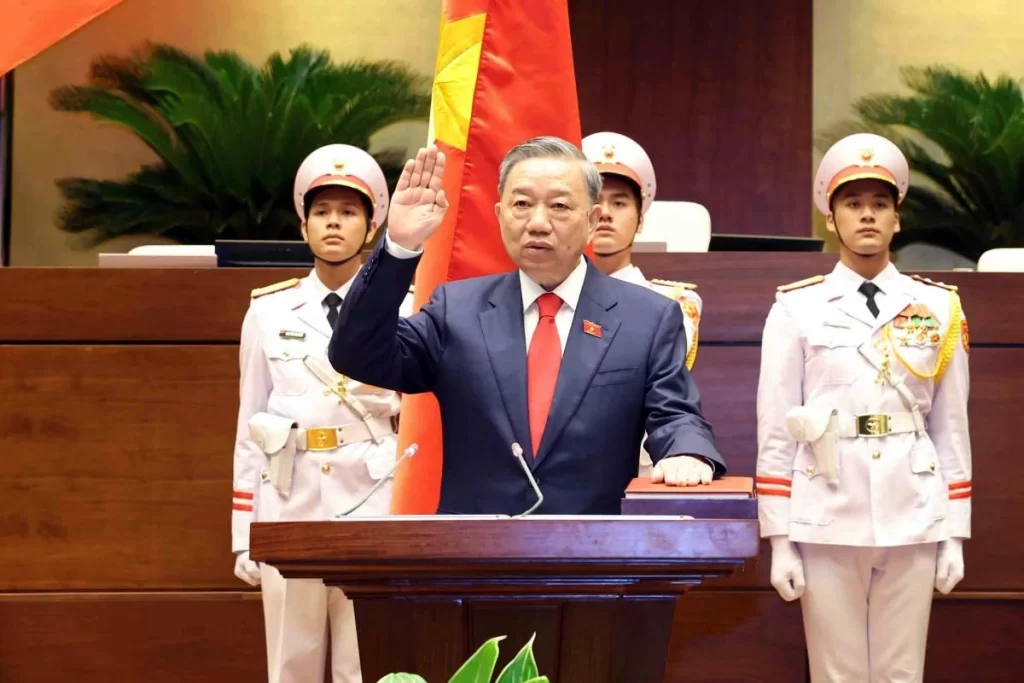
The National Assembly has chosen Tô Lâm to be the new president of Vietnam, which shows how firmly the country is under one-party rule. The 67-year-old career security official takes on the job at a time when Hanoi is under a lot of strain from trade disputes across the world, rivalries in the region, and calls for economic change at home. This change isn’t just a formality; it’s a statement that Vietnam’s tightly regulated political system is still going strong. The implications could ripple outwards, affecting everything from U.S.-China relations to India’s growing influence in the area.
Just weeks after the shocking removal of his predecessor, Võ Văn Thưởng, Tô Lâm’s ascension comes at a time when the Communist Party elite is showing signs of internal conflict. Lâm was elected unanimously on Thursday, getting 479 out of 480 votes. His rise feels like a reset button for a system that has brought about decades of rapid progress. What does this signify for Vietnam’s status in the world, though? And can a strict enforcer like Lâm lead the country into its next chapter?
A Security Strongman Takes Charge
Tô Lâm is not like other politicians. He was born in 1957 in Hung Yen province in northern Vietnam. He worked his way up through the Ministry of Public Security, which is Vietnam’s formidable internal security agency. By 2016, he was the minister in charge of everything from spying on people online to cracking down on dissent. Critics outside of Vietnam call him the architect of the country’s harsh approach to human rights, referring to the arrests of bloggers and activists while he was in charge. But at home, they regard him as a no-nonsense fixer who got rid of corruption in the police.
His path to the presidency accelerated in 2021 when he joined the all-powerful Politburo, Vietnam’s top decision-making body. He was acting president for a short time last year after Nguyễn Phú Trọng, the famous party general secretary who died in July 2024, called for anti-corruption purges that brought down several important people. Trọng, who was sometimes called “Uncle Hồ’s heir” for his unrelenting fight against corruption, chose people like Lâm to protect the party’s power.
This election is in line with Vietnam’s own political playbook. The presidency is mostly ceremonial, but it does have an impact on international affairs and protocol. The general secretary, who is currently the relatively inexperienced Tô Anh Dũng, has real influence. He was promoted just days before Lâm’s vote. Lâm’s dual function as party leader and state president, on the other hand, is similar to that of prior strongmen, which suggests a consolidation of power.
The Background: A Party Purge Like No Other
The leadership carousel in Vietnam has been going around faster than normal. Thưởng was kicked out of the party in March 2024 for “violations of party discipline.” This was the first time a general secretary had been kicked out of office in the middle of a term since 1930. It was part of Trọng’s “blazing furnace” effort, which has caught more than 100 high-ranking officials since 2016, including past presidents and billionaires. It’s easy to see that there are more scalps than in the last ten years combined.
Key victims: deputy prime ministers, party secretary in Hanoi, and even family members of powerful people.
The economy has suffered billions of dollars in fines and seized assets, and investors are on edge because they fear arbitrary crackdowns.
Public opinion: Many regular Vietnamese people are happy with the purge because it’s a rare success against the elite’s excesses.
This churn isn’t random; it’s planned. The party can’t afford scandals to hurt its credibility because Vietnam’s population is growing quickly toward 100 million and its GDP is growing at a rate of 6 to 7 percent a year. Lâm comes in, and his background in security makes him the right person to keep things under control while pressing for change.
Domestic Priorities: Finding a Balance Between Growth and Control
Vietnam’s tale is one of unlikely triumph. It used to be a poor country torn apart by conflict in the 1980s, but now it’s Southeast Asia’s breakout star, attracting industries from Apple to Samsung. Last year, exports reached $370 billion, thanks to “China Plus One” tactics that corporations use to make their supply chains more diverse. But there are big problems ahead.
Inflation is around 4–5%, youth unemployment is at about 7%, and real estate bubbles are about to explode, just like in locations like Pune or Mumbai in India. Lâm has promised to deal with these issues directly. In recent speeches, he’s talked a lot about “creative growth” and digital transformation, which is a tribute to Vietnam’s IT boom. Hanoi wants to teach 100,000 AI experts by 2030. This might create jobs and help the city keep up with its neighbors, like Singapore.
But control is still the most important thing. Lâm has made internet censorship stricter by passing regulations that require data to be stored locally and cracking down on VPNs. Activists talk of “exporting repression,” which means sending dissidents into exile or worse. But for most people, stability is the most important thing. Farmers in the Mekong Delta and street sellers in Ho Chi Minh City care more about getting more money and having power that doesn’t go out than about abstract liberties.
People who watch India see similarities here. Modi’s government tries to find a balance between economic freedom and national security. Vietnam under Lâm might do the same thing by becoming more self-reliant. Vietnam is interested in India’s pharmaceutical and IT industries, and bilateral trade reached $15 billion last year. Could this change in leadership lead to new partnerships in the semiconductor or green energy industries?
Foreign Policy: Navigating the U.S.-China Relationship
Discussions of Tô Lâm’s presidency inevitably circle back to geopolitics. Vietnam finds itself at the heart of Southeast Asia’s most contentious areas. Consider the South China Sea, where China’s territorial assertions directly challenge those of Hanoi, and the broader rivalry between the United States and China.
and China. Lâm gets a “bamboo diplomacy” handbook that says to bend but not break and make friends with everyone.
There are a lot of upgrades. Joe Biden’s visit in 2023 raised the relationship to a “comprehensive strategic partnership,” putting it on the same level as India and Japan. The U.S. promised to contribute more than $15 billion, mostly in electronics and renewable energy. China is Vietnam’s biggest economic partner, with $170 billion in trade. Xi Jinping hosted Trọng last year during maritime tensions.
Lâm’s security skills are on full display here. He has been in charge of updating the navy, which includes Russian Kilo-class submarines and Indian BrahMos missiles. Hanoi stays out of trouble, even if there are still skirmishes with Chinese ships. What will happen if Trump comes back in 2025? Vietnam’s export machine, which sends 30% of its goods to the U.S., could face tariffs. This made Lâm work harder to win over Europe and ASEAN.
This is important for India in the region. Pune-based companies are looking at Vietnam as a place to make things, and stable leadership gives them confidence. Vietnam’s push for electric vehicles, which included VinFast’s IPO in the U.S. last year, is similar to Tata’s goals. One issue remains: Will Lâm’s harsh approach make South China Sea patrols bolder and bring India into Indo-Pacific agreements?
Engine of the economy: growth in the face of challenges
Let’s look at the numbers that show how Vietnam’s path will change under new leadership.
Vietnam’s economic growth has been impressive. Its GDP per capita has seen a fourfold increase since 2010, now standing at $4,300, which puts it ahead of Thailand and the Philippines. Even with a global economic downturn, foreign direct investment jumped by 15% in 2024, amounting to $36 billion.
Lâm’s early signs point to being practical. He has supported free trade agreements like the CPTPP and RCEP, which cover 30% of the world’s GDP. Vietnam has been a popular destination for Indian tourists and investors since it stopped requiring visas in 2023. Hill stations like Sapa are just as good as Himachal, but with less people.
Human Rights Shadow: Are we making progress or just pretending?
The problematic topic of rights is always brought up in profiles of Tô Lâm. Every year, Amnesty International records scores of journalists who are in jail, many of whom are there because of laws he wrote. The 2024 U.S. State Department report says that there are “credible” reports of torture in prison.
Defenders say that Vietnam’s stability helped poverty drop from 60% to less than 5%. They believe that dissent might lead to the same kind of instability that happened during Myanmar’s coup. Still, some changes are happening, like more talk online and marches led by young people against land seizures. Will Lâm let go of the reins or tighten them even more?
Vietnam Names Tô Lâm as New President in Important Change of Leadership in Southeast Asia