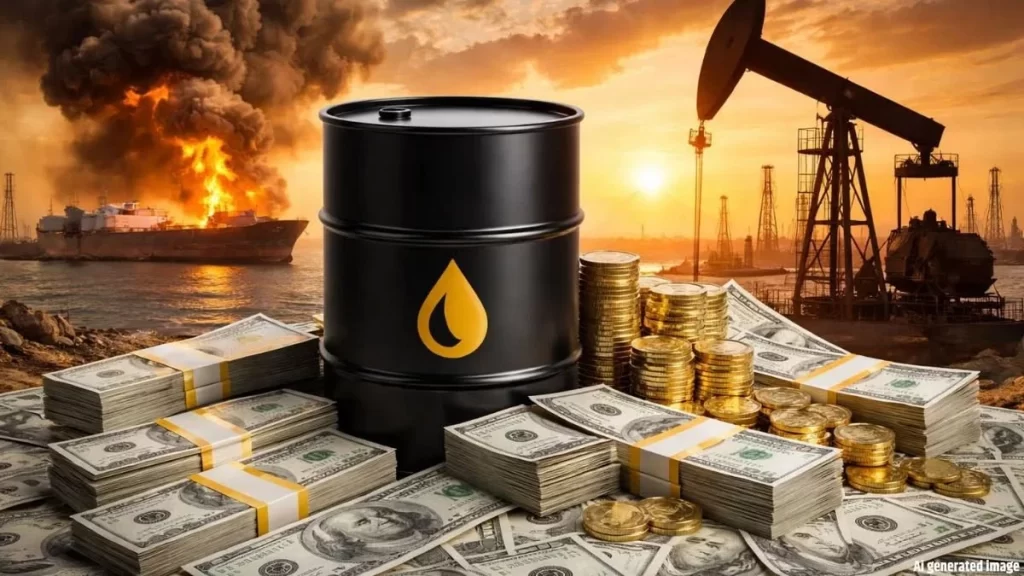
Crude oil prices are staging a forceful comeback, with major benchmarks breaching or retesting the psychologically loaded 100–110 dollar‑per‑barrel range after a spike triggered by renewed tensions around the Strait of Hormuz. What began as localized military flare‑ups and threats to tanker traffic has rapidly morphed into a global supply‑side shock, pumping inflation higher, unsettling financial markets, and forcing governments and central banks to rethink their assumptions about “lower‑for‑longer” energy costs. For consumers from New Delhi to New York, the message is clear: the price of fuel, transport, and many everyday goods is likely to remain uncomfortably elevated for months, if not longer.
Why the Strait of Hormuz Matters
The Strait of Hormuz is a narrow maritime corridor between Iran and Oman, roughly 30–40 kilometers wide at its narrowest point. Despite its size, it carries an outsized share of the world’s energy flows: roughly 20–30 percent of globally traded oil and a significant chunk of liquefied natural gas pass through this channel on their way from the Persian Gulf producers to markets in Asia, Europe, and beyond.
When warships move, missiles are fired, or major shipping lanes become unsafe, insurance costs for tankers jump, some routes are rerouted, and in the worst‑case scenarios, large volumes of crude effectively vanish from the global market almost overnight. One analyst estimate suggests that a near‑closure scenario could remove around a fifth of traded oil from circulation, an abrupt shock that would reverberate far beyond the energy sector.
How the Current Crisis Escalated
Over recent weeks, a combination of military strikes, threats to Iranian ports, and political brinkmanship has heightened the risk of a prolonged blockade of Hormuz‑linked traffic. After U.S.–Iran talks collapsed, the American administration reportedly moved toward a de facto blockade of shipping tied to Iranian ports in the strait, prompting reprisals and forcing several vessels to avoid the area altogether.
The immediate market reaction was sharp. In early Asian trading, West Texas Intermediate (WTI) crude surged above 105 dollars a barrel, while the international benchmark Brent broke above 103 dollars, reflecting both real supply constraints and a powerful wave of fear‑driven positioning. Even when the headlines briefly calmed, prices stayed well above the 60–65 dollar range that many economies had come to expect in recent years.
From Oil Spikes to Inflation Headaches
For policymakers and ordinary households alike, the jump from “cheap oil” to “100‑plus‑dollar crude” is more than a headline number; it is a direct hit to inflation and purchasing power. Higher crude prices raise the cost of petrol and diesel at the pump, which feeds into transport logistics, food delivery, and last‑mile distribution.
Take India, one of the world’s largest oil importers. The country’s landed cost of crude has climbed sharply, with March levels touching around 113 dollars per barrel and April still hovering near 110 dollars. Chief Economic Advisor V. Anantha Nageswaran has warned that these jumps, combined with broader commodity pressures, could complicate India’s inflation outlook and even push the central bank to maintain relatively tight monetary policy for longer.
Similar dynamics are playing out across the emerging world and parts of Europe, where energy accounts for a larger share of consumer‑price baskets than in the United States. In economies already struggling with high debt or fragile external balances, an oil‑driven inflation surge can quickly erode real incomes, destabilize currencies, and raise the risk of social unrest.
Supply Shocks and the “Stagflation” Risk: What makes this situation so scary is that the current price spike is not because of high demand, but because of a supply shock caused by conflict. When growth is already softening or uncertain, an external shock that pushes up prices without boosting output creates the classic ingredients of stagflation: higher inflation alongside slower or stagnant growth.
In Europe, for example, energy‑driven supply shocks are already testing the resilience of an economy that has been through a series of energy crises over the past few years. If disruptions around the Strait of Hormuz persist, the region could face renewed pressure on industrial margins, higher household bills, and tougher trade‑off choices for the European Central Bank.
For the United States, the risk is not quite the same, but the spillover is real. Elevated oil prices feed into headline inflation, which can delay expected interest‑rate cuts and force the Federal Reserve to maintain a more cautious stance, even as growth slows.
Financial Markets on Edge
Beyond the real economy, the Hormuz‑driven oil shock has sent ripples through financial markets. When headline Brent prices breached 100 dollars and some analysts began floating scenarios in the 150–200 dollar range for a prolonged closure, investors scrambled to reassess risk.
Equity markets have swung sharply, with energy‑heavy indices benefiting from higher price expectations while consumer‑facing and travel‑related sectors have suffered under the weight of rising fuel costs. Bond markets, meanwhile, have wrestled with the dual threat of higher inflation and slower growth, a combination that can compress yields in some maturities while pushing others higher.
Some market‑watchers argue that fears may be overblown, noting that flows through the strait have been rerouted or delayed rather than completely cut off, and that spare production capacity in a few large exporters could help ease the shock. But as long as the military and political situation stays unstable, volatility is likely to stay high.
India and Other Emerging Markets in the Crosshairs
For India, the timing of the price surge is particularly delicate. The economy has been navigating a mix of post‑pandemic recovery, structural reforms, and external‑sector vulnerabilities. With more than 80 percent of Persian Gulf oil destined for Asian markets, any prolonged disruption through Hormuz hits India, Japan, China, South Korea, and Southeast Asia first and hardest.
Higher oil import bills mean a wider current‑account deficit unless offset by stronger exports or capital inflows. They also strain government finances, as subsidies for fuel and cooking gas become harder to sustain, and put pressure on the rupee if foreign‑exchange reserves are used to smooth the shock.
India’s policymakers are now in the unenviable position of trying to balance inflation control with growth support. If crude stays above 100 dollars for an extended period, the Reserve Bank of India may need to hold rates higher, which could slow private investment and consumer credit growth.
Is This a Short‑Term Panic or a New Era?
One of the big unanswered questions is whether the current surge is a temporary panic, fed by fear and positioning, or a signal of a more durable shift in the global energy landscape. Some analysts point out that even if the Strait of Hormuz is never fully closed, the mere presence of repeated disruptions—via mines, missiles, or political blockades—could permanently raise the “risk premium” baked into oil prices.
On the other hand, there are structural buffers. Global demand for oil may be peaking in some advanced economies as electric vehicles and efficiency gains take hold, while investment in non‑OPEC production and alternative fuels continues. Yet those long‑term trends offer little comfort to households and businesses facing 10‑15 percent higher fuel bills today.
Global Oil Prices Surge Amid Strait of Hormuz Tensions – A New Shock for Inflation and Growth