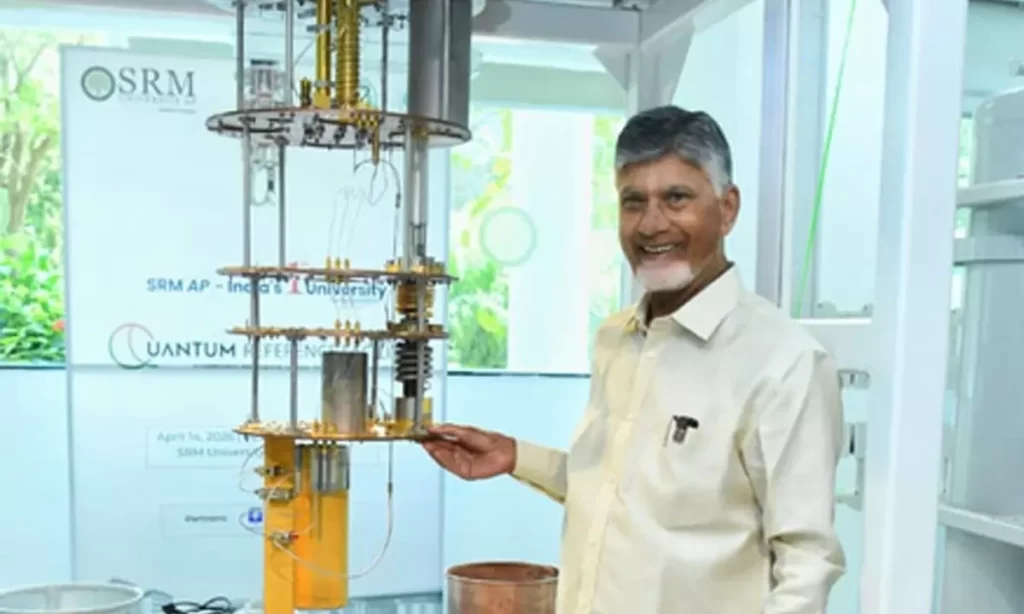
The Amaravati Quantum Reference Facility in India is a big step in the right direction. The Amaravati Quantum Reference Facility (AQRF) in Andhra Pradesh is a big step forward for India in the field of quantum physics. This historic project began on April 14, 2026, and it is the first native quantum testing center in the country. This indicates that Amaravati is a key part of the quantum network around the world. The AQRF was built by the state government and the Union Ministry of Science and Technology working together. Because it was released on World Quantum Day, the AQRF is a world standard. Right now, it’s a big part of India’s National Quantum Mission (NQM). The NQM wants India to be one of the best places in the world for quantum technology by 2031. The facility’s cryogenic infrastructure, low-cost test beds, and connections to big firms like Amber Enterprises show that India’s IT industry is about to change a lot. The Fourth Industrial Revolution will bring about big changes in several areas, including healthcare, cybersecurity, and the economy. The first quantum reference and testing venue in India would cost ₹40 crore, which is around $4.5 million. The Amaravati Quantum Valley (AQV) complex is home to both this facility and Amber Enterprises’ ₹200 crore quantum cryogenic components plant. N. Chandrababu Naidu, the Chief Minister of Andhra Pradesh, talked about this double investment at a meeting. Like quantum clusters in Silicon Valley and other places across the world, it speeds up the idea of “Quantum Valley” as a destination for research and development and manufacturing. The NQM, which started in 2023 with a budget of ₹6,003.65 crore till 2030–31, has already helped eight firms and a lot of “T-Hubs” expand. The AQRF is a highly significant testbed for spreading quantum technology and its benefits all around the country, though.
India needs quantum parts from other countries, therefore the AQRF fills a big hole in the country’s plans. When there is political unrest throughout the world, such when advanced chips can’t be supplied, it helps individuals become more self-sufficient by letting testing and certification happen at very low temperatures. The facility’s goals are the same as the NQM’s: to develop between 50 and 1,000 physical qubit quantum computers in eight years. India can now compete with the US, China, and the EU, which spend more than $30 billion on quantum research. The AQRF says that Andhra Pradesh’s economy will grow quickly because of quantum technology. This will be especially helpful for the state’s IT and defense corridors. By 2030, it should create 10,000 high-skilled employment and bring in foreign direct investment in the hardware and software industries.
Inside the Quantum Test Beds: New Ideas in Motion
The AQRF is made up of two test beds: Amaravati 1Q at Medha Towers in Gannavaram and Amaravati 1S at SRM University in Amaravati. These platforms are open to everyone, thus anyone can do quantum experiments. These test beds run at extremely low temperatures, -273°C (-459°F), which is the lowest temperature at which superconducting qubits can stay coherent without losing coherence due to thermal noise. People who research and work in quantum computing can use quantum processors here to do tasks that are similar to those in the real world. They don’t have to spend a lot of money to make their own gear. There are many different kinds of quantum platforms that can fit in the building, like superconducting qubits and photonic qubits. This makes it easy to create new prototypes and makes diverse systems operate together better.
Some important things of the AQRF Test Beds are:
Cryogenic Precision: Refrigeration systems can cool items down to almost absolute zero. This maintains the qubits stable and makes measurements very, very precise.
Open Access: Academic institutions, entrepreneurs, and industry partners can gain free or low-cost access, which makes it easier for them to get involved in quantum research and development.
The NQM is what keeps India’s quantum ecosystem going.
India’s whole quantum ecosystem has been meticulously put together by the NQM to help in planting, growing, and boosting research and development. Everything is affected by the AQRF.
It helps with technology transfer when AQRF funds incubation programs for entrepreneurs who work with companies like Quantum Machines and Rigetti Computing.
The NQM is working with ISRO to test quantum sensors for satellite navigation and with DRDO to test them for military usage. These tests are looked at at AQRF.
The NITI Aayog plan says that by 2030, this joint effort will help India get 5–7% of the global quantum software market. That’s $100 billion out of $1.5 trillion. The AQRF helps India sell more by focusing on local IP, like designs for cryogenic parts. India’s exports should be around ₹5,000 crore (US$600 million) a year by the end of the decade. The center is working on quantum preparedness planning, which is critical for things like energy and public infrastructure. This stops quantum attacks from getting to cryptography, which is very important for a country with 800 million internet users.
India’s Quantum Leap: Amaravati Quantum Reference Facility Charts a New Course